Carbon compounds as fuels and feedstock
邊玩邊學
回答這些題目賺取能量,接著就能釣魚、探索。不需要帳號。
給教育者: 為 Carbon compounds as fuels and feedstock(Science、Chemistry)準備好可直接使用的課程投影片, 複習筆記——用於你的課程,或把這個主題當成互動班級活動,讓學習者以即時遊戲的方式進行。
課程筆記
Crude Oil and Hydrocarbons
- Crude oil is a finite resource found in the Earth's crust; it is a thick, sticky, black liquid found in porous rock under the ground and under the sea.
- It formed over millions of years from the effects of high pressures and temperatures on the remains of ancient biomass, mainly plankton, that was buried in mud.
- Crude oil is a complex mixture of many different hydrocarbon compounds of different sizes.
- A hydrocarbon is a compound that contains hydrogen and carbon atoms only.
- The hydrocarbon molecules in crude oil have a carbon backbone that can be a chain or a ring, with hydrogen atoms attached.
- Crude oil is being used up much faster than it is formed, so it is a finite resource.
- Crude oil is the main source of fuels such as petrol and diesel, and also provides feedstock (raw materials) for the petrochemical industry.
Alkanes and Homologous Series
- Alkanes are a homologous series of saturated hydrocarbons, meaning they contain only single carbon-carbon bonds.
- The general formula for alkanes is CnH2n+2.
- The first four alkanes are methane (CH4), ethane (C2H6), propane (C3H8) and butane (C4H10).
- A homologous series is a family of organic compounds that have the same functional group, the same general formula, similar chemical properties, and a gradual change in physical properties.
- Each member of a homologous series differs from the next by a -CH2- unit.
- Alkanes are generally unreactive, but they undergo combustion, can be cracked into smaller molecules, and react with halogens in the presence of light.
- Methane is the major component of natural gas.
Fractional Distillation of Crude Oil
- Crude oil is separated into fractions by fractional distillation; each fraction contains hydrocarbons with a similar number of carbon atoms.
- The process works because different hydrocarbons have different boiling points, which depend on the size of the molecule.
- Fractional distillation takes place in a fractionating column with a temperature gradient: it is very hot at the bottom and cooler at the top.
- The crude oil is heated and vaporised; vapours rise up the column.
- Hydrocarbons with high boiling points condense at the bottom of the column, while those with lower boiling points rise and condense at the top.
- The fractions are tapped off as liquids at different heights according to their boiling points.
- Smaller hydrocarbon molecules are collected at the top as gases; larger hydrocarbon molecules are collected lower down.
- Fractional distillation is a physical process, not a chemical change.
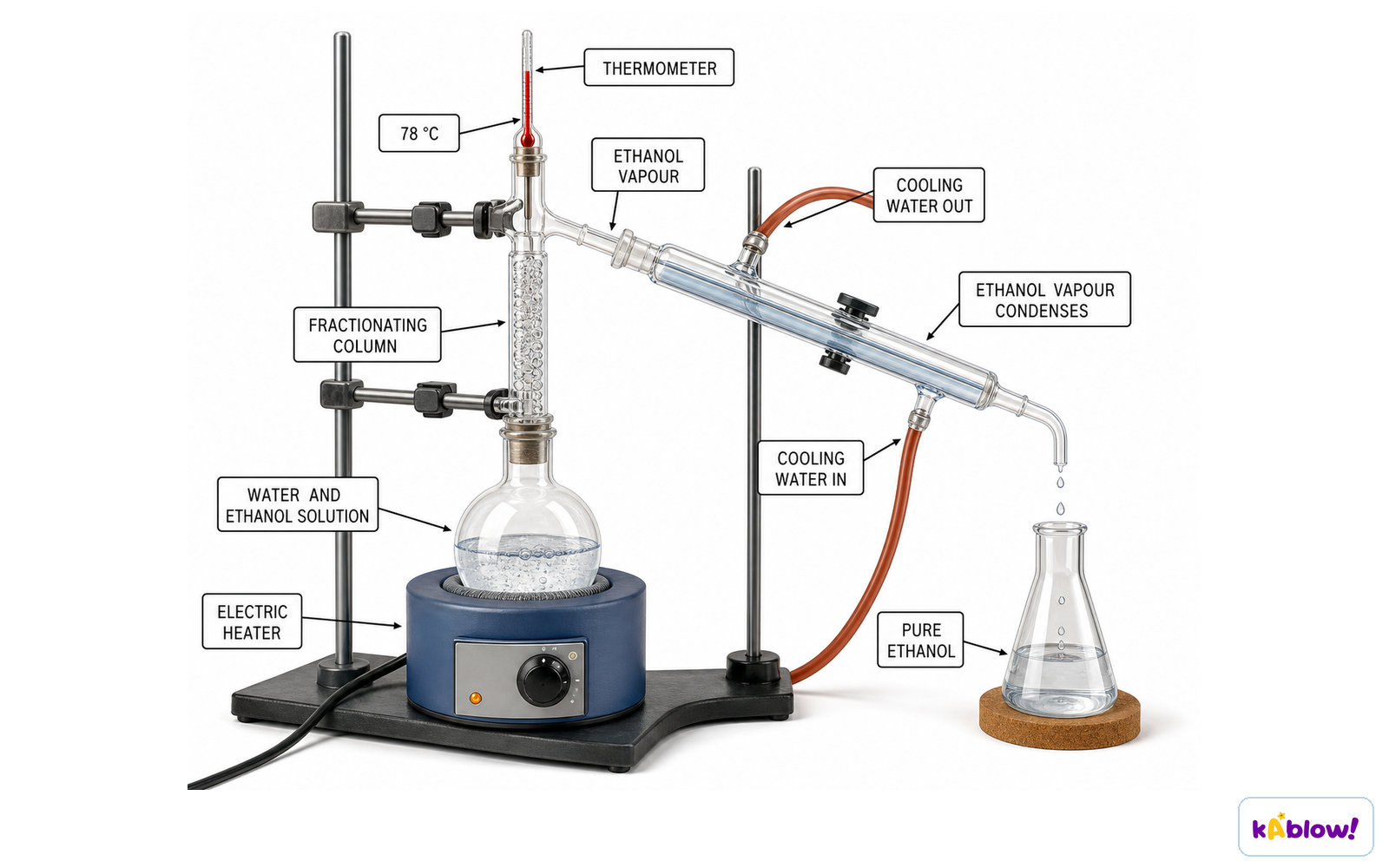
Fractional distillation apparatus
Uses of Crude Oil Fractions
- Liquefied petroleum gas (LPG) is used for domestic heating and cooking.
- Petrol (gasoline) is used as fuel for cars.
- Kerosene is used as jet fuel.
- Diesel oil is used as fuel in diesel engines.
- Heavy fuel oil is used for ships and power stations.
- Bitumen is used for making roads.
- The petrochemical industry uses crude oil fractions to produce polymers, lubricants, solvents, detergents and adhesives.
Properties of Hydrocarbons
- As the size of hydrocarbon molecules increases, their boiling point increases.
- This is because larger molecules have greater intermolecular forces of attraction, so more energy is needed to separate them.
- Viscosity is the ease of flow of a liquid; high viscosity means thick and flows less easily.
- Viscosity increases as hydrocarbon chain length increases, due to stronger intermolecular forces.
- Flammability (ease of ignition) decreases as hydrocarbon molecules get larger; smaller molecules are more flammable and easier to ignite.
- These properties influence how hydrocarbons are used as fuels: smaller molecules are useful as fuels, while larger, more viscous alkanes are useful as lubricants.
Combustion of Fuels
- A fuel is a substance that releases energy in an exothermic reaction when burned.
- Complete combustion occurs with an excess supply of oxygen and produces carbon dioxide and water.
- During combustion, the carbon and hydrogen in the fuel are oxidised (gain oxygen).
- Example: propane undergoes complete combustion: C3H8 + 5O2 → 3CO2 + 4H2O.
- Incomplete combustion occurs with an insufficient supply of oxygen and produces carbon monoxide, carbon (soot) and water.
- Carbon monoxide is a toxic, odourless gas that binds to haemoglobin, preventing it from carrying oxygen; it can cause dizziness, loss of consciousness and death.
- Carbon dioxide is a major contributor to global warming; incomplete combustion also produces unburnt hydrocarbons and carbon particulates.
Acid Rain: Nitrogen Oxides and Sulfur Dioxide
- Fossil fuels often contain sulfur impurities; when burned, the sulfur is oxidised to sulfur dioxide (SO2).
- Sulfur dioxide dissolves in rainwater to form sulfuric acid, which contributes to acid rain.
- Nitrogen oxides (NO and NO2) are formed when nitrogen and oxygen from the air react in the high temperature and pressure conditions of internal combustion engines.
- Nitrogen dioxide reacts with rainwater to form nitrous and nitric acids, which also contribute to acid rain.
- Acid rain causes corrosion of metal structures and buildings, damages carbonate rocks (e.g., statues), harms aquatic organisms, pollutes crops and water supplies, and irritates lungs, throats and eyes.
- Catalytic converters in vehicles contain transition metal catalysts (platinum, palladium, rhodium) in a honeycomb structure to increase surface area.
- In a catalytic converter, carbon monoxide is oxidised to carbon dioxide, nitrogen oxides are reduced to nitrogen gas, and unburned hydrocarbons are oxidised to carbon dioxide and water.
Hydrogen as a Fuel
- Hydrogen reacts with oxygen in an exothermic reaction: 2H2 + O2 → 2H2O.
- Advantage: hydrogen releases more energy per kilogram than any other fuel (except nuclear fuels).
- Advantage: hydrogen does not pollute when burned because it only produces water.
- Disadvantage: hydrogen is expensive to produce and requires energy for the production process.
- Disadvantage: hydrogen is difficult and dangerous to store and move around; it is usually stored as liquid hydrogen in highly pressurised containers.
- Disadvantage: the production of hydrogen releases carbon dioxide.
- Most of the world's energy supply still comes from fossil fuels (over 80%).
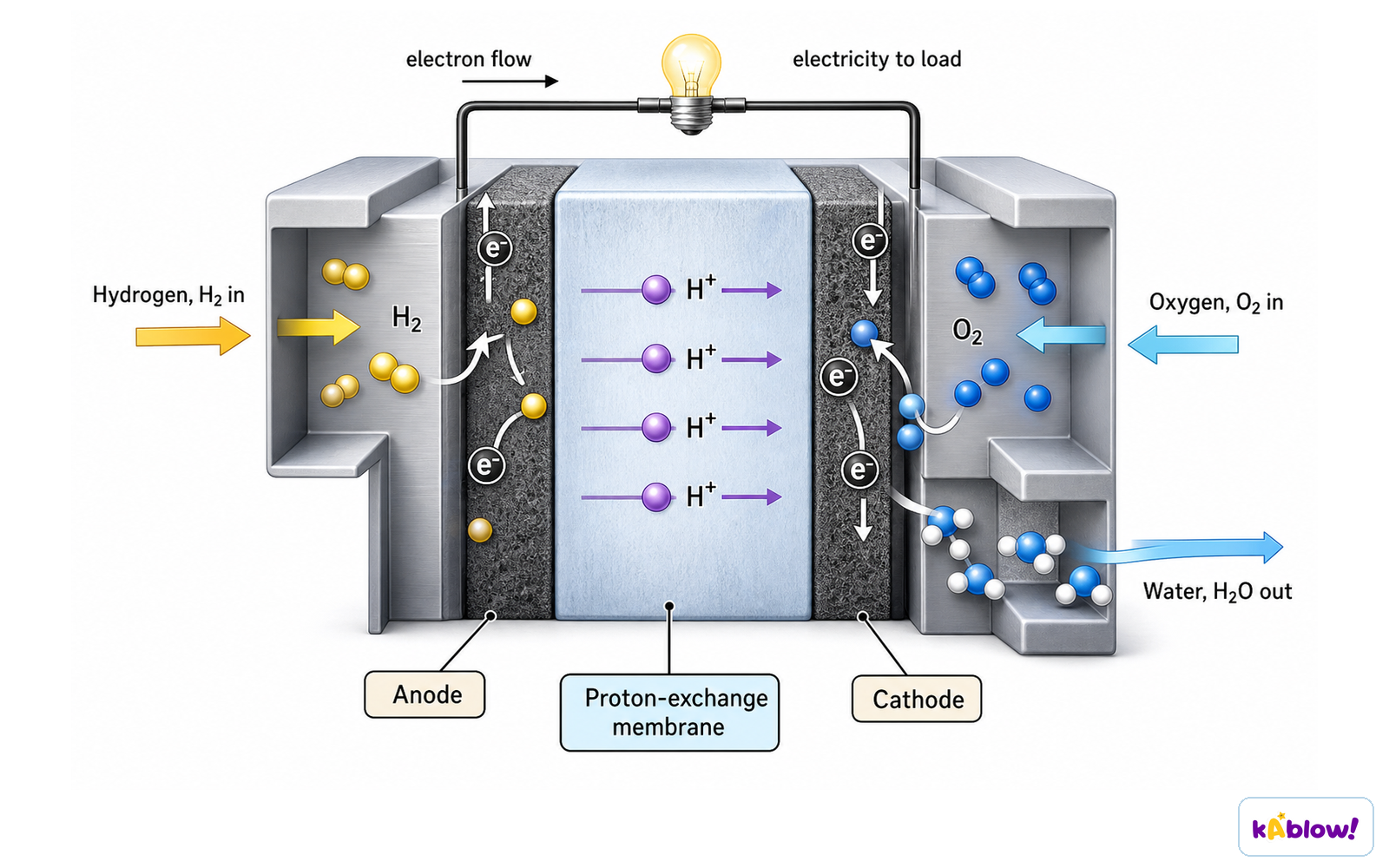
Diagram showing the movement of hydrogen, oxygen and electrons in a hydrogen-oxygen fuel cell
Cracking and Alkenes
- Cracking is an industrial process that breaks long-chain hydrocarbon molecules into smaller, more useful molecules.
- It is used because the demand for short-chain fractions (such as petrol, kerosene and diesel) is greater than the supply, while there is a surplus of long-chain fractions (such as fuel oil).
- Catalytic cracking involves heating hydrocarbons to about 470–550°C to vaporise them, then passing the vapours over a hot powdered aluminium oxide catalyst.
- Steam (thermal) cracking uses higher temperatures and mixes the vaporised hydrocarbons with steam.
- Cracking produces a mixture of shorter alkanes and alkenes; hydrogen and a higher proportion of alkenes are formed at higher temperatures and pressures.
- Alkanes are saturated (single C–C bonds); alkenes are unsaturated (contain a C=C double bond) and have the general formula CnH2n.
- Alkenes are more reactive than alkanes and are used to make polymers and as starting materials for many chemicals.
- Test for alkenes: bromine water (orange) is decolourised by alkenes; it remains orange with alkanes.
- In a cracking equation, the total number of carbon and hydrogen atoms must be the same on both sides (Law of Conservation of Mass).
投影片
練習題
免費預覽——61 題中的 8 題。註冊即可查看全部。
1.Which of the following is the general formula of the alkenes?
Easy- ACnH2n
- BCnH2n+2
- CCnH2n-2
- DCnH2n+1OH
2.Which of the following is the molecular formula of propane?
Medium- AC3H8
- BC3H6
- CC3H4
- DC3H10
3.Which of the following is the molecular formula of ethene?
Medium- AC2H4
- BC2H6
- CC2H2
- DC2H8
4.Which of the following is the correct definition of a hydrocarbon?
Easy- AA compound that contains carbon and hydrogen atoms only
- BA compound that contains carbon, hydrogen and oxygen atoms
- CA mixture of carbon and hydrogen gases
- DA compound that contains carbon and hydrogen atoms, and may contain other elements
5.Crude oil is a mixture of hydrocarbons.
EasyTrue or false?
6.Fractional distillation separates crude oil into fractions by chemical reactions.
MediumTrue or false?
7.Which fraction of crude oil is used as jet fuel?
Medium- AKerosene
- BPetrol
- CDiesel oil
- DBitumen
8.Which fraction of crude oil is used for making roads?
Medium- ABitumen
- BKerosene
- CDiesel oil
- DLiquefied petroleum gas
歷屆試題
這個主題的歷屆試題練習即將推出。
即將推出