Chemical measurements, conservation of mass and the quantitative interpretation of chemical equations
邊玩邊學
回答這些題目賺取能量,接著就能釣魚、探索。不需要帳號。
給教育者: 為 Chemical measurements, conservation of mass and the quantitative interpretation of chemical equations(Science、Chemistry)準備好可直接使用的課程投影片, 複習筆記——用於你的課程,或把這個主題當成互動班級活動,讓學習者以即時遊戲的方式進行。
課程筆記
Conservation of Mass
- The law of conservation of mass states that no matter is lost or gained during a chemical reaction.
- The total mass of the reactants equals the total mass of the products.
- This means that all chemical equations must be balanced.
- In a closed system, no substances can enter or leave, so the total mass remains constant.
- In an open system, a gaseous product can escape, causing the total mass to decrease.
- If the mass of a reaction flask increases, it is likely that a gaseous reactant from the air has been used and all products are solids or liquids.
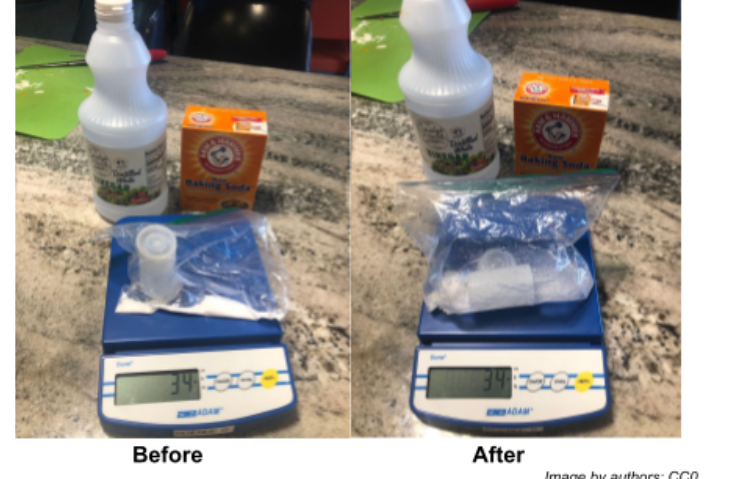
A sealed bag of vinegar and baking soda has a mass of 34g before and after the reaction.
Balanced Chemical Equations
- A balanced equation has the same number of atoms of each element on both sides.
- You balance equations by changing the coefficients (large numbers in front of formulas), never by changing subscripts.
- A coefficient applies to the entire formula that follows it. For example, 2H₂O means 4 hydrogen atoms and 2 oxygen atoms.
- If a group of atoms (like NO₃) remains unchanged, count it as a single entity.
- Balance elements that appear on their own last.
- The following non-metals are written as molecules: H₂, N₂, O₂, F₂, Cl₂, Br₂, I₂.
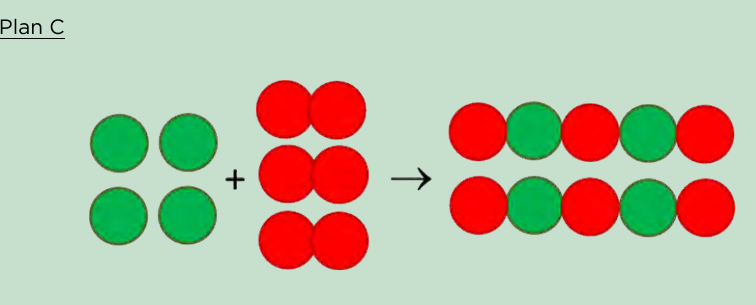
A balanced chemical equation
Interpreting Chemical Formulas
- If there is no subscript after an element, there is one atom of that element.
- A subscript number applies only to the element immediately before it.
- A subscript after brackets applies to all elements inside the brackets.
- For example, Ca(OH)₂ contains 1 calcium, 2 oxygen, and 2 hydrogen atoms.
- In Ca(NO₃)₂, the subscript 2 outside the brackets multiplies everything inside: 1 calcium, 2 nitrogen, and 6 oxygen atoms.
Relative Formula Mass (Mr)
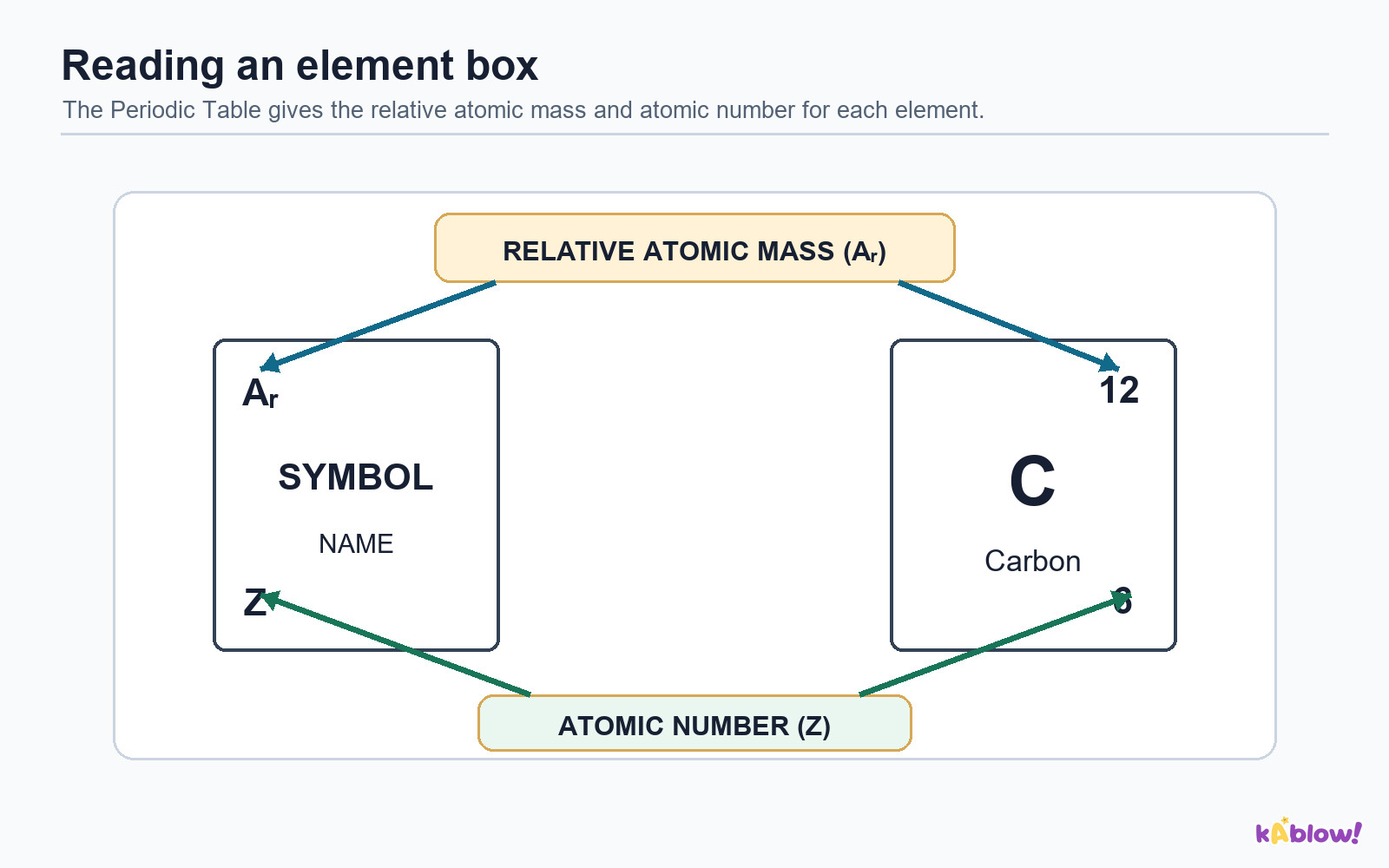
- The relative atomic mass (Ar) of an element is the larger number shown on the Periodic Table.
- The relative formula mass (Mr) is the sum of the relative atomic masses of all atoms in the formula.
- For example, Mr of H₂O = (2 × 1) + 16 = 18.
- For Ca(OH)₂: Mr = 40 + (2 × 16) + (2 × 1) = 74.
- In a balanced equation, the sum of the Mr values of the reactants equals the sum of the Mr values of the products.
The Periodic Table key showing where relative atomic mass (Ar) and atomic number (Z) are given for each element, using carbon as the example.
Percentage by Mass
- The percentage by mass of an element in a compound is calculated using: (Ar × number of atoms of the element) ÷ Mr of the compound × 100.
- For water, the percentage of hydrogen is (2 × 1) ÷ 18 × 100 = 11.1%.
- The percentage of oxygen in water is (1 × 16) ÷ 18 × 100 = 88.9%.
- The percentages of all elements in a compound must add up to 100%.
- A common error is to put the numbers upside down, giving a percentage greater than 100%, which is impossible.
Mass Changes with Gases
- Some reactions appear to involve a mass change because a reactant or product is a gas.
- If a gaseous product escapes from an open system, the total mass decreases.
- When a metal reacts with oxygen, the mass of the oxide produced is greater than the mass of the metal because oxygen from the air is added.
- When a metal carbonate thermally decomposes, carbon dioxide is released, leaving the metal oxide as the only solid product.
- For example, in the reaction 2HCl(aq) + CaCO₃(s) → CaCl₂(aq) + H₂O(l) + CO₂(g), mass is lost as CO₂ escapes.
- In a closed system, no gas can escape, so the mass remains constant.
Chemical Measurements and Uncertainty
- Every measurement has some uncertainty.
- Random errors cause results to be scattered around the true value, sometimes too high and sometimes too low.
- Systematic errors always shift results in the same direction, e.g. a balance not zeroed.
- For an analogue instrument, uncertainty is ± half the smallest division.
- For a digital instrument, uncertainty is ± the smallest division.
- For repeated measurements, uncertainty can be estimated as ± half the range of results.
Calculating Mean and Uncertainty
- The mean is the sum of all measurements divided by the number of measurements.
- The range is the difference between the highest and lowest values.
- Uncertainty from repeated measurements is calculated as range ÷ 2.
- For example, if repeat results are 2.9 g, 2.7 g, and 2.8 g, the range is 0.2 g, so uncertainty is ±0.1 g.
- Always report a measurement with an appropriate number of significant figures, matching the precision of the instrument.
投影片
練習題
免費預覽——62 題中的 8 題。註冊即可查看全部。
1.What does the law of conservation of mass state?
Easy- ANo matter is lost or gained during a chemical reaction.
- BMass is always lost when a gas is produced.
- CThe mass of the products is always greater than the mass of the reactants.
- DAtoms are created and destroyed during a chemical reaction.
2.In the formula Fe2O3, how many atoms are shown in total?
Easy- A5
- B2
- C3
- D6
3.How many atoms are present in one formula unit of iron(II) nitrate, Fe(NO3)2?
Easy- A9
- B7
- C5
- D11
4.In a chemical reaction, the total number of atoms stays the same.
EasyTrue or false?
5.Which of the following statements about a balanced chemical equation are correct? (select all that apply)
Medium- AThe number of atoms of each element is the same on both sides.
- BYou can balance an equation by changing subscripts in a formula.
- CThe total mass of reactants equals the total mass of products.
- DCoefficients (multipliers) in front of formulae can be changed to balance the equation.
- EAtoms are converted into energy during the reaction.
6.What is the relative formula mass (Mr) of calcium hydroxide, Ca(OH)2? (Ar: Ca=40, O=16, H=1)
Medium- A74
- B57
- C58
- D80
7.A student heats magnesium in an open crucible. The mass of the contents increases. Why?
Medium- AOxygen from the air reacts with the magnesium to form magnesium oxide.
- BMagnesium atoms are converted into energy.
- CSome magnesium evaporates and is lost.
- DThe balance is faulty and always reads high.
8.When calcium carbonate is heated in an open test tube, the mass decreases. Which statement best explains this?
Hard- ACarbon dioxide gas is produced and escapes into the air.
- BCalcium atoms are destroyed during the reaction.
- COxygen from the air reacts with the calcium carbonate.
- DWater vapour is absorbed from the air.
歷屆試題
這個主題的歷屆試題練習即將推出。
即將推出