How bonding and structure are related to the properties of substances
邊玩邊學
回答這些題目賺取能量,接著就能釣魚、探索。不需要帳號。
給教育者: 為 How bonding and structure are related to the properties of substances(Science、Chemistry)準備好可直接使用的課程投影片, 複習筆記——用於你的課程,或把這個主題當成互動班級活動,讓學習者以即時遊戲的方式進行。
課程筆記
The Three States of Matter
- The three states of matter are solid, liquid and gas.
- In a solid, particles are very close together in a regular arrangement and vibrate about fixed positions.
- In a liquid, particles are close together and randomly arranged, and they move around each other.
- In a gas, particles are far apart and randomly arranged, and they move quickly in all directions.
- The simple particle model represents particles as small solid spheres.
- A substance can usually exist in all three states depending on temperature (and pressure).
Changes of State
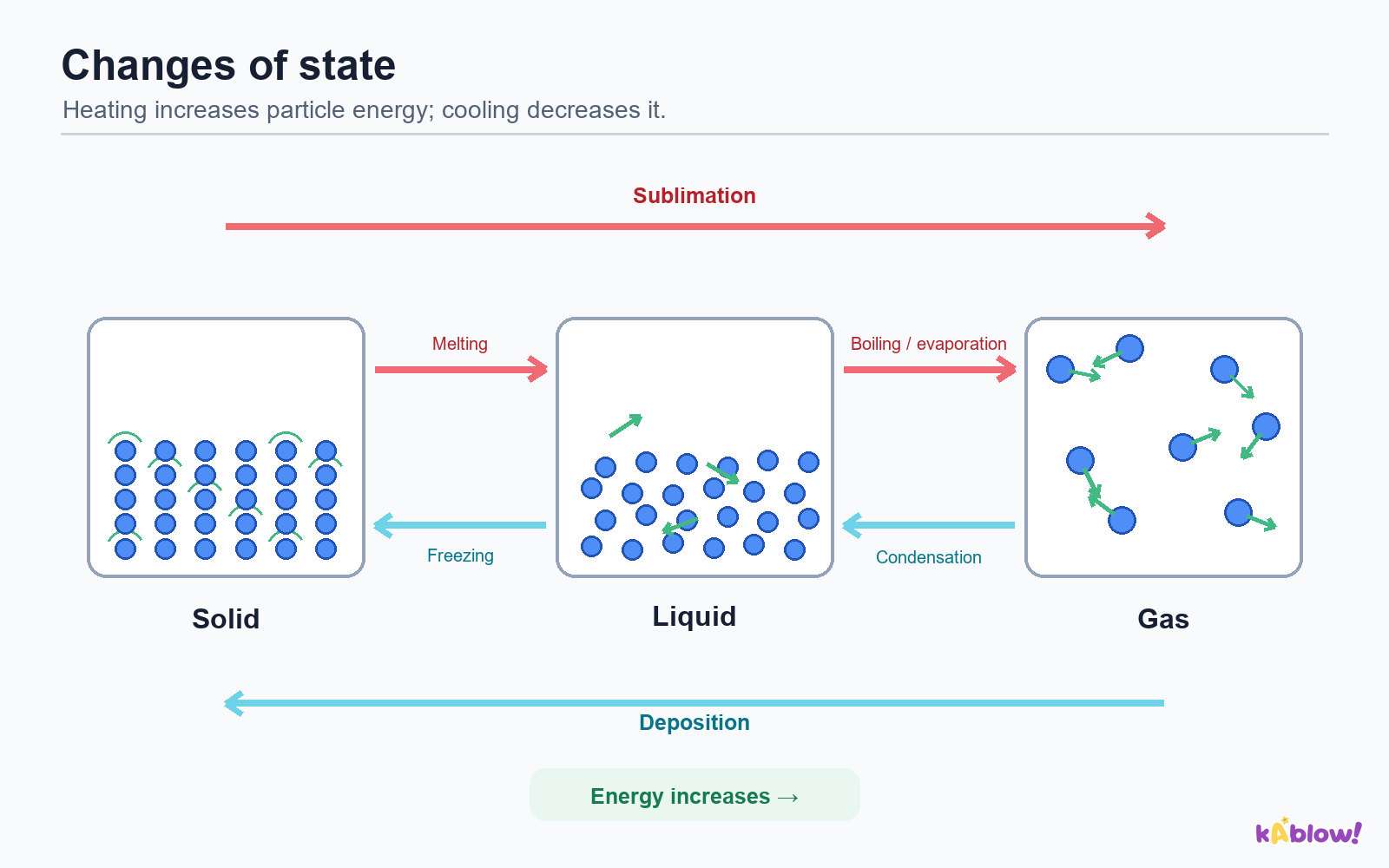
- Melting is a solid changing into a liquid; freezing is the reverse, liquid to solid.
- Melting and freezing occur at the melting point; boiling and condensing occur at the boiling point.
- Boiling is a liquid changing into a gas throughout the liquid, forming bubbles.
- Evaporation is a liquid changing into a gas only at the surface, and it occurs over a range of temperatures below the boiling point.
- Condensation is a gas changing into a liquid on cooling.
- Sublimation is a solid changing directly into a gas (e.g. iodine, solid carbon dioxide); the reverse is called deposition or desublimation.
- Changes of state are physical changes: the particles themselves remain the same, only the forces between them change, and the change is easily reversed.
The state changes
Energy and Interconversions
- The amount of energy needed to change state depends on the strength of the forces between the particles.
- The stronger the forces between particles, the more energy is needed to overcome them, so the higher the melting point and boiling point.
- When a substance is heated, particles absorb thermal energy and convert it into kinetic energy, so they vibrate or move more.
- On a heating or cooling curve, horizontal sections show a change of state where temperature stays constant as energy is absorbed or released.
- The sloped sections show the substance heating up or cooling down in a single state.
- The interconversion of states can be shown with a reversible arrow: ⇌.
Predicting Physical State
- Below the melting point, a substance is a solid.
- Between the melting point and the boiling point, a substance is a liquid.
- Above the boiling point, a substance is a gas.
- For example, a substance with melting point −7 °C and boiling point 59 °C is a liquid at 20 °C and a gas at 100 °C.
- Individual atoms do not have the bulk properties of the material they make up.
State Symbols
- State symbols show the physical state of each substance in a chemical equation.
- (s) = solid, (l) = liquid, (g) = gas, (aq) = aqueous (dissolved in water).
- State symbols are written after each formula in brackets.
- Example: CuCO₃(s) + 2HCl(aq) → CuCl₂(aq) + CO₂(g) + H₂O(l).
- Aqueous means the substance is dissolved in water to form a solution.
Properties of Ionic Compounds
- Ionic compounds form giant ionic lattices with strong electrostatic forces of attraction in all directions between oppositely charged ions.
- They have high melting and boiling points because a large amount of energy is needed to overcome the many strong electrostatic forces.
- The greater the charge on the ions, the stronger the electrostatic forces and the higher the melting point (e.g. MgO has a higher melting point than NaCl).
- Solid ionic compounds do not conduct electricity because the ions are in fixed positions and cannot move.
- When molten or dissolved in water, ionic compounds conduct electricity because the ions are free to move and carry charge.
Properties of Small Molecules
- Substances made of small molecules are usually gases or liquids with relatively low melting and boiling points.
- They have strong covalent bonds between the atoms within each molecule, but only weak intermolecular forces between molecules.
- When a simple molecular substance melts or boils, it is the intermolecular forces that are overcome, not the covalent bonds.
- The intermolecular forces increase with the size of the molecules, so larger molecules have higher melting and boiling points.
- Small molecular substances do not conduct electricity because there are no free ions or electrons to carry charge.
Polymers
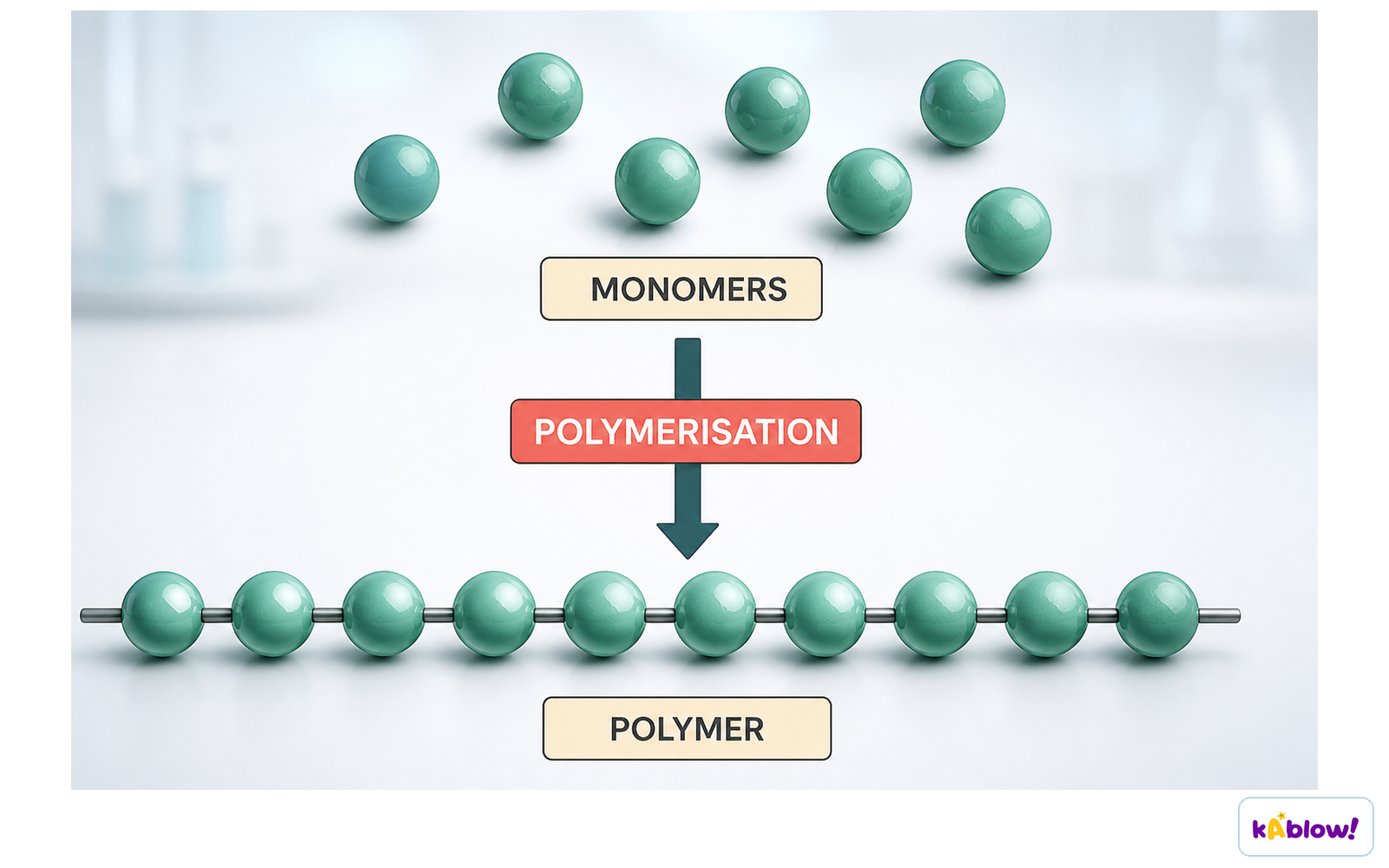
- Polymers consist of very large molecules made by linking many small molecules called monomers.
- The atoms in polymer molecules are linked by strong covalent bonds.
- The intermolecular forces between polymer chains are relatively strong compared with those between simple molecules.
- Because of these stronger intermolecular forces, polymers are usually solids at room temperature.
- Examples include polythene and poly(chloroethene), commonly known as PVC.
Monomers joining to form a polymer
Giant Covalent Structures
- Giant covalent structures are solids with very high melting points, made of many non-metal atoms bonded by strong covalent bonds.
- All the atoms are linked by strong covalent bonds, and these bonds must be overcome to melt or boil the substance.
- Examples include diamond, graphite and silicon dioxide (silica).
- Diamond: each carbon atom bonds to four others in a tetrahedron; it is extremely hard, has a very high melting point, and does not conduct electricity.
- Graphite: each carbon atom bonds to three others in layers of hexagons, leaving one free electron per carbon atom, so graphite conducts electricity and is soft and slippery.
- Silicon dioxide is made from silicon and oxygen atoms and also has a giant covalent structure.
Properties of Metals and Alloys
- Metals have giant structures with strong metallic bonding – the attraction between positive metal ions and negative delocalised electrons.
- Most metals have high melting and boiling points because the metallic bonds are strong and need lots of energy to break.
- Pure metals are malleable because the atoms are arranged in layers that can slide over each other when a force is applied.
- An alloy is a mixture of two or more metals, or a metal with a non-metal such as carbon (e.g. steel is iron and carbon).
- Alloys are harder than pure metals because the different-sized atoms distort the layers, making it more difficult for the layers to slide over each other.
- Metals are good conductors of electricity because the delocalised electrons are free to move through the structure and carry charge.
- Metals are good conductors of thermal energy because the delocalised electrons transfer energy through the structure.
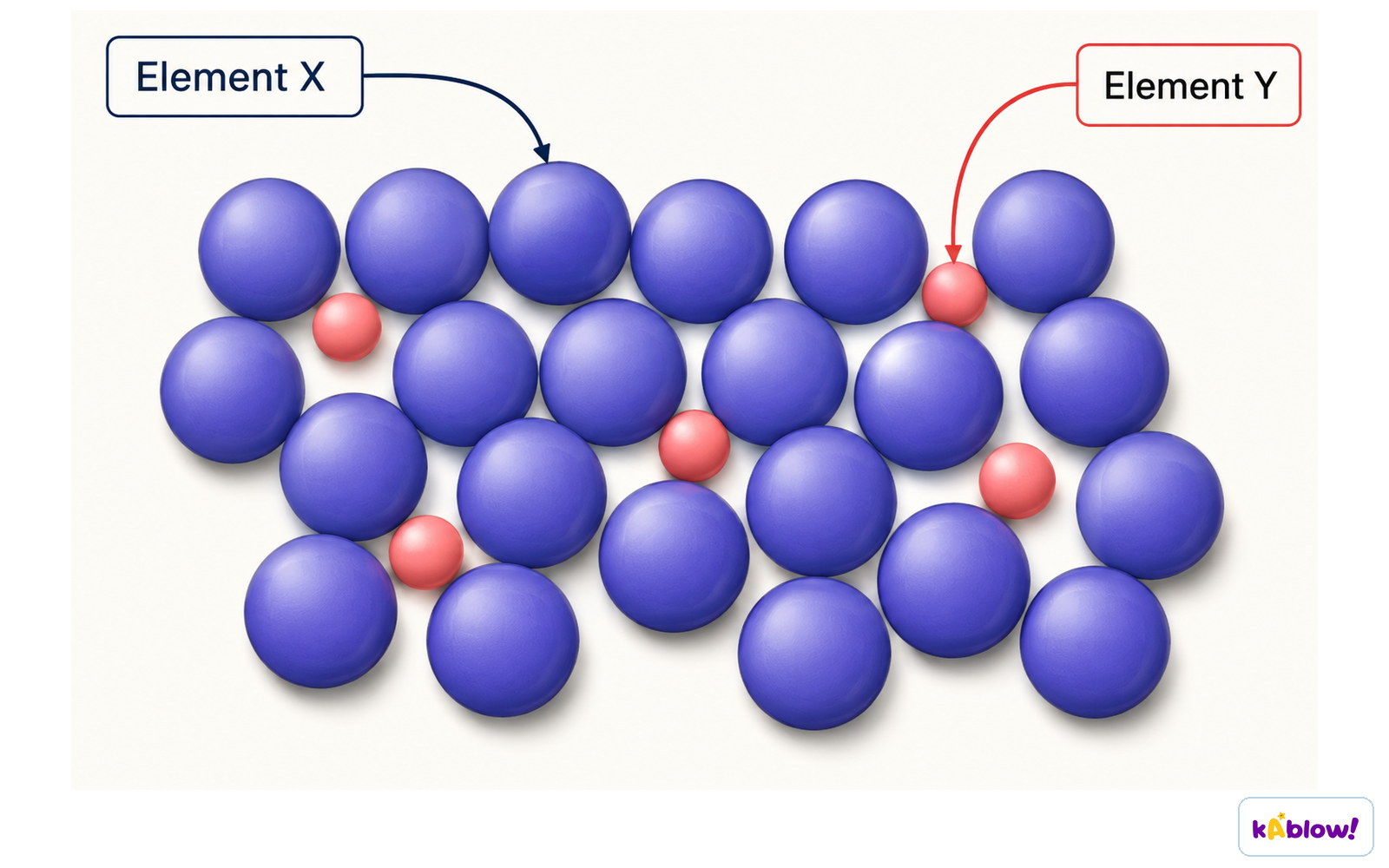
In an alloy, atoms of a different size (Element Y) are scattered among the host metal's atoms (Element X), distorting the regular layered arrangement that a pure metal has.
投影片
練習題
免費預覽——51 題中的 8 題。註冊即可查看全部。
1.Which of the following is the name of the change of state when a liquid changes into a solid?
Easy- Acondensation
- Bevaporation
- Cfreezing
- Dmelting
2.Substance Y melts at -101 °C and boils at -35 °C. What is the state of substance Y at -110 °C?
Easy- Asolid
- Bliquid
- Cgas
- Daqueous
3.Substance Z has a melting point of -7 °C and a boiling point of 59 °C. What is the state of Z at 0 °C and at 100 °C?
Medium- Asolid at 0 °C and gas at 100 °C
- Bgas at 0 °C and liquid at 100 °C
- Cliquid at 0 °C and solid at 100 °C
- Dliquid at 0 °C and gas at 100 °C
4.Substances exist as solids, liquids or gases. What change of state occurs at Y?
Medium- Amelting
- Bfreezing
- Cboiling
- Dcondensation
5.A balloon is filled with helium gas. What is true about the gas particles inside the balloon?
Medium- AThey have little energy
- BThey vibrate in fixed positions
- CThey fall to the bottom of the balloon
- DThey move in random directions
6.Which of the following is not a chemical change?
Medium- AIron railings becoming rusty
- BBurning a piece of wood
- CNeutralising an acid with alkali
- DDissolving salt in water
7.The three states of matter are solid, liquid and gas.
EasyTrue or false?
8.In a solid, the particles are arranged randomly and move quickly in all directions.
EasyTrue or false?
歷屆試題
這個主題的歷屆試題練習即將推出。
即將推出