Pressure and pressure differences in fluids
邊玩邊學
回答這些題目賺取能量,接著就能釣魚、探索。不需要帳號。
給教育者: 為 Pressure and pressure differences in fluids(Science、Physics)準備好可直接使用的課程投影片, 複習筆記——用於你的課程,或把這個主題當成互動班級活動,讓學習者以即時遊戲的方式進行。
課程筆記
Pressure in Fluids
- A fluid is either a liquid or a gas.
- Pressure is the concentration of a force, or the force per unit area.
- Pressure is calculated using p = F / A, where p is in pascals (Pa), F in newtons (N) and A in metres squared (m²).
- The area used is always the cross-sectional area — the area where the force acts at right angles.
- A fluid exerts pressure evenly across the whole surface of an immersed object and in all directions.
- The forces created by fluid pressure act at 90° (normal) to the surface.
- Spreading a force over a large area gives a small pressure; concentrating it over a small area gives a large pressure.
- Examples: tractor tyres are wide to reduce pressure and stop sinking into mud; nails and high heels have small areas to create large pressures.
Atmospheric Pressure
- The atmosphere is a thin layer of air around the Earth, extending more than 100 km into space.
- At sea level, atmospheric pressure is about 100–101 kPa.
- Atmospheric pressure is caused by air molecules colliding with a surface, creating a force per unit area.
- The atmosphere becomes less dense with increasing altitude, so pressure decreases as height increases.
- The number of air molecules (and so the weight of air) above a surface decreases as the surface's height above ground increases.
- As height increases there is always less air above a surface than at a lower height, so atmospheric pressure decreases with height.
- Atmospheric pressure varies slightly from day to day with the weather; fine clear weather is usually linked to high pressure.
Pressure in a Liquid
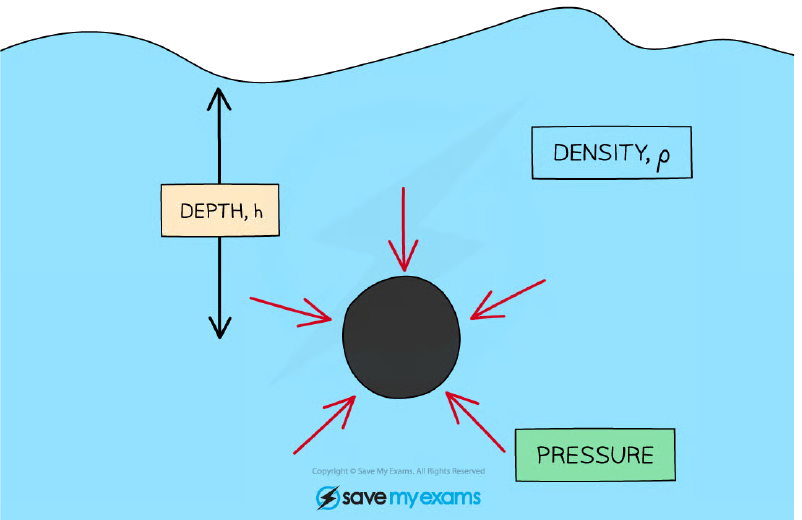
- The greater the depth of the liquid, the greater the pressure.
- The greater the density of the liquid, the greater the pressure.
- Liquid pressure is caused by the weight of the liquid pushing against objects immersed in it.
- As depth increases, the amount (and weight) of liquid above a point increases, so pressure increases.
- A more dense liquid has a greater weight, so it exerts a higher pressure.
- In a column of water, the highest pressure is at the bottom — a hole there produces a strong jet, while a hole near the top produces a weak jet.
- The pressure on the seabed is far higher than at the surface of the ocean.
- Liquid pressure does not depend on the shape of the container or the total volume of liquid.
Pressure in a liquid increases with depth and density, and acts equally in all directions.
Calculating Pressure in a Liquid
- The pressure due to a column of liquid is calculated using p = h × ρ × g.
- p = pressure in pascals (Pa); h = height of the column in metres (m).
- ρ = density of the liquid in kg/m³; g = gravitational field strength in N/kg.
- The value of g will be given in any calculation.
- This equation is given on the Physics equation sheet, but you must be able to rearrange it for h, ρ or g.
- The equation gives the difference in pressure at different depths, since pressure changes with depth.
- Example: at a depth of 10 m in water, the extra pressure is about 100 kPa; adding the 101 kPa atmospheric pressure gives a total of 201 kPa.
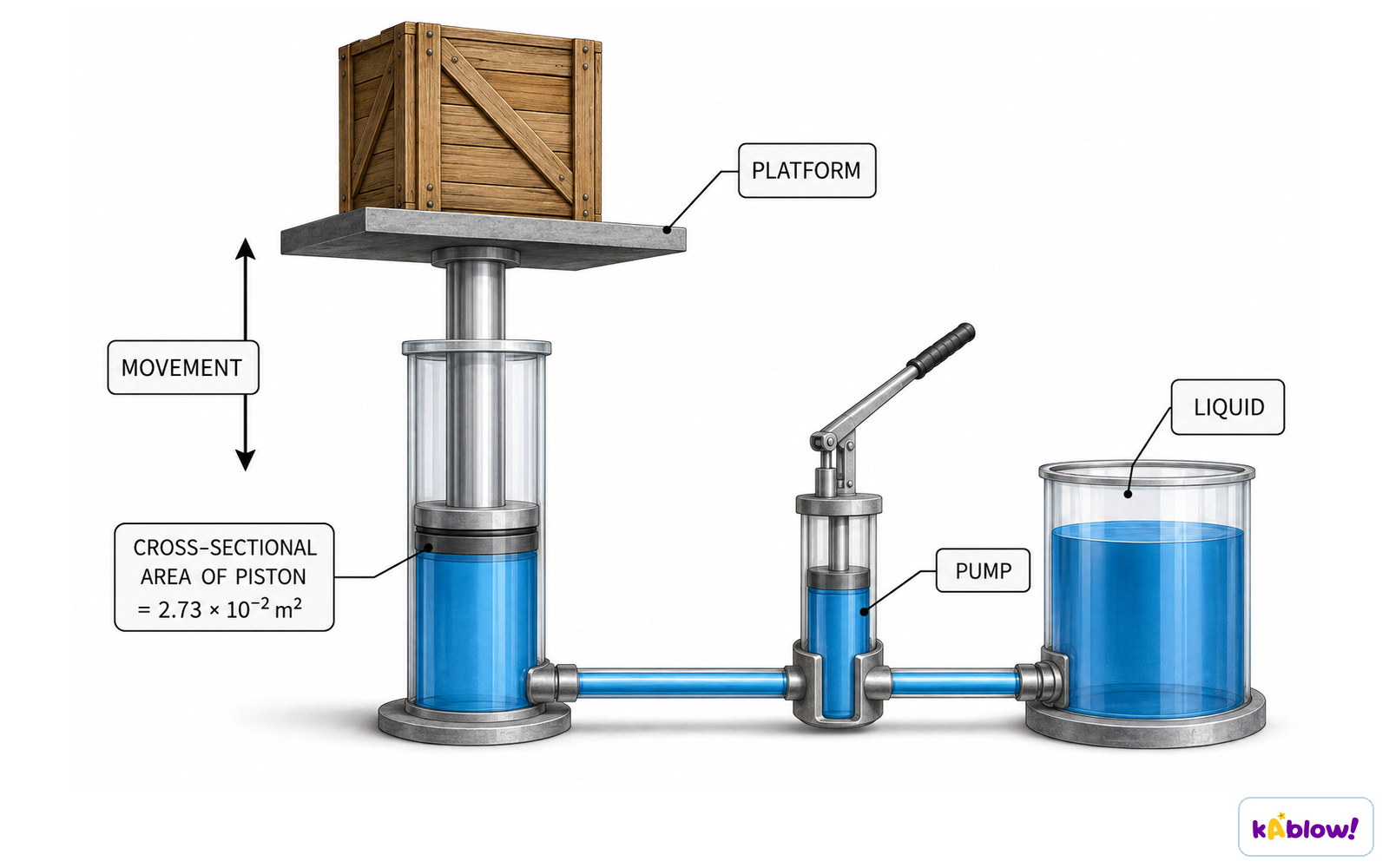
A hydraulic lift: a pump creates pressure in the liquid, transmitted to a piston of known cross-sectional area to raise the platform.
Upthrust
- Upthrust is a force that pushes upwards on an object submerged in a fluid.
- It always acts in the opposite direction to the object's weight.
- Upthrust arises because a submerged object experiences greater pressure on its bottom surface than on its top surface.
- This is because pressure is proportional to depth, so the difference in pressure creates a resultant force upwards.
- The size of the upthrust depends on the density of the fluid and the volume of fluid displaced (equal to the volume of the object).
- The denser the liquid, the greater the upthrust it exerts.
- Upthrust equals the weight of fluid displaced.
- Upthrust is why objects appear to weigh less when immersed in a liquid.
Floating and Sinking
- If the upthrust equals (or is greater than) the object's weight, the object floats.
- If the upthrust is smaller than the weight, the object sinks.
- An object less dense than the fluid will float; an object more dense than the fluid will sink.
- A denser-than-fluid object can never displace enough fluid to create an upthrust that supports its weight.
- Polystyrene (0.05 g/cm³) floats in water (1.0 g/cm³); a wooden block (0.9 g/cm³) floats partially submerged; an iron block (7.9 g/cm³) sinks.
- Objects float because upthrust balances weight, not simply because they are light.
Calculating Upthrust
- To find upthrust, first calculate the volume of the object immersed in the fluid.
- Use mass = density × volume (m = ρV) to find the mass of fluid displaced.
- Use weight = mass × gravitational field strength (W = mg) to find the weight of displaced fluid.
- The upthrust equals this weight of displaced fluid.
- Example: a cube 40 cm × 40 cm × 40 cm submerged to 20 cm displaces 32 000 cm³ of water, giving a mass of 32 kg and an upthrust of 320 N (with g = 10 N/kg).
Key Equations and Units
- p = F / A — pressure equals force normal to a surface divided by the area of that surface.
- p = h ρ g — pressure due to a column of liquid.
- Pressure is measured in pascals (Pa); 1 kPa = 1000 Pa.
- Force is measured in newtons (N); large forces may be quoted in kN (1 kN = 1000 N).
- Density is measured in kg/m³; gravitational field strength in N/kg.
- Always convert areas from cm² to m² before substituting into equations.
投影片
練習題
免費預覽——65 題中的 8 題。註冊即可查看全部。
1.What is the correct definition of pressure?
Easy- AThe force per unit area
- BThe total force acting on a surface
- CThe weight of an object
- DThe volume of a fluid
2.Which of the following is the correct unit for pressure?
Easy- ANewton (N)
- BPascal (Pa)
- CJoule (J)
- DKilogram (kg)
3.The pressure in a fluid acts at right angles to any surface it contacts.
EasyTrue or false?
4.Which of the following statements about atmospheric pressure are correct? (Select all that apply)
Medium- AAtmospheric pressure decreases as altitude increases.
- BAtmospheric pressure is caused by air molecules colliding with a surface.
- CAtmospheric pressure increases as the density of air decreases.
- DAtmospheric pressure at sea level is about 101 kPa.
- EAtmospheric pressure is greater at the top of a mountain than at sea level.
5.How does the pressure beneath the surface of a liquid change with depth and density?
Easy- AIt increases with depth and increases with density.
- BIt increases with depth and decreases with density.
- CIt decreases with depth and increases with density.
- DIt decreases with depth and decreases with density.
6.A diver swims deeper into a lake. What happens to the pressure of the water on the diver?
Medium- AIt increases.
- BIt decreases.
- CIt stays the same.
- DIt first increases then decreases.
7.Why is the total pressure on a diver greater than just the pressure due to the water above the diver?
Medium- ABecause the atmosphere also exerts pressure on the diver.
- BBecause the diver's body creates additional pressure.
- CBecause water pressure acts in all directions.
- DBecause the diver is moving.
8.An aeroplane gains height after take-off. Which two factors affect the atmospheric pressure on the aeroplane as it rises?
Medium- AThe density of the air and the height above the surface
- BThe speed of the aeroplane and the temperature of the air
- CThe weight of the aeroplane and the volume of air displaced
- DThe gravitational field strength and the density of the aeroplane
歷屆試題
這個主題的歷屆試題練習即將推出。
即將推出