Solar system; stability of orbital motions; satellites
邊玩邊學
回答這些題目賺取能量,接著就能釣魚、探索。不需要帳號。
給教育者: 為 Solar system; stability of orbital motions; satellites(Science、Physics)準備好可直接使用的課程投影片, 複習筆記——用於你的課程,或把這個主題當成互動班級活動,讓學習者以即時遊戲的方式進行。
課程筆記
Gravity and Weight
- Weight is the force acting on an object due to gravitational attraction.
- Planets have strong gravitational fields, so they attract nearby masses with a strong gravitational force.
- Weight keeps objects firmly on the ground, makes objects fall to the ground, and keeps satellites in orbit.
- Objects are attracted towards the centre of the Earth due to its gravitational field strength.
- The greater the mass of a planet, the greater its gravitational field strength.
- A higher gravitational field strength means a larger attractive force towards the centre of that planet or moon.
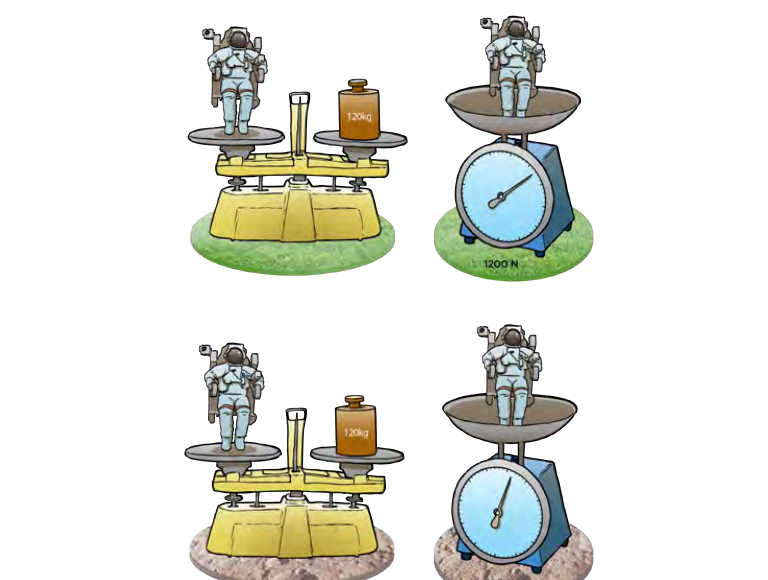
- The gravitational field strength g on Earth is approximately 10 N/kg.
- The gravitational field strength on the Moon is less than on Earth, so it is easier to lift a mass there; on the gas giants it is greater, so lifting a mass is harder.
An astronaut's mass and weight on Earth and the Moon
Objects in the Solar System
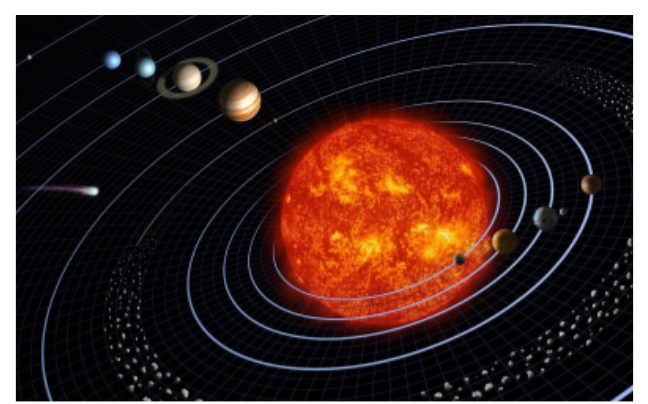
- The Solar System consists of the Sun, eight planets, natural and artificial satellites, dwarf planets, asteroids and comets.
- The Sun lies at the centre of the Solar System and is a star that makes up over 99% of the mass of the Solar System.
- The gravitational field around planets is strong enough to have pulled in all nearby objects except natural satellites.
- The gravitational field around a dwarf planet is not strong enough to have pulled in nearby objects.
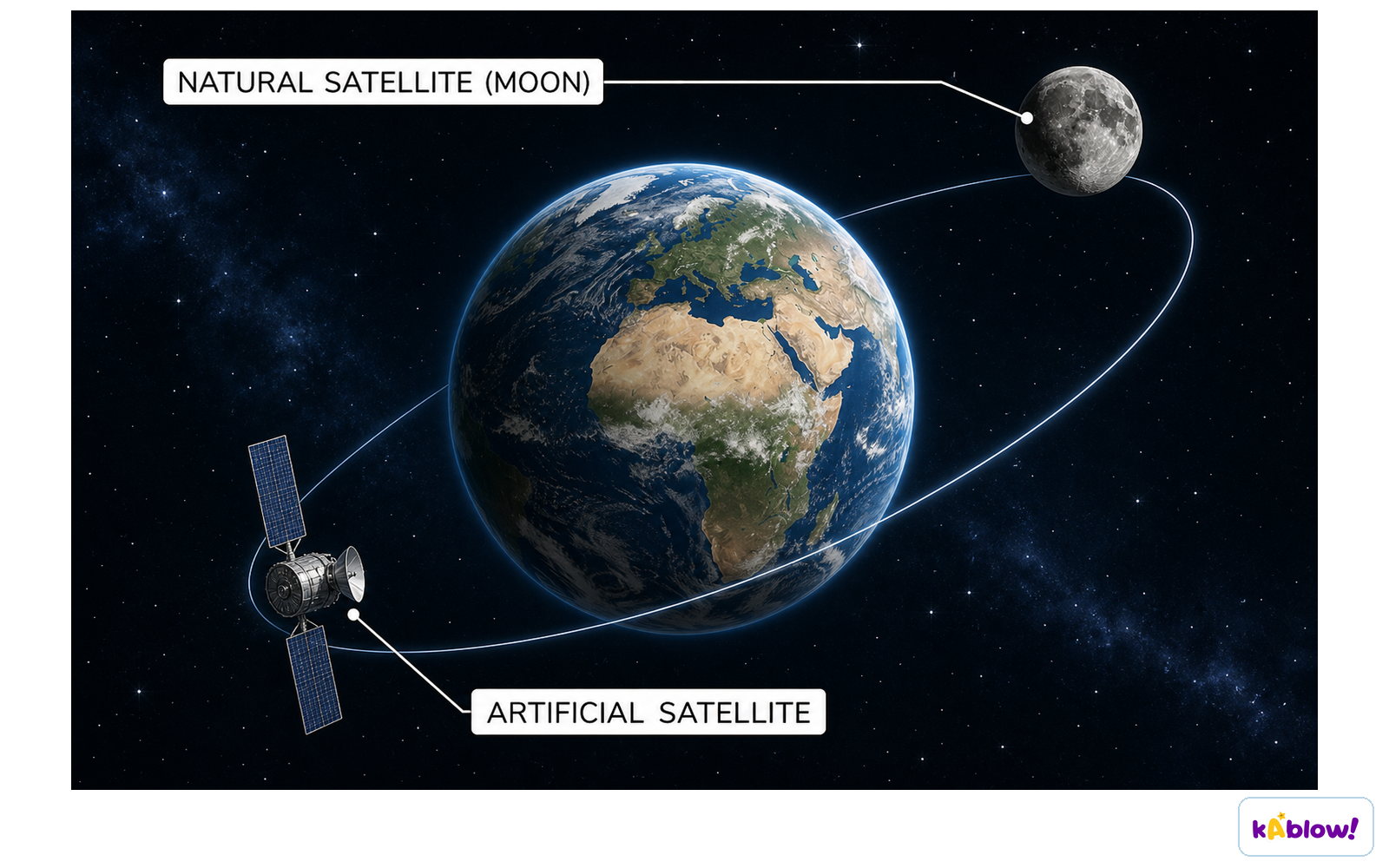
- Moons are natural satellites that orbit planets; artificial satellites are man-made and can orbit any object in space.
- The International Space Station (ISS) orbits the Earth and is an example of an artificial satellite.
- Asteroids are small rocky objects orbiting the Sun; the asteroid belt lies between Mars and Jupiter.
- Comets are made of dust and ice and orbit the Sun in a different orbit to the planets; the ice melts as a comet approaches the Sun and forms its tail.
The solar system
The Eight Planets
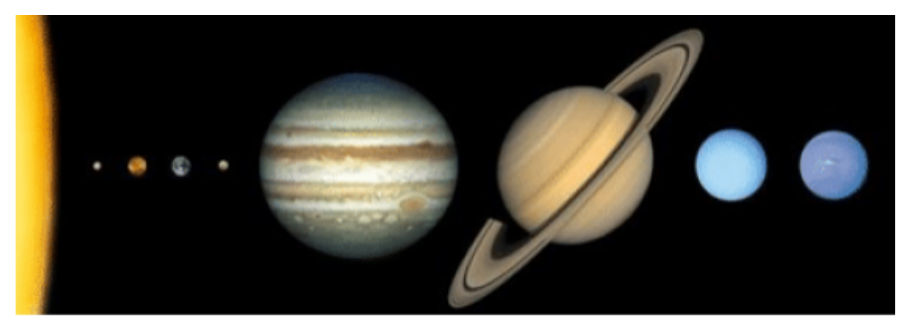
- The eight planets in ascending order of distance from the Sun are: Mercury, Venus, Earth, Mars, Jupiter, Saturn, Uranus, Neptune.
- The four rocky planets are Mercury, Venus, Earth and Mars.
- The four gas planets are Jupiter, Saturn, Uranus and Neptune.
- Mercury is the planet nearest to the Sun.
- Planets and moons are visible from Earth when they reflect light from the Sun.
- The light we receive on Earth from the Sun takes 8 minutes to reach us.
- The nearest star to us after the Sun is so far away that its light takes 4 years to reach us.
- The speed of light is a constant 3 × 10⁸ m/s, so time taken can be found using time = distance ÷ speed.
The eight planets to scale
Changing Models of the Solar System
- Ideas about the Solar System have changed many times throughout history.
- Before the telescope, ideas were based only on what could be seen with the naked eye, which restricted the detail that could be gathered.
- Ptolemy (AD 100–168) described one of the earliest models, with the Earth at the centre — the geocentric model.
- Evidence for the geocentric model: to the naked eye the Sun, Moon, stars and planets appear to move across the sky in a predictable pattern each day.
- Evidence against the geocentric model: the moons of other planets (such as Jupiter) can be seen orbiting those planets, not the Earth.
- Detailed telescope observations show planets do not move in a simple orbital path around the Earth — shown by the retrograde motion of planets.
- Nicolas Copernicus (1473–1543) first suggested the Sun at the centre; this heliocentric model is now accepted.
Circular Orbits
- A smaller body or object will orbit a larger body, for example a planet orbiting the Sun.
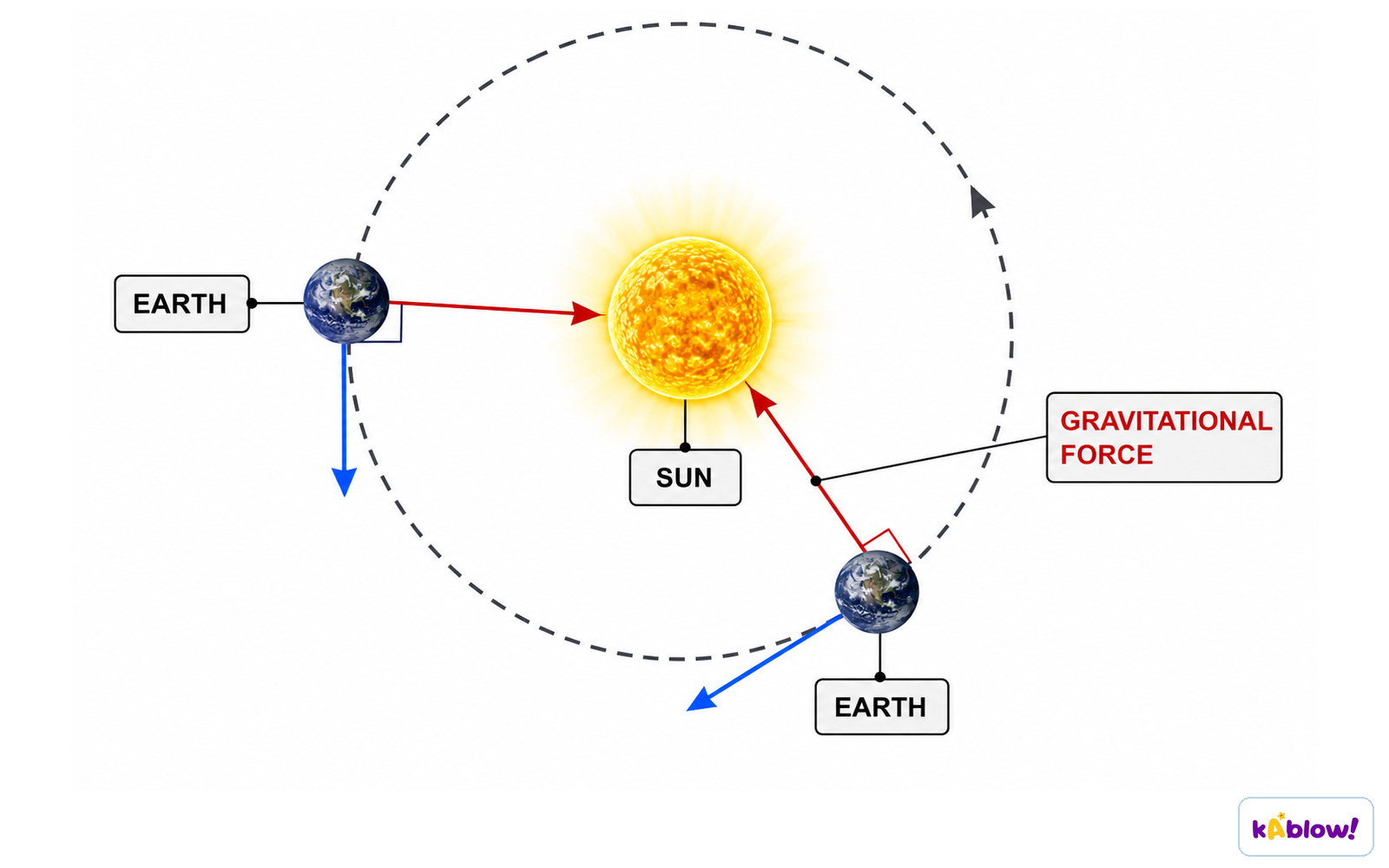
- To orbit a body there must be a force pulling the object towards it — gravity provides this force.
- The gravitational force exerted by the larger body is always attractive, so it always acts towards the centre of the larger body.
- This gravitational force causes the body to move and maintain a circular path.
- Planets travel around the Sun in orbits that are approximately circular.
- An object in circular orbit travels at a constant speed but a changing velocity, because its direction is constantly changing.
- Since velocity is constantly changing, the object in orbit is accelerating; acceleration is the rate of change of velocity.
- The resultant force (gravity) must act at right angles to the instantaneous velocity to create a circular orbit, always towards the centre of the orbit.
The Sun's gravitational force of attraction keeps the Earth in orbit around the Sun
Orbits of Planets, Moons and Comets
- Planetary orbits are all slightly elliptical (stretched circles) with the Sun at one focus, approximately the centre of the orbit.
- All planets orbit in the same plane and travel in the same direction around the Sun.
- Planets orbit at different distances from the Sun, at different speeds, and take different amounts of time to orbit the Sun.
- Moons orbit planets in a circular path; some planets have more than one moon.
- The closer a moon is to its planet, the shorter the time it takes to orbit and the greater the speed of the orbit.
- Comet orbits are highly elliptical (very stretched) or hyperbolic, so their speed changes significantly as their distance from the Sun changes.
- Not all comets orbit in the same plane as the planets, and some do not even orbit in the same direction.
Stability of Orbits and Artificial Satellites
- A satellite needs to travel at a specific speed to maintain a circular orbit at a particular distance from the object.
- If the speed of the satellite is too large, the radius of the orbit increases and the satellite spirals into space, because gravitational attraction cannot provide enough force to keep it in orbit.
- If the speed of the satellite is too low, the radius of the orbit decreases and the satellite moves towards the object, because gravitational attraction is too strong to maintain a constant orbital radius.
- To maintain a stable orbit: if the speed increases the radius must decrease, and if the speed decreases the radius must increase.
- Non-circular orbits, such as those of comets, are still stable — the radius must change if the orbital speed changes.
- As a comet approaches the Sun, the radius of the orbit decreases and the orbital speed increases due to the Sun's strong gravitational pull.
- As a comet travels further from the Sun, the radius of the orbit increases and the orbital speed decreases due to a weaker gravitational pull.
- As a comet approaches the Sun it loses gravitational potential energy and gains kinetic energy, and its icy body sublimates to form a tail that always points away from the Sun.
Natural and artificial satellites of Earth: the Moon and an orbiting artificial satellite
Equilibrium in Stars
- Stars are held together by a delicate balance of inwards and outwards forces.
- The inward force is gravity, an attractive force which pulls the outer layers inwards.
- The outward force is the force from the pressure caused by thermal expansion, exerted by the expanding hot gases inside the star.
- When the inward pull of gravity and the outward force from thermal expansion are equal, the star is in equilibrium.
- This is how stars in the main sequence remain stable for millions of years.
- If the temperature of a star increases, the outward pressure increases and the star expands; if the temperature drops, the outward pressure decreases and the star contracts.
- Once the forces are unbalanced the star is no longer in equilibrium and will expand or contract — this happens when fusion in the core, and hence thermal expansion, ceases at the end of the star's life.
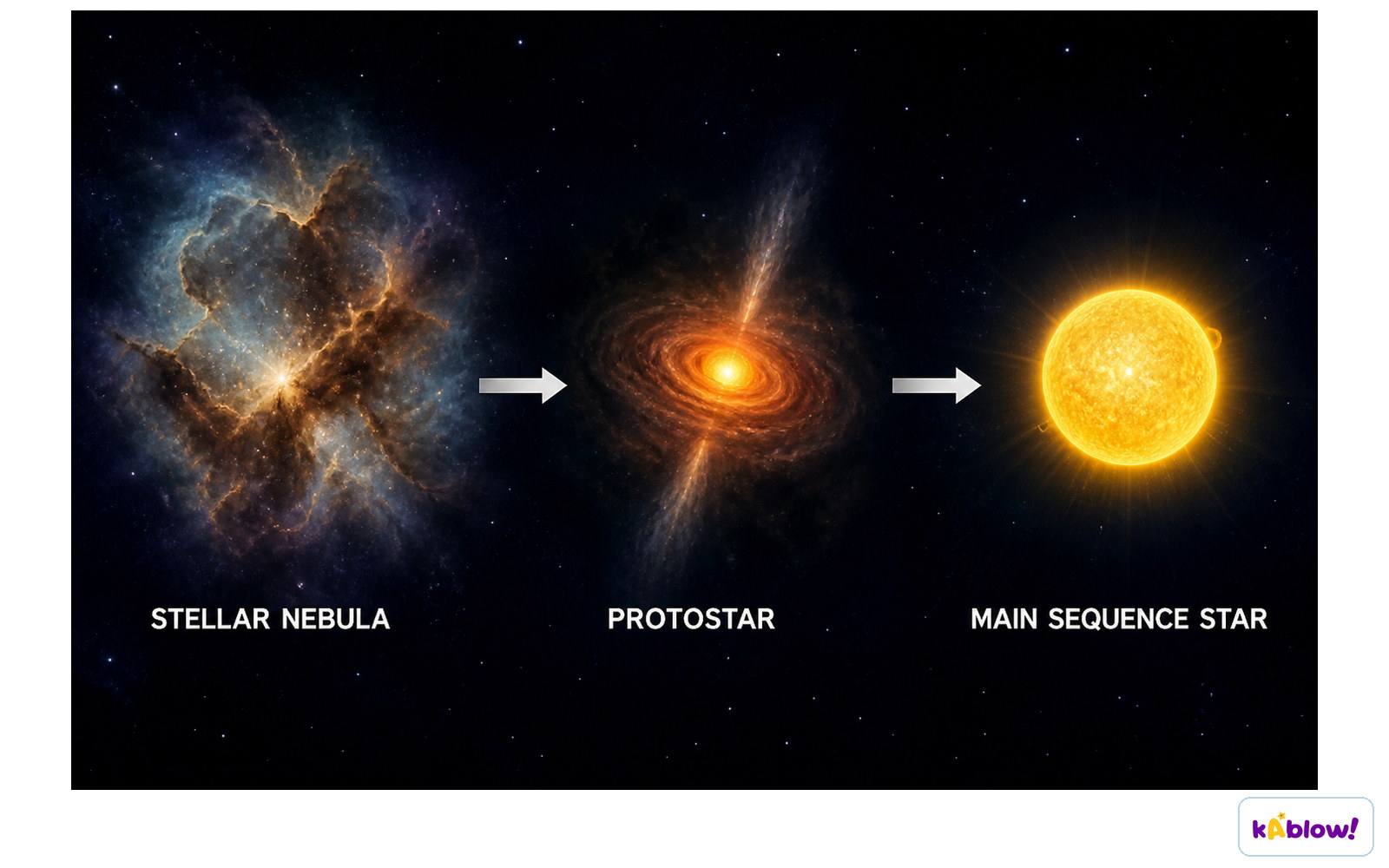
A nebula contracts into a protostar, which becomes a main sequence (stable) star.
Life Cycle of Solar Mass Stars
- Nebula: all stars form from a giant cloud of hydrogen gas and dust called a nebula.
- Protostar: gravity pulls the particles closer together into a hot ball of gas; density increases, causing more frequent collisions between particles and a rise in temperature.
- Main sequence star: once hot enough, thermal expansion from fusion reactions in the core balances gravity, so the star is in equilibrium and stable.
- Red giant: after several billion years the reactions die down as the star runs out of fuel; the core shrinks and heats up because gravity becomes greater than the outward pressure, and the outer part expands.
- A red giant is red because its outer surface starts to cool.
- White dwarf: the star becomes unstable and ejects its outer layer of dust and gas as a planetary nebula; the remaining core collapses completely under gravity to become a white dwarf.
- The white dwarf cools down, so the amount of energy it emits decreases.
Life Cycle of Larger Stars
- A large star is one much larger than the Sun; such stars have much shorter lifespans — in the region of hundreds of millions of years instead of billions.
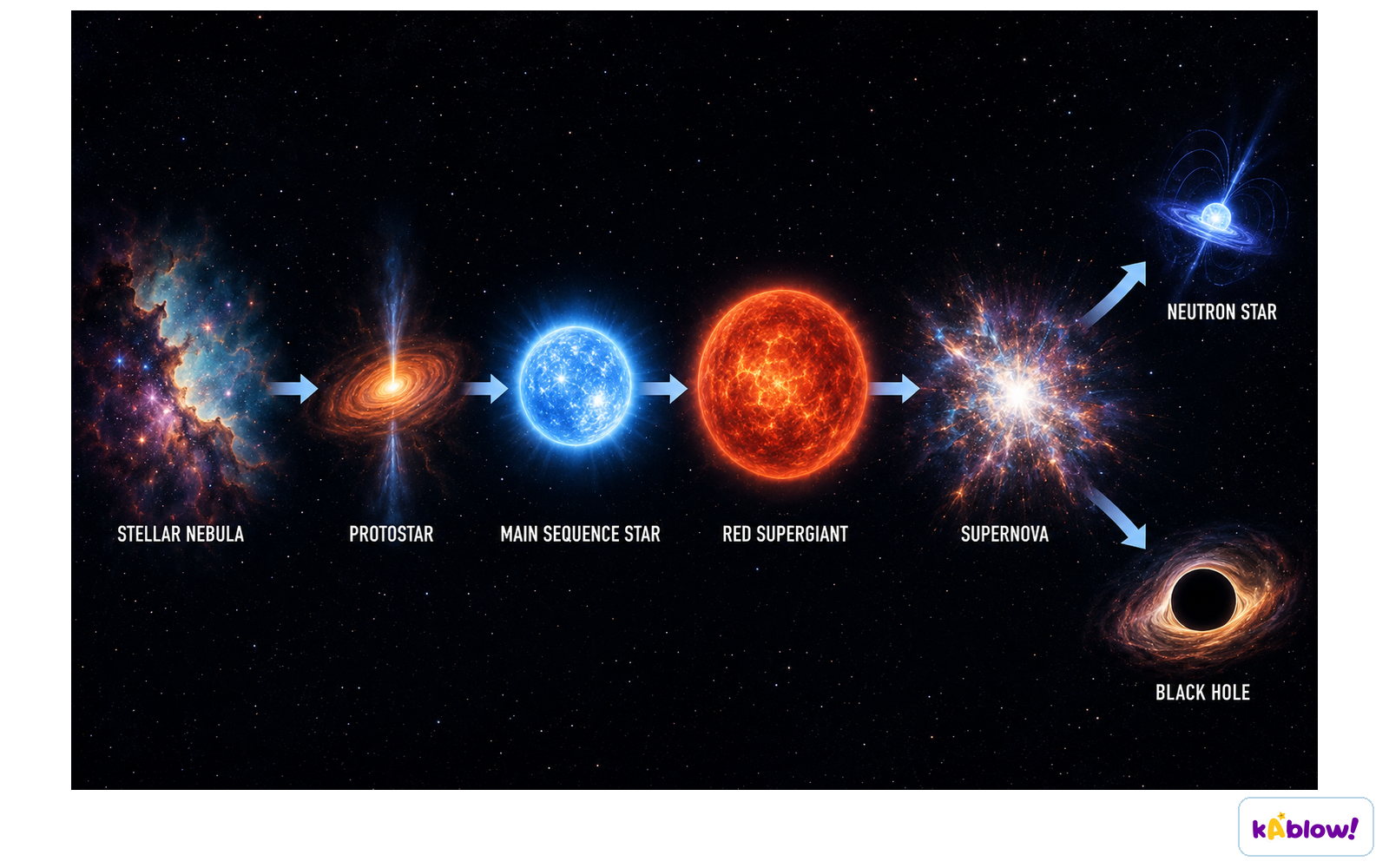
- The life cycle of a star larger than the Sun starts in the same way as a solar mass star: nebula, protostar, then main sequence star.
- Red supergiant: when the main sequence star runs out of fuel in its core, the core shrinks and heats up because gravity is greater than the outward pressure, and the outer part expands.
- A red supergiant is much larger than a red giant.
- Supernova: once the reactions inside the red supergiant finish, the core collapses suddenly and rebounds in a gigantic explosion, ejecting the outer remnants into space.
- Neutron star: a dense body called a neutron star forms at the centre of the explosion.
- For the largest stars, the neutron star continues to collapse under gravity until it forms a black hole — an extremely dense point in space that not even light can escape from.
Flow diagram showing the life cycle of a star much larger than the Sun.
投影片
練習題
免費預覽——56 題中的 8 題。註冊即可查看全部。
1.Which planet is nearest to the Sun?
Easy- AJupiter
- BMars
- CMercury
- DVenus
2.The Moon orbits the Earth. Which of these describes the Moon?
Easy- Aan asteroid
- Ba comet
- Ca nebula
- Da natural satellite
3.An object's mass is the same on the Moon as it is on the Earth, but its weight is less on the Moon.
EasyTrue or false?
4.Which of the following is the correct definition of weight?
Easy- AThe amount of matter in an object
- BThe force acting on an object due to gravitational attraction
- CThe gravitational field strength of a planet
- DThe speed at which an object falls
5.Which of these is an example of an artificial satellite?
Easy- AThe Moon
- BThe International Space Station
- CA comet
- DThe dwarf planet Pluto
6.Which statement about the gravitational field strength of the gas giants is correct?
Medium- AIt is less than on the Earth, so it is easier to lift a mass there
- BIt is more than on the Earth, so it is harder to lift a mass there
- CIt is the same as on the Earth
- DIt is zero because they are made of gas
7.Which row correctly lists the planets that are gas planets?
Medium- AMercury, Venus, Earth, Mars
- BJupiter, Saturn, Uranus, Neptune
- CMercury, Venus, Jupiter, Saturn
- DEarth, Mars, Jupiter, Saturn
8.Match each object to its correct description.
Medium- Asteroid
- Comet
- Moon
- The Sun
- A small rocky object which orbits the Sun
- Made of dust and ice, with a tail that forms near the Sun
- A natural satellite orbiting a planet
- The star at the centre of the Solar System
歷屆試題
這個主題的歷屆試題練習即將推出。
即將推出