Human reproduction and puberty
邊玩邊學
回答這些題目賺取能量,接著就能釣魚、探索。不需要帳號。
給教育者: 為 Human reproduction and puberty(MYP Biology、Year 2)準備好可直接使用的課程投影片, 複習筆記——用於你的課程,或把這個主題當成互動班級活動,讓學習者以即時遊戲的方式進行。
課程筆記
Big idea: change and development
- Big idea (key concept): Change. Humans change enormously over a lifetime: from a single cell, to a baby, to a child, to an adult. This lesson looks at the changes that make that possible.
- Related concept: Development. Development means growing and changing in structure and ability over time. Puberty and pregnancy are both stages of human development.
- Global context: Identities and relationships. How our bodies develop is part of who we are. Every person is different, and understanding the science helps us treat ourselves and other people with respect.
- Reproduction is one of the seven life processes. In humans it is sexual reproduction: two special sex cells, called gametes, join together to make a new individual.
- The male gamete is the sperm cell and the female gamete is the egg cell. Gametes are made in the testes (male) and the ovaries (female).
- The new individual receives genes from both parents, so it is similar to each parent but not identical to either.
Puberty: how the body changes
- Puberty is the stage of development when a child's body changes into an adult body that is able to reproduce. It usually starts somewhere between about 8 and 14 years of age and takes several years.
- Puberty is controlled by hormones: chemical messengers made in glands and carried around the body in the blood. The pituitary gland in the brain releases hormones that tell the testes or ovaries to start making sex hormones.
- In boys the testes make testosterone. In girls the ovaries make oestrogen.
- Changes in both boys and girls: a growth spurt; hair grows under the arms and in the pubic area; sweat glands become more active; skin becomes oilier, which can cause spots; and moods can change more quickly.
- Changes in boys: the voice becomes deeper as the larynx grows; facial and body hair grows; the shoulders broaden; and the testes begin to make sperm.
- Changes in girls: the breasts develop; the hips widen; the ovaries begin to release eggs; and periods begin.
- Everyone goes through puberty at their own pace. Starting earlier or later than friends is normal. A parent, carer, school nurse or doctor is a good person to ask if you have questions.
The male reproductive system
- The two testes hang in a bag of skin called the scrotum. They make sperm all the time after puberty, and they make the hormone testosterone. Sperm develop best a few degrees cooler than the rest of the body, which is why the testes are held outside the abdomen.
- Each testis is joined to a sperm duct, a muscular tube that carries sperm towards the urethra.
- The prostate gland and the seminal vesicles add a fluid that gives the sperm an energy supply and helps them swim. Sperm and this fluid together are called semen.
- The urethra is the tube that runs through the penis. It carries semen out of the body, and at other times it carries urine from the bladder. It never carries both at once.
- During sexual intercourse the penis becomes firm and places semen inside the vagina of the female. Several hundred million sperm are released, but only one will fertilise an egg.
The female reproductive system and the menstrual cycle
- The two ovaries contain thousands of immature egg cells from birth. From puberty onwards, about one egg matures and is released roughly every month. This release is called ovulation.
- The oviduct is a tube that carries the egg towards the uterus. Tiny hairs called cilia and waves of muscle move it along. Fertilisation usually happens here.
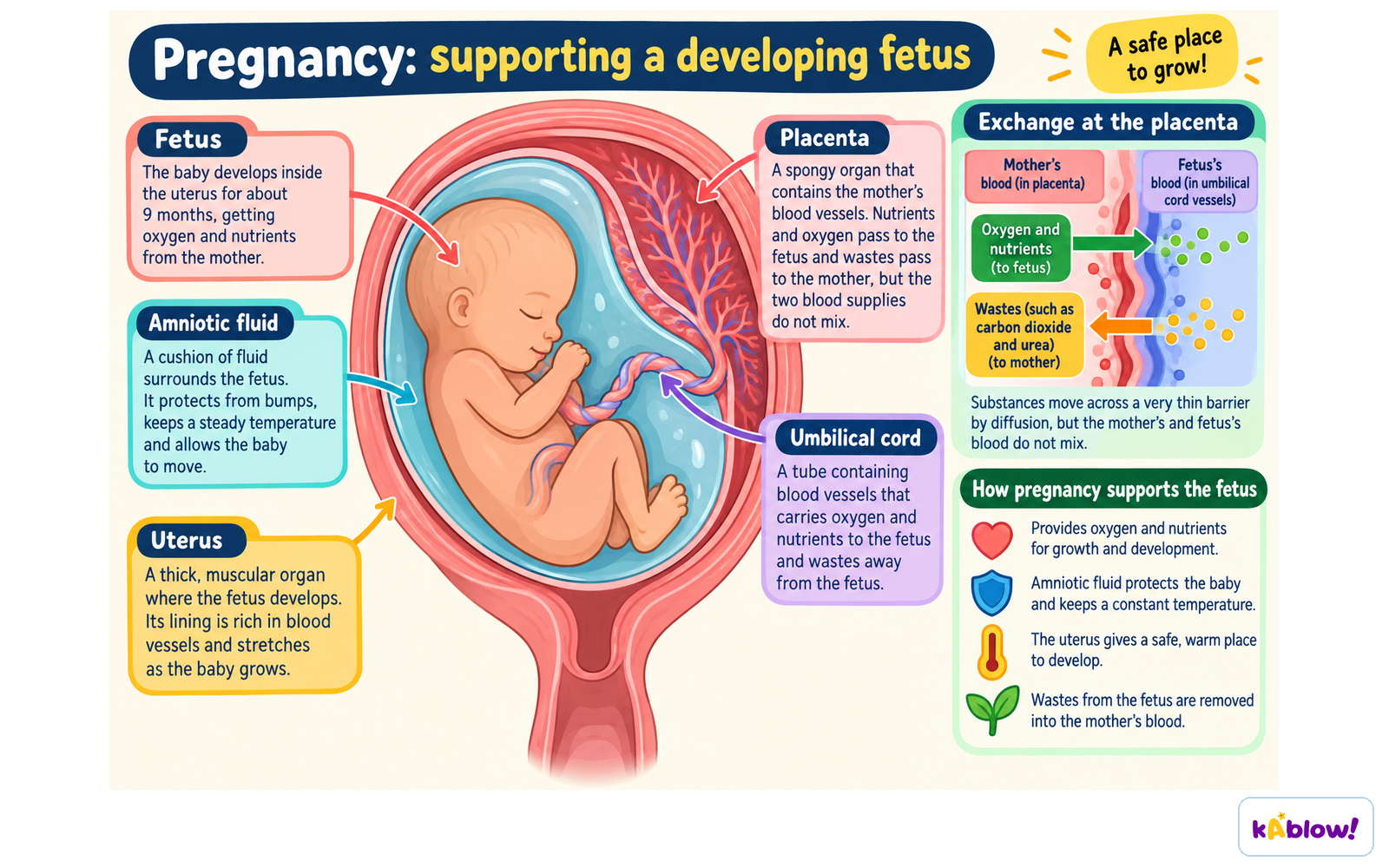
- The uterus is a muscular organ with a soft lining rich in blood vessels. A fertilised egg attaches to the lining and a baby can develop here. The cervix is a ring of muscle at the bottom of the uterus, and the vagina is the muscular tube that leads to the outside of the body.
- The menstrual cycle repeats about every 28 days, although the length varies from person to person and can be irregular in the first years. Day 1 is the first day of bleeding.
- Menstruation (a period) lasts about 3 to 7 days. The lining of the uterus breaks down and leaves the body through the vagina, with a little blood. It is a normal, healthy process, not an illness.
- After a period the lining rebuilds. FSH from the pituitary gland makes an egg mature in an ovary, and the ovary releases oestrogen, which thickens the lining. A peak of LH around day 14 triggers ovulation.
- After ovulation the lining is kept thick, ready for a fertilised egg. If the egg is not fertilised, hormone levels fall, the lining breaks down and a new cycle begins.
Fertilisation, pregnancy and development
- Gametes are haploid: they have one set of 23 chromosomes. Body cells have two sets, 46 chromosomes in all. When the nucleus of a sperm fuses with the nucleus of an egg in fertilisation, the new cell, the zygote, has 46 chromosomes again, 23 from each parent.
- A sperm is adapted to reach and enter an egg. It has a tail to swim, mitochondria that release energy for swimming, and an acrosome containing enzymes that digest a way into the egg. The egg is much larger and holds a food store.
- The zygote divides again and again to form a ball of cells, the embryo. It travels down the oviduct and attaches to the uterus lining. This is called implantation, and it is when pregnancy begins.
- From about eight weeks, when the main organs have begun to form, the developing baby is called a foetus. A pregnancy lasts about 40 weeks.
- The placenta grows into the uterus lining. The mother's blood and the foetus's blood flow close together but do not mix. Oxygen, glucose and amino acids diffuse from the mother to the foetus. Carbon dioxide and urea diffuse the other way. The umbilical cord carries the blood between the foetus and the placenta.
- The amniotic fluid inside the amniotic sac cushions the foetus and keeps its temperature steady.
- Harmful substances such as alcohol, nicotine and some viruses can cross the placenta, so a pregnant person is advised to avoid them.
- At the end of pregnancy the muscles of the uterus contract, the cervix widens and the baby is pushed out through the vagina. This is birth.
How the uterus supports a developing foetus
Think like a scientist: how does growth change with age?
- Question: at what age do young people grow fastest, and is it the same for boys and girls? A class collects average growth rates from a large health survey (cm per year): girls 5.5 at age 9, 8.0 at age 11, 6.0 at age 13 and 1.5 at age 15; boys 5.5 at age 9, 6.0 at age 11, 9.0 at age 13 and 5.0 at age 15.
- Variables: the independent variable is age. The dependent variable is the growth rate in cm per year. Control variables include measuring with the same type of ruler or stadiometer, measuring without shoes, and measuring at the same time of day, because height changes slightly across a day.
- Reliability: measuring many people and calculating a mean is more reliable than measuring one person, because individuals vary. The survey data show a trend, not a rule for every person.
- Ethics: people should agree to take part, only height should be recorded, and results should be anonymous so nobody is compared or embarrassed.
- Inquiry task: plan a survey to find out how mean height changes between Year 7 and Year 9. State the independent and dependent variables, three control variables, how you will make the data reliable and how you will protect students' privacy. Then predict what a graph of mean height against year group will look like and explain your prediction using what you know about puberty.
投影片
練習題
免費預覽——55 題中的 8 題。註冊即可查看全部。
1.What are hormones?
Easy- AEnzymes that break down food in the gut
- BElectrical signals carried along nerves
- CChemical messengers carried in the blood
- DCells that fight infection in the blood
2.Which sex hormone is made mainly in the testes?
Easy- ATestosterone
- BOestrogen
- CInsulin
- DAdrenaline
3.Which sex hormone is made mainly in the ovaries?
Easy- ATestosterone
- BInsulin
- CThyroxine
- DOestrogen
4.Which gland in the brain releases the hormones that start puberty by signalling the testes or ovaries?
Medium- AThe thyroid gland
- BThe pituitary gland
- CThe pancreas
- DThe prostate gland
5.Puberty starts at exactly the same age for everyone.
EasyTrue or false?
6.Which change happens in both boys and girls during puberty?
Easy- AThe voice becomes much deeper
- BA growth spurt
- CPeriods begin
- DFacial hair starts to grow
7.Which change usually happens in boys but not in girls?
Easy- AThe body grows taller
- BHair grows under the arms
- CSweat glands become more active
- DThe voice becomes deeper
8.Which change usually happens in girls but not in boys?
Easy- APeriods begin
- BThe skin becomes oilier
- CHair grows in the pubic area
- DA growth spurt starts
歷屆試題
這個主題的歷屆試題練習即將推出。
即將推出