Inheritance and genetic crosses
邊玩邊學
回答這些題目賺取能量,接著就能釣魚、探索。不需要帳號。
給教育者: 為 Inheritance and genetic crosses(MYP Biology、Year 3)準備好可直接使用的課程投影片, 複習筆記——用於你的課程,或把這個主題當成互動班級活動,讓學習者以即時遊戲的方式進行。
課程筆記
Big idea: patterns in who we take after
- Big idea (key concept): Relationships. Children are related to their parents, and the pattern of how characteristics pass from one generation to the next can be predicted.
- Related concept: Patterns. Inheritance follows rules. Once you know the rules, you can calculate the chances of a child inheriting a characteristic.
- Global context: Identities and relationships. Why do you look like some relatives and not others? Why can two healthy parents have a child with a genetic disorder? Genetics gives scientific answers to these personal questions.
- Inheritance is the passing of characteristics from parents to offspring through genes. Each parent passes on one allele of each gene, in a sex cell called a gamete.
- The pattern was first worked out by Gregor Mendel, a monk in what is now the Czech Republic. In the 1850s and 1860s he bred thousands of pea plants and counted the offspring. He found that characteristics were passed on in fixed, predictable ratios.
- Mendel studied characteristics with two clear options, such as tall or dwarf plants and round or wrinkled seeds. When he crossed a tall plant with a dwarf plant, all the offspring were tall. When he crossed those offspring with each other, about three in every four were tall and one in four was dwarf. The dwarf characteristic had been hidden, not lost.
- His work was ignored for over thirty years. It was only after he died, around 1900, that other scientists rediscovered it. Genes, DNA and chromosomes were not understood in his lifetime, so he called the units of inheritance 'factors'.
Alleles, genotype and phenotype
- A gene comes in different versions called alleles. An organism has two alleles of each gene, one from each parent. We write alleles as letters: a capital letter for the dominant allele and a lower-case letter for the recessive allele. For pea height, T is tall and t is dwarf.
- A dominant allele shows its effect even if there is only one copy. A recessive allele shows its effect only when there are two copies and no dominant allele is present. Dominant does not mean 'better' or 'more common'. It describes how the alleles interact.
- The genotype is the combination of alleles an organism has, such as TT, Tt or tt. The phenotype is the characteristic you can observe, such as being tall or dwarf. The phenotype also depends on the environment: a plant with genes for tallness will still be short if it is starved of light.
- If both alleles are the same, the organism is homozygous. TT is homozygous dominant and tt is homozygous recessive. If the alleles are different, the organism is heterozygous, for example Tt.
- So a TT plant and a Tt plant have different genotypes but the same phenotype: both are tall. Only a tt plant is dwarf.
- Many human characteristics are controlled by more than one gene, so they do not fit this simple pattern. Skin colour and height are examples. Characteristics controlled by a single gene, such as some genetic disorders, follow the patterns in this lesson.
Homozygous and heterozygous pairs of alleles
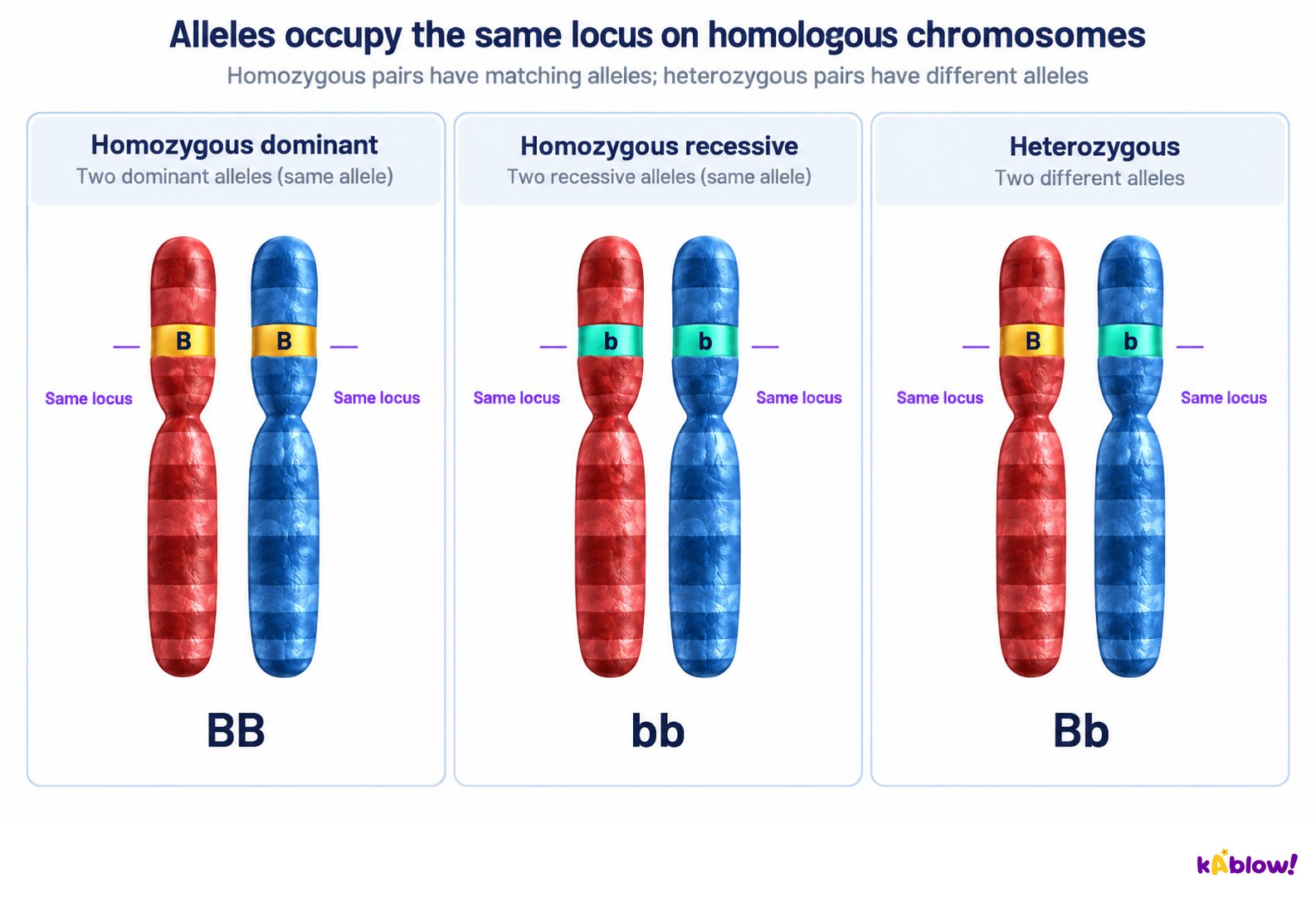
Monohybrid crosses and Punnett squares
- A monohybrid cross looks at the inheritance of one gene. A Punnett square is a grid that shows every way the parents' alleles can combine in the offspring.
- Method. (1) Write the genotypes of the parents. (2) Work out the gametes each parent can make. Each gamete gets only one allele of the gene. (3) Write one parent's gametes along the top and the other's down the side. (4) Fill each box with the alleles from its row and its column. (5) Read the results as genotypes, phenotypes and ratios.
- Worked example: Tt x Tt. Both parents are heterozygous tall plants. Each makes T gametes and t gametes in equal numbers. The four boxes read TT, Tt, Tt and tt.
- That gives a genotype ratio of 1 TT : 2 Tt : 1 tt. Because TT and Tt are both tall, the phenotype ratio is 3 tall : 1 dwarf. The probability of a dwarf offspring is 1 in 4 (25%).
- TT x tt gives only Tt, so all offspring are tall. Tt x tt gives two Tt and two tt, so the ratio is 1 tall : 1 dwarf. tt x tt gives only tt, so all offspring are dwarf.
- A Punnett square gives probabilities, not guarantees. Each fertilisation is a separate chance event, like tossing a coin. With only a few offspring, the real numbers can be quite different from the prediction. Mendel counted large numbers of plants: in one cross he got about 787 tall and 277 dwarf plants, which is close to 3 : 1.
- A test cross finds the genotype of a tall plant. Cross it with a dwarf (tt) plant. If any offspring are dwarf, the tall parent must be Tt. If the offspring are all tall, the parent is probably TT.
Sex determination in humans
- Human body cells have 23 pairs of chromosomes. One pair is the sex chromosomes. Females have two X chromosomes (XX). Males have one X and one Y (XY).
- A gene on the Y chromosome triggers the development of testes, so a person who inherits a Y chromosome develops as male.
- Every egg cell carries an X chromosome. Half of the sperm cells carry an X and half carry a Y. So it is the father's sperm that decides the sex of the child.
- The Punnett square for XX x XY gives XX, XX, XY and XY. The chance of a girl is 50% and the chance of a boy is 50%.
- Each pregnancy is an independent event. A couple who already have three boys still have a 50% chance of a girl next time, because the sperm that fertilises the egg does not remember earlier children.
- Some genes are found on the X chromosome but not on the Y. These are called sex-linked genes, and they affect males and females differently. Males have only one X, so a single recessive allele on it will show.
Carriers, genetic disorders and family pedigrees
- Some genetic disorders are caused by a faulty allele. Cystic fibrosis (CF) is caused by a recessive allele. In a person with CF, the body makes thick, sticky mucus that blocks the lungs and the tubes of the digestive system. Treatments help, but there is no simple cure.
- Let C be the normal allele and c the faulty allele. A person with genotype CC does not have CF. A person with cc has CF. A person with Cc does not have CF, because the normal allele is dominant. They are a carrier: they have one copy of the faulty allele and can pass it on.
- Roughly 1 in 25 people of European ancestry is a carrier of the CF allele, and most carriers do not know. If two carriers (Cc x Cc) have children, the boxes read CC, Cc, Cc and cc. Each child has a 25% chance of having CF, a 50% chance of being a carrier and a 25% chance of being neither.
- This shows how two parents who are both healthy can have a child with the disorder. It also shows why dominant does not mean common. A disorder such as polydactyly (extra fingers or toes) is caused by a dominant allele but is rare.
- A family pedigree is a family tree used to follow a characteristic. Squares are males, circles are females, a horizontal line joins a couple, and shaded shapes show affected people. If two unaffected parents have an affected child, the characteristic must be caused by a recessive allele and both parents must be carriers.
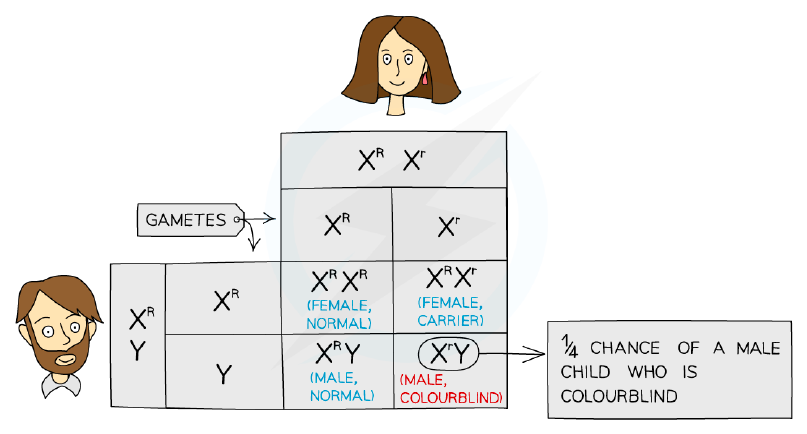
- Colour vision gives another example. Red-green colour blindness is caused by a recessive allele on the X chromosome. A carrier mother (XRXr) and a father with typical colour vision (XRY) have a 1 in 4 chance of a colour-blind son. The condition is far more common in males than in females, because males have only one X.
A cross for a recessive allele carried on the X chromosome
Think like a scientist: modelling a genetic cross with coins
- A model can show how alleles are shared out. Toss a coin to model a gamete: heads is the allele T and tails is the allele t. A heterozygous parent (Tt) makes T and t gametes with equal chance.
- To model Tt x Tt, toss two coins together, one for each parent. HH is TT, HT or TH is Tt and TT is tt. Do this 40 times and record your results in a tally chart.
- The Punnett square predicts 10 TT, 20 Tt and 10 tt, which is a 1 : 2 : 1 ratio. Your actual results will probably be a little different, because each toss is a matter of chance.
- The independent variable in your investigation could be the number of tosses (10, 20, 40, 80). The dependent variable is how close your results are to the 1 : 2 : 1 prediction. You should control the coins used and the way you toss them.
- Pooling the results of the whole class gives a larger sample, and the results usually get closer to the prediction. This is why Mendel counted so many plants.
- Inquiry task: design an investigation to find out whether a bigger sample gives results closer to a 3 : 1 ratio. State your variables, explain how you will keep the test fair, say how many times you will repeat the tosses, and evaluate one limit of using coins to model inheritance.
投影片
練習題
免費預覽——52 題中的 8 題。註冊即可查看全部。
1.What is a dominant allele?
Easy- AAn allele that only works when there are two copies
- BAn allele that shows its effect even when only one copy is present
- CAn allele that is found only on the X chromosome
- DAn allele that is always passed on to every child
2.What does the word 'genotype' mean?
Easy- AThe characteristic that can be seen or measured
- BThe number of chromosomes in a cell
- CThe sex of the offspring
- DThe combination of alleles an organism has
3.What does the word 'phenotype' mean?
Easy- AThe characteristic an organism shows
- BThe pair of alleles the organism has
- CThe place on a chromosome where a gene sits
- DThe type of cell division that made the gamete
4.A pea plant has the genotype Tt. How can this genotype be described?
Easy- AHomozygous dominant
- BHomozygous recessive
- CHeterozygous
- DHaploid
5.A pea plant with the genotype Tt is tall. Why is it tall?
Easy- AThe t allele is stronger than the T allele
- BTall plants always have two identical alleles
- CThe T allele is dominant over the t allele
- DThe plant has received two T alleles
6.A recessive allele only affects the phenotype when two copies of it are present.
EasyTrue or false?
7.Match each description to an example from the pea plant height gene (T is tall, t is dwarf).
Easy- Homozygous dominant
- Heterozygous
- Homozygous recessive
- Recessive allele
- tt
- t
8.Which scientist bred pea plants to discover the patterns of inheritance?
Easy- AGregor Mendel
- BCharles Darwin
- CFrancis Crick
- DLouis Pasteur
歷屆試題
這個主題的歷屆試題練習即將推出。
即將推出