Atomic structure
邊玩邊學
回答這些題目賺取能量,接著就能釣魚、探索。不需要帳號。
給教育者: 為 Atomic structure(MYP Chemistry、Year 2)準備好可直接使用的課程投影片, 複習筆記——用於你的課程,或把這個主題當成互動班級活動,讓學習者以即時遊戲的方式進行。
課程筆記
Big idea: using models to see the invisible
- Big idea (key concept): Systems. An atom is a small system of particles that work together, and everything around you is built from atoms.
- Related concept: Models. Atoms are far too small to see, so scientists use models. A model is a simplified picture or idea that explains evidence and helps us make predictions.
- Global context: Scientific and technical innovation. Better equipment let scientists learn more about atoms, and each new discovery changed the model.
- An atom is the smallest part of an element that still has the properties of that element. Atoms are so small that millions of them would fit across the full stop at the end of this sentence.
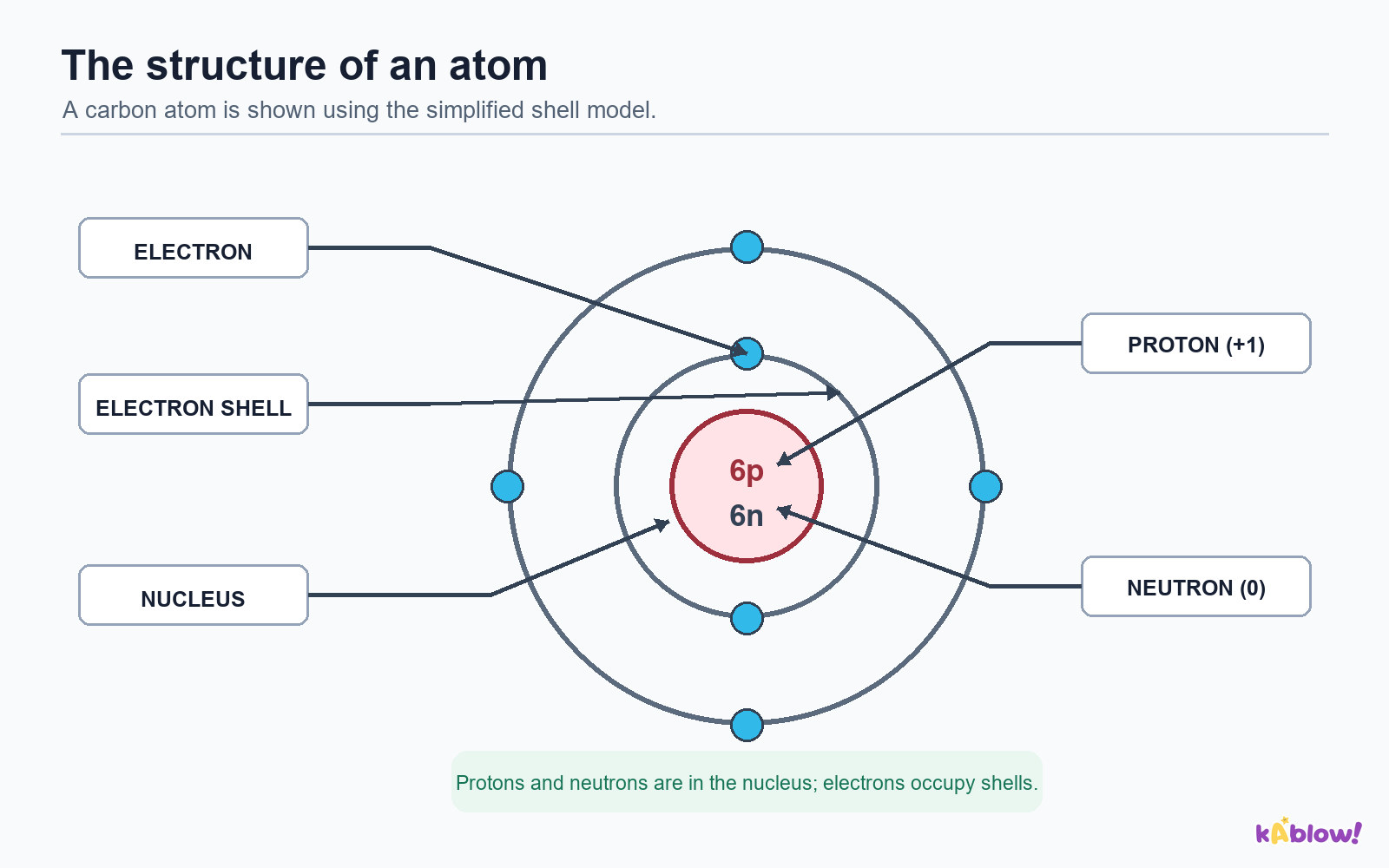
- At the centre of an atom is the nucleus. It is tiny but contains almost all of the atom's mass. The nucleus is made of protons and neutrons.
- Moving around the nucleus are electrons, arranged in layers called shells (or energy levels). Most of an atom is empty space.
- The picture shows a simple model of a carbon atom: six protons and six neutrons in the nucleus, with six electrons in two shells.
A carbon atom: the nucleus and its electron shells
Protons, neutrons and electrons
- Proton: found in the nucleus, relative mass 1, relative charge +1.
- Neutron: found in the nucleus, relative mass 1, relative charge 0 (no charge).
- Electron: found in the shells outside the nucleus, relative mass very small (about 1/2000 of a proton), relative charge -1.
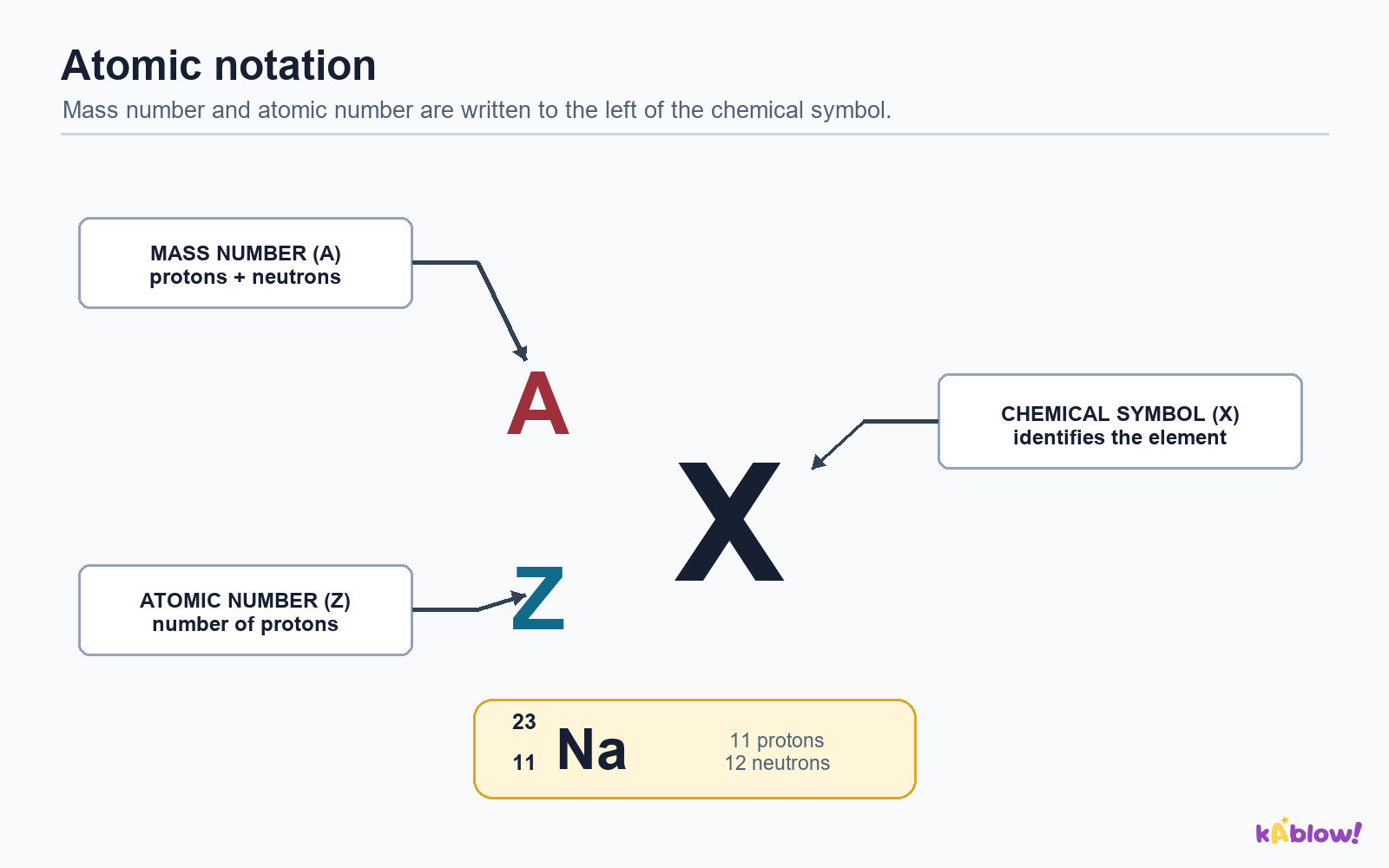
- The atomic number is the number of protons in an atom. Every atom of an element has the same atomic number, and this is what makes it that element. Carbon always has 6 protons, and an atom with 7 protons is always nitrogen.
- The mass number is the number of protons plus the number of neutrons. It is a count of the particles in the nucleus.
- To find the number of neutrons: neutrons = mass number - atomic number. Sodium has mass number 23 and atomic number 11, so it has 23 - 11 = 12 neutrons.
- In the symbol, the mass number is written at the top left and the atomic number at the bottom left of the chemical symbol, as in the picture for sodium.
Atomic notation: mass number, atomic number and symbol
Electron shells and the Periodic Table
- An atom has no overall charge. Its positive protons are balanced by an equal number of negative electrons, so the number of electrons = the number of protons.
- Electrons are arranged in shells, and each shell can hold only a certain number. The first shell holds up to 2 electrons, the second up to 8 and the third up to 8 (for the first 20 elements).
- Electrons fill the shell closest to the nucleus first. Only when it is full does the next shell start to fill.
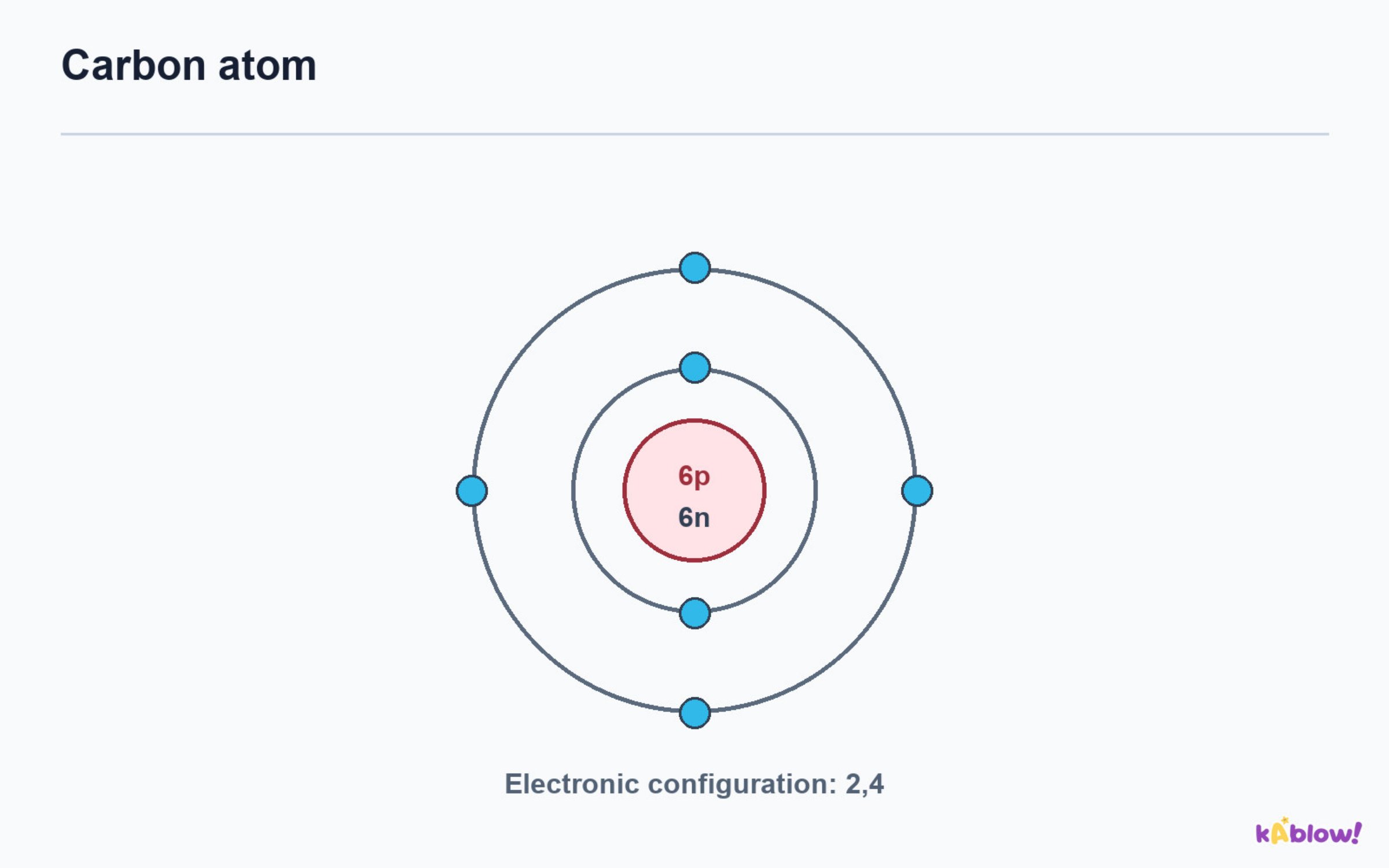
- We write the electron arrangement as numbers. Carbon (6 electrons) is 2,4. Oxygen (8) is 2,6. Sodium (11) is 2,8,1. Chlorine (17) is 2,8,7.
- The outer shell is the one furthest from the nucleus. The electrons in it are the outer electrons, and they decide how an atom reacts.
- The number of occupied shells gives the period (row) and the number of outer electrons gives the group (column, Groups 1 to 7). Chlorine is 2,8,7: three shells and 7 outer electrons, so Period 3, Group 7.
- Elements in the same group have the same number of outer electrons, which is why they react in similar ways. Lithium (2,1), sodium (2,8,1) and potassium (2,8,8,1) each have one outer electron.
- Helium (2), neon (2,8) and argon (2,8,8) have full outer shells. This is why these noble gases are so unreactive.
A carbon atom with the electron arrangement 2,4
Isotopes
- All atoms of one element have the same number of protons, but they do not all have the same number of neutrons.
- Isotopes are atoms of the same element with the same number of protons but a different number of neutrons. They therefore have the same atomic number but different mass numbers.
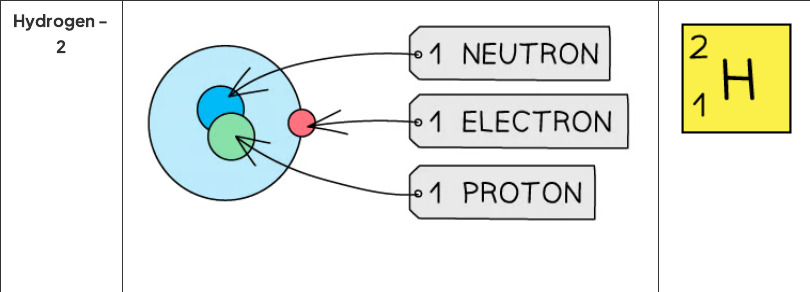
- Hydrogen has three isotopes. Hydrogen-1 has 1 proton and 0 neutrons. Hydrogen-2 (deuterium) has 1 proton and 1 neutron. The picture shows hydrogen-2.
- Carbon-12 has 6 protons and 6 neutrons. Carbon-14 has 6 protons and 8 neutrons. Chlorine-35 has 18 neutrons and chlorine-37 has 20 neutrons.
- Isotopes of an element have the same number of electrons, so they have the same chemical properties. They only differ in mass.
- Many elements are a mixture of isotopes. This is why the mass number shown for chlorine in the Periodic Table is not a whole number: it is an average of its isotopes.
Hydrogen-2: one proton, one neutron and one electron
The history of the atom: models change with evidence
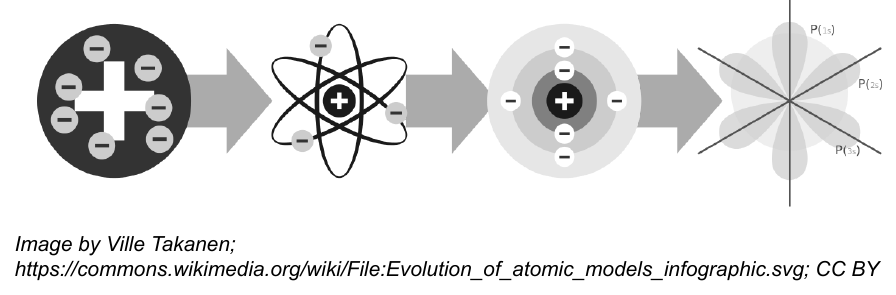
- Around 1803 Dalton pictured atoms as tiny solid spheres that cannot be split.
- In 1897 Thomson discovered the electron. His plum pudding model showed negative electrons scattered through a ball of positive charge.
- In about 1909 to 1911, Rutherford and his team fired positive particles at thin gold foil. Most went straight through, but a few bounced back. This showed that most of an atom is empty space, with a tiny, dense, positive nucleus at the centre.
- In 1913 Bohr suggested that electrons orbit the nucleus in fixed shells. This is the model used in this lesson.
- In 1932 Chadwick discovered the neutron, which explained why atoms are heavier than their protons alone.
- A model is not wrong forever or right forever. Scientists keep a model until new evidence does not fit it, and then they improve it. Today's electron-cloud model is more detailed still.
How the model of the atom has changed over time
Think like a scientist: modelling the unseen
- The question: how can we find out the shape of something we cannot see? Rutherford could not see inside atoms, so he used indirect evidence.
- A safe classroom model: hide a shape under a board, roll marbles at the board from the same place, and record where each marble ends up. Different hidden shapes make the marbles bounce in different ways.
- The independent variable is the hidden shape or its size. The dependent variable is what you record, such as how many marbles bounce back or the angle they leave at.
- Control variables: the same marble, the same rolling speed and distance, the same start point and the same number of rolls each time.
- Evaluate: the model shows how scientists can work out structure from patterns of results, but it is not an atom. Repeating the test and using more marbles makes the pattern clearer and the result more reliable.
- Your task: plan an investigation to work out the size of a hidden object under a board. Say what you will change, measure and keep the same, draw a results table, and explain how your evidence supports your conclusion.
投影片
練習題
免費預覽——50 題中的 8 題。註冊即可查看全部。
1.Which particle in an atom has a positive charge?
Easy- AProton
- BNeutron
- CElectron
- DShell
2.Which particle in an atom has no charge?
Easy- AProton
- BNeutron
- CElectron
- DIon
3.Electrons are found inside the nucleus of an atom.
EasyTrue or false?
4.Where is almost all of the mass of an atom found?
Easy- AIn the outer shell
- BSpread evenly through the atom
- CIn the nucleus
- DIn the electrons
5.What does the atomic number of an atom tell you?
Easy- AThe number of neutrons
- BThe number of shells
- CThe mass of the atom in grams
- DThe number of protons
6.How is the mass number of an atom worked out?
Easy- AProtons plus neutrons
- BProtons plus electrons
- CNeutrons plus electrons
- DProtons minus neutrons
7.A neutral atom has the same number of protons and electrons.
EasyTrue or false?
8.Match each particle to its relative charge.
Easy- Proton
- Neutron
- Electron
- Whole atom
- 0
- +1
- 0 (neutral overall)
歷屆試題
這個主題的歷屆試題練習即將推出。
即將推出