The electromagnetic spectrum and risk
邊玩邊學
回答這些題目賺取能量,接著就能釣魚、探索。不需要帳號。
給教育者: 為 The electromagnetic spectrum and risk(MYP Physics、Year 4)準備好可直接使用的課程投影片, 複習筆記——用於你的課程,或把這個主題當成互動班級活動,讓學習者以即時遊戲的方式進行。
課程筆記
Big idea: the electromagnetic spectrum and risk
- Key concept: Relationships. All electromagnetic waves travel at the same speed in a vacuum. Higher frequency means shorter wavelength and greater photon energy.
- Related concepts: Models and evidence. Use a scientific explanation to make predictions, then test it against observations.
- Global context: Scientific and technical innovation. Different spectrum regions support communication, imaging and treatment.
Electromagnetic Waves
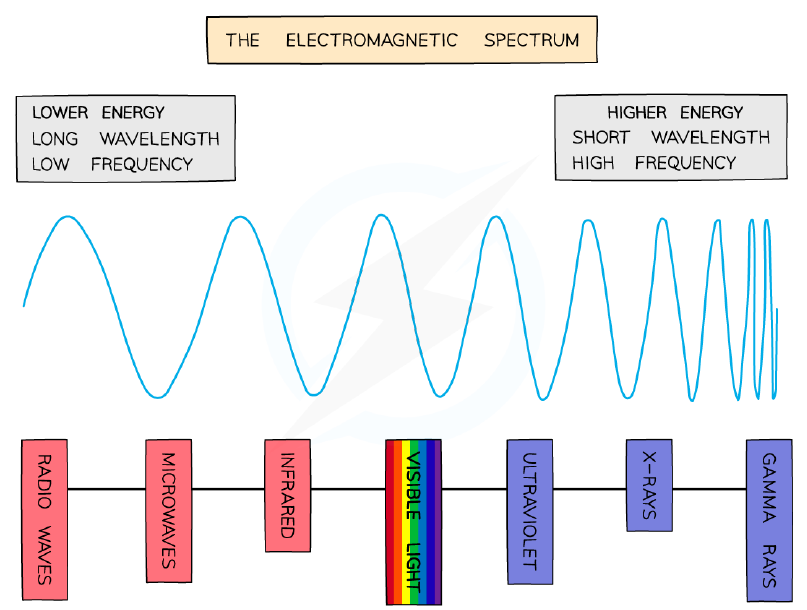
- The electromagnetic spectrum is a continuous range of waves arranged by wavelength or frequency.
- Longer wavelength → lower frequency; shorter wavelength → higher frequency.
- Order from longest to shortest wavelength: radio waves, microwaves, infrared, visible light (ROYGBIV), ultraviolet, X-rays, gamma rays.
- All EM waves are transverse waves that transfer energy.
- All EM waves travel at the same speed in a vacuum: 3.0 × 10⁸ m/s (also approximately the speed in air).
- Visible light is only a small part of the EM spectrum.
The electromagnetic spectrum, showing the seven regions in order of decreasing wavelength (increasing frequency), from radio waves to gamma rays.
Uses of Electromagnetic Waves
- Radio waves: radio/TV transmissions, astronomy, RFID.
- Microwaves: satellite TV, mobile phones, microwave ovens, WiFi.
- Infrared: remote controls, thermal imaging, optical fibres, intruder alarms.
- Visible light: vision, photography, illumination.
- Ultraviolet: security marking, detecting fake bank notes, sterilising water, fluorescence.
- X-rays: medical scanning, security scanners (absorbed by bone, pass through tissue).
- Gamma rays: sterilising food/equipment, cancer detection and treatment.
Dangers of Electromagnetic Waves
- Higher frequency EM waves carry more energy and can ionise atoms (UV, X-rays, gamma rays).
- Microwaves: internal heating of body cells (water absorption).
- Infrared: skin burns.
- Ultraviolet: skin cancer, eye damage; protection via sunscreen and sunglasses.
- X-rays and gamma rays: cell mutation, DNA damage, cancer; radiographers use lead screens.
- Radiation risk depends on radiation type, absorbed dose, exposure and the tissue affected. Greater electromagnetic frequency increases photon energy but does not by itself determine risk.
Communications
- Microwaves are used for satellite communication (mobile phones, satellite TV) because they are not absorbed/reflected by the atmosphere.
- Radio waves diffract around hills (similar wavelength to obstacles), used for local radio and Bluetooth.
- Optical fibres use visible light or infrared for high-speed broadband; high frequency allows high data rates.
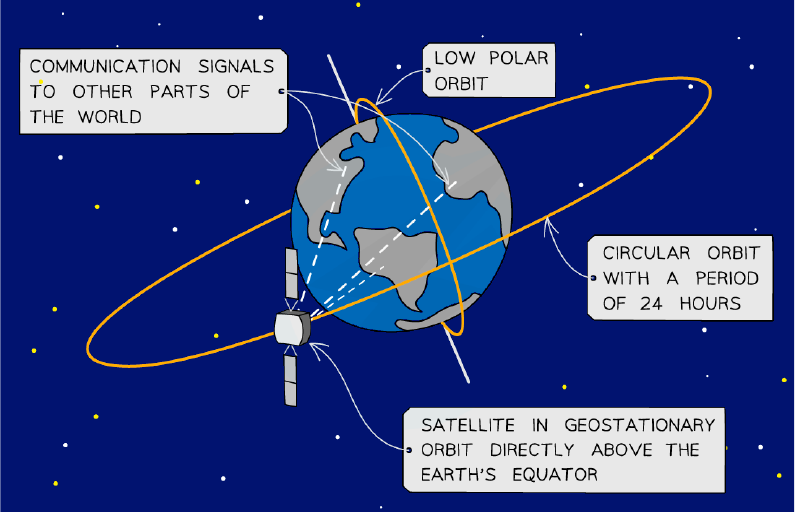
- Geostationary satellites: orbit at 36 000 km, period 24 h, used for broadcasting; longer time delay.
- Low‑orbit/polar satellites: orbit at ~200 km, shorter delay, used for weather and imaging.
A satellite in geostationary orbit above the Earth's equator, showing communication signals to other parts of the world.
Digital & Analogue Signals
- Analogue signals vary continuously and can take any value.
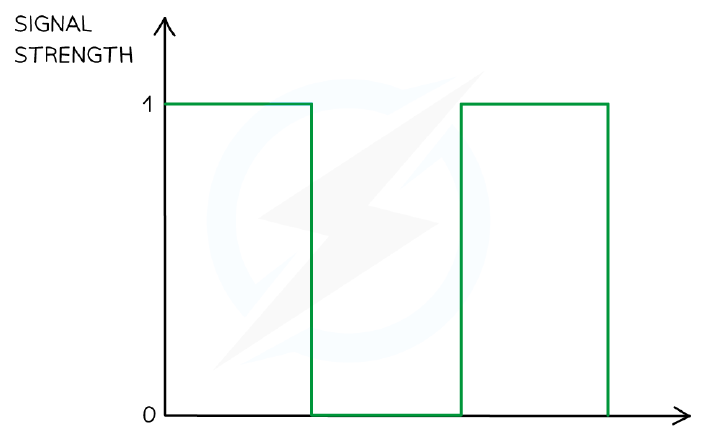
- Digital signals have only two states (0/1, high/low).
- Digital signals can be regenerated with minimal noise, giving larger range and higher data rate.
- Extra data can be added to digital signals for error checking.
- Digital sampling converts an analogue signal to digital by recording at set time intervals.
A digital signal, which can only take one of two states (0 or 1).
Think like a scientist
- Analyse teacher-provided frequency and wavelength values for electromagnetic waves in a vacuum.
- Comparison: the frequency of the radiation. Outcome: the corresponding wavelength.
- Control: compare propagation in a vacuum. Explain why this makes the comparison fairer.
- Evidence: Use a consistent method, repeated observations where appropriate and a table with labelled quantities and units. Keep unexpected results and investigate their cause.
- Safety: Practical activities need teacher supervision and an appropriate risk assessment. Use the provided data or simulation where the investigation specifies it.
- Inquiry task: State a testable question, predict the outcome using the science, then explain how your observations would support or challenge the prediction.
Evaluate the science
- Different spectrum regions support communication, imaging and treatment.
- Risk depends on type, dose and exposure; non-ionising radiation can still cause harm through heating or other interactions.
- Evaluation task: Link your conclusion to evidence, identify a limitation and suggest a specific improvement. Distinguish a measured result from an explanation of its cause.
投影片
練習題
免費預覽——51 題中的 8 題。註冊即可查看全部。
1.Which of the following lists the electromagnetic spectrum in order of decreasing wavelength?
Easy- ARadio waves, microwaves, infrared, visible, ultraviolet, X-rays, gamma rays
- BGamma rays, X-rays, ultraviolet, visible, infrared, microwaves, radio waves
- CRadio waves, infrared, microwaves, visible, ultraviolet, gamma rays, X-rays
- DVisible, infrared, radio waves, microwaves, ultraviolet, X-rays, gamma rays
2.All electromagnetic waves travel at the same speed in a vacuum. What is this speed?
Easy- A3.0 × 108 m/s
- B3.0 × 106 m/s
- C3.0 × 1010 m/s
- D3.0 × 103 m/s
3.Which type of electromagnetic radiation is used for television remote controls?
Easy- AInfrared
- BRadio waves
- CUltraviolet
- DMicrowaves
4.Which of the following is a harmful effect of excessive exposure to ultraviolet radiation?
Easy- ASkin cancer
- BInternal heating of body cells
- CSkin burns
- DMutation of DNA
5.Which type of electromagnetic radiation has a wavelength of about 1 km?
Easy- ARadio waves
- BMicrowaves
- CInfrared
- DVisible light
6.A geostationary satellite orbits at a height of 36 000 km above the Earth's surface. What is its orbital period?
Easy- A24 hours
- B12 hours
- C48 hours
- D72 hours
7.Which property increases as you move from radio waves to gamma rays in the electromagnetic spectrum?
Easy- AFrequency
- BWavelength
- CSpeed in a vacuum
- DAmplitude
8.Which type of signal can only take one of two discrete values?
Easy- ADigital signal
- BAnalogue signal
- CRadio signal
- DMicrowave signal
歷屆試題
這個主題的歷屆試題練習即將推出。
即將推出