Energy resources and evidence-based choices
邊玩邊學
回答這些題目賺取能量,接著就能釣魚、探索。不需要帳號。
給教育者: 為 Energy resources and evidence-based choices(MYP Physics、Year 5)準備好可直接使用的課程投影片, 複習筆記——用於你的課程,或把這個主題當成互動班級活動,讓學習者以即時遊戲的方式進行。
課程筆記
Big idea: energy resources and evidence-based choices
- Key concept: Systems. Resources differ in availability, power output, reliability and environmental effects. Renewable means replenished on a human timescale, not impact-free.
- Related concepts: Models and evidence. Use a scientific explanation to make predictions, then test it against observations.
- Global context: Scientific and technical innovation. Energy planning combines supply requirements with environmental and economic evidence.
Energy from the Sun
- The Sun transfers energy to Earth by electromagnetic radiation (mostly visible light and infrared).
- Most energy resources on Earth come indirectly from the Sun: wind, waves, rain (hydroelectric), and plant growth (biofuels and fossil fuels).
- Resources not from the Sun: geothermal (Earth's core heat), nuclear (elements in Earth's crust), tidal (mainly Moon's gravity).
- Solar cells (photovoltaic) convert sunlight directly into electricity using semiconducting materials.
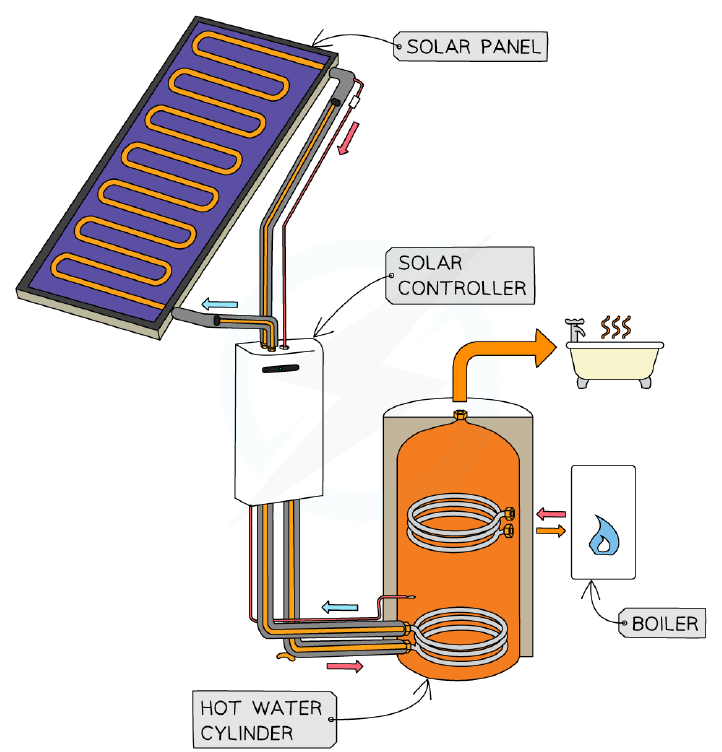
- Solar panels use sunlight to heat water for domestic use; solar furnaces focus sunlight to boil water for steam turbines.
- Advantages of solar: renewable, no pollution, reliable in sunny regions, can be used in remote areas, low running costs.
- Disadvantages: low energy density (large area needed), intermittent, expensive to install, low efficiency (20–40%).
Solar panels use energy from sunlight to heat water
Wind Energy
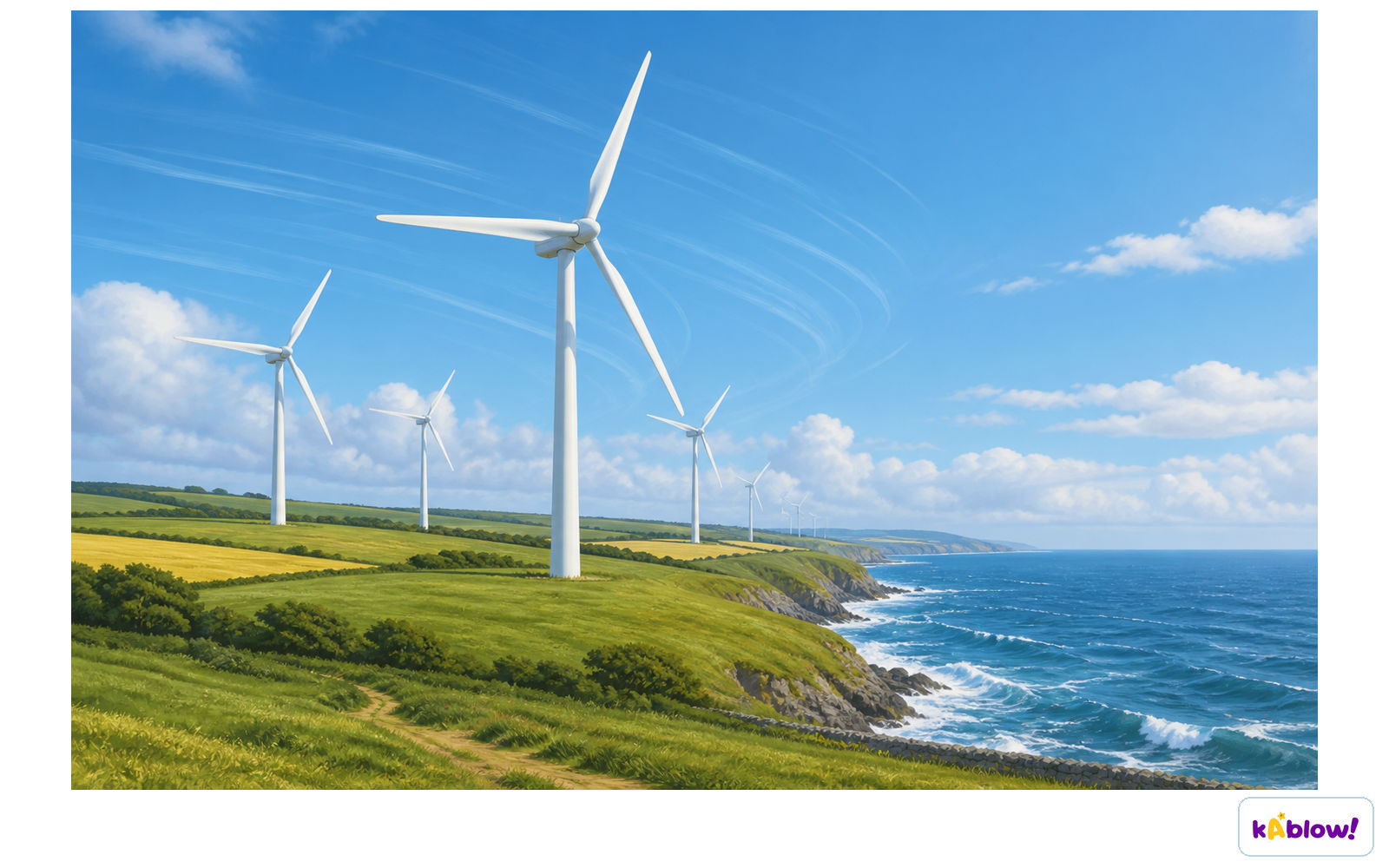
- Wind turns turbines → generator → electricity; energy transfers: kinetic (wind) → kinetic (turbine) → kinetic (generator) → electrical.
- Advantages: renewable, no pollution, relatively cheap, high efficiency (~50%), land can still be used for farming.
- Disadvantages: unreliable (wind not constant), visual pollution, each turbine produces little power, needs high-voltage lines.
Wind turbines use energy from the wind to generate electricity
Energy from Fuels: Fossil Fuels
- Fossil fuels: coal, natural gas (methane), crude oil (refined into petrol, diesel). Formed from remains of plants/animals; chemical energy originally from sunlight via photosynthesis.
- Advantages: reliable, responsive (can be turned on/off), well-established infrastructure, safe to store.
- Disadvantages: non-renewable (millions of years to form, predicted to run out in ~200 years), burning releases CO₂ (greenhouse gas) and SO₂ (acid rain), extraction damages environment, expensive to build/decommission.
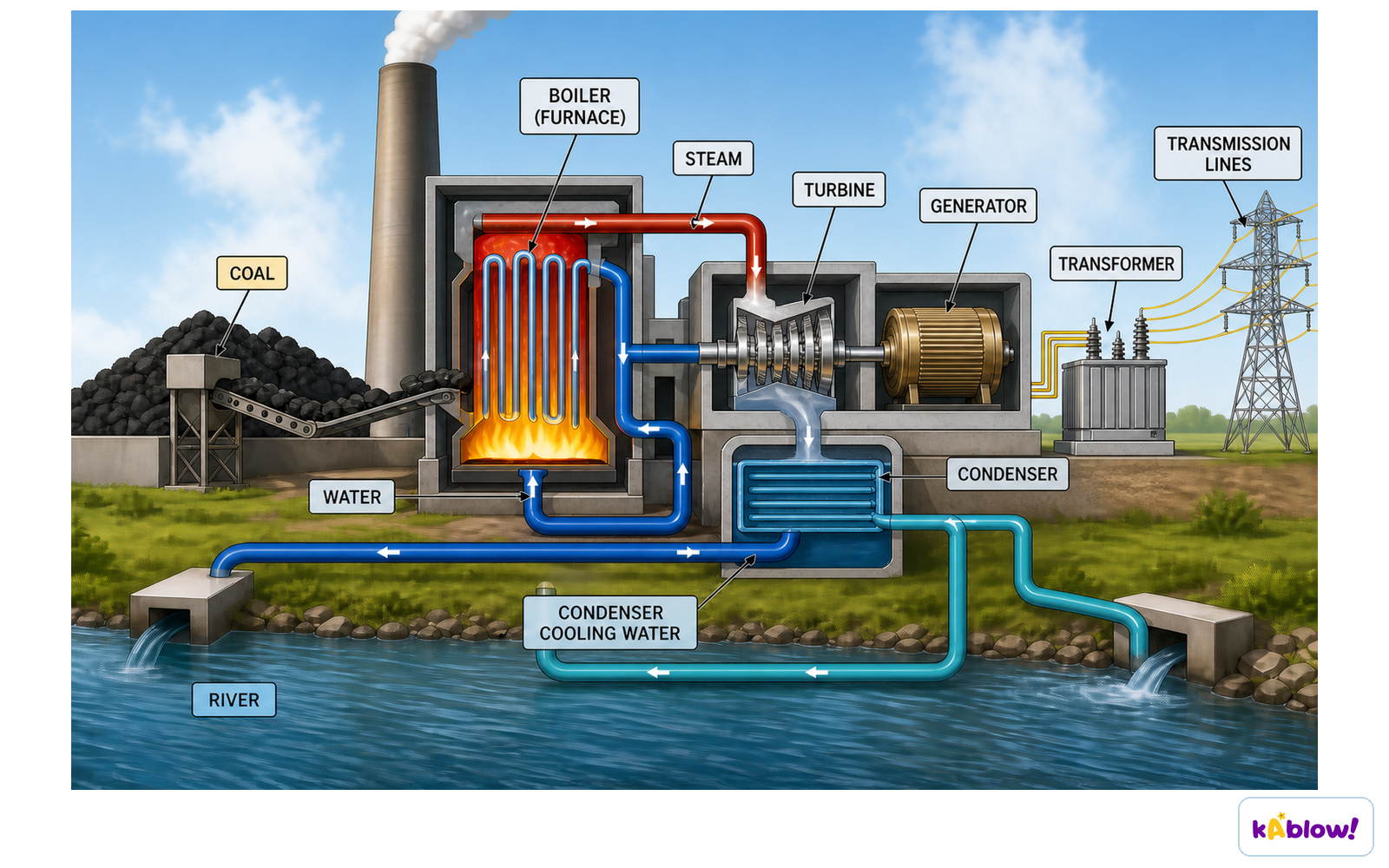
- Uses: transport, electricity generation (burned to heat water → steam → turbine → generator), heating.
Electricity generation in a coal-fired power station
Energy from Fuels: Biofuels
- Biofuels (ethanol, methane) made from plant matter; energy from sunlight stored chemically.
- Advantages: renewable, considered carbon neutral (plants absorb CO₂ during growth), no SO₂ produced.
- Disadvantages: requires land and resources for crops, only half the energy density of fossil fuels, controversial carbon neutrality (land could have been used for food).
Energy from Fuels: Nuclear Fuel
- Nuclear fission splits large nuclei (e.g., uranium) into smaller ones, releasing energy; used to heat water → steam → turbine → generator.
- Advantages: no atmospheric pollution, reliable, responsive, massive power output (twice that of fossil fuel plant), high energy density.
- Disadvantages: non-renewable (finite uranium), produces radioactive waste (stored for thousands of years), expensive to build and decommission, risk of accidents.
Energy from Water
- Wave power: underwater turbines turned by wave motion; tidal power: tidal barrages store water at height, released through turbines.
- Advantages: renewable, no pollution, no fuel costs, tidal is reliable and predictable, high efficiency (~80%), responsive.
- Disadvantages: few suitable locations (estuaries), interferes with shipping and habitats, technology not yet large-scale, wave power unreliable.
- Hydroelectric dams: water stored in reservoir has gravitational potential energy; flowing water turns turbines.
- Advantages: reliable, responsive, cheap to run, large electricity output, renewable.
- Disadvantages: flooding valleys destroys habitats and settlements, expensive to build, drought can affect supply.
Geothermal Energy
- Heat from Earth's core heats rocks; water injected into shafts is heated and returned as steam/hot water to generate electricity or heat homes.
- Advantages: renewable, reliable (rocks hot for thousands of years).
- Disadvantages: few suitable locations (tectonic activity), can release methane (greenhouse gas), expensive to build, small scale, low efficiency (~12%).
Nuclear Fusion
- Nuclear fusion fuses hydrogen nuclei into helium, releasing massive energy (powers the Sun).
- Requires extremely high temperatures and pressures; currently research aims to sustain fusion at lower temperatures.
- Potential: virtually limitless, carbon-free electricity; but currently reactions require nearly as much energy as they release.
Think like a scientist
- Compare published generation datasets for different energy resources using the same reporting period and system boundaries.
- Comparison: the energy resource being assessed. Outcome: energy output and lifecycle impacts.
- Control: use consistent units and comparison boundaries. Explain why this makes the comparison fairer.
- Evidence: Use a consistent method, repeated observations where appropriate and a table with labelled quantities and units. Keep unexpected results and investigate their cause.
- Safety: Practical activities need teacher supervision and an appropriate risk assessment. Use the provided data or simulation where the investigation specifies it.
- Inquiry task: State a testable question, predict the outcome using the science, then explain how your observations would support or challenge the prediction.
Evaluate the science
- Energy planning combines supply requirements with environmental and economic evidence.
- A single metric cannot decide every energy choice; reliability, storage, land use, cost and lifecycle emissions also matter.
- Evaluation task: Link your conclusion to evidence, identify a limitation and suggest a specific improvement. Distinguish a measured result from an explanation of its cause.
投影片
練習題
免費預覽——52 題中的 8 題。註冊即可查看全部。
1.Which energy resource does not use the Sun as the source of its energy?
Easy- AHydroelectric
- BWind
- CNuclear
- DCoal
2.Which energy resource involves splitting heavy nuclei?
Easy- ANuclear fission
- BGeothermal
- CBiomass
- DNuclear fusion
3.Which energy resource does not release greenhouse gases?
Easy- AOil
- BHydro-electric power
- CBiofuel
- DCoal
4.Which disadvantage does not apply to geothermal energy?
Medium- AExpensive to build
- BFew suitable locations
- CCan result in the release of greenhouse gases
- DNot reliable
5.Which energy source relies on radiation from the Sun?
Easy- AFossil fuels
- BNuclear fission
- CTidal power
- DGeothermal energy
6.Which source of energy is renewable?
Easy- Acoal
- Bnatural gas
- Coil
- Dwind
7.Which energy resource does not originate from the Sun's radiation?
Easy- Atidal power
- Bwind power
- Cwave power
- Dhydroelectric power
8.Listed below are some energy resources. W wind powering a turbine X water falling through a hydroelectric turbine Y alcohol made from crops which have been grown for burning in a biomass generator Z uranium for nuclear fission reactors Which of the resources are renewable?
Medium- AW, X and Z
- BW and X
- CW, X and Y
- DW, X, Y and Z
歷屆試題
這個主題的歷屆試題練習即將推出。
即將推出