Gravity, orbits and the Solar System
邊玩邊學
回答這些題目賺取能量,接著就能釣魚、探索。不需要帳號。
給教育者: 為 Gravity, orbits and the Solar System(MYP Physics、Year 5)準備好可直接使用的課程投影片, 複習筆記——用於你的課程,或把這個主題當成互動班級活動,讓學習者以即時遊戲的方式進行。
課程筆記
Big idea: gravity, orbits and the solar system
- Key concept: Systems. Gravity supplies the inward force that changes an orbiting object's velocity direction. A circular orbit can have constant speed while the object accelerates.
- Related concepts: Models and evidence. Use a scientific explanation to make predictions, then test it against observations.
- Global context: Scientific and technical innovation. Orbital models help predict satellite and planetary motion.
The Earth, Moon & Sun
- Earth rotates on its axis once every 24 hours, causing day and night.
- Earth orbits the Sun once every 365 days (one year).
- Earth's axis is tilted at 23.5° from the vertical, causing the seasons.
- The Moon is a natural satellite orbiting Earth approximately every 27.3 days relative to distant stars; it rotates once per orbit so the same side always faces Earth.
- Moon phases result from reflected sunlight; order: new moon → first quarter → full moon → last quarter.
- Day and night are caused by Earth's rotation; seasons are caused by the combination of Earth's orbit and axial tilt.
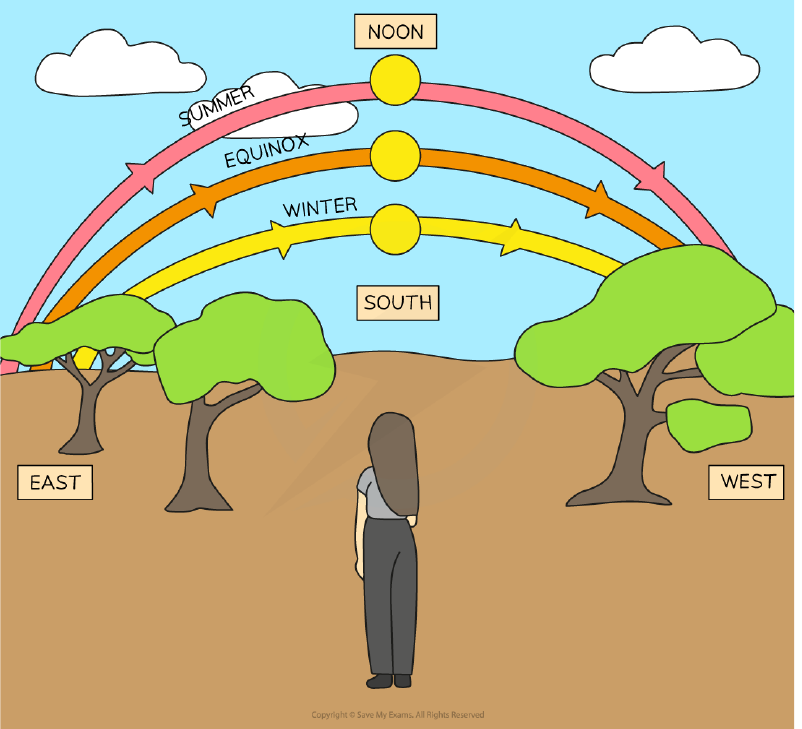
The apparent path of the Sun across the sky at noon during different seasons
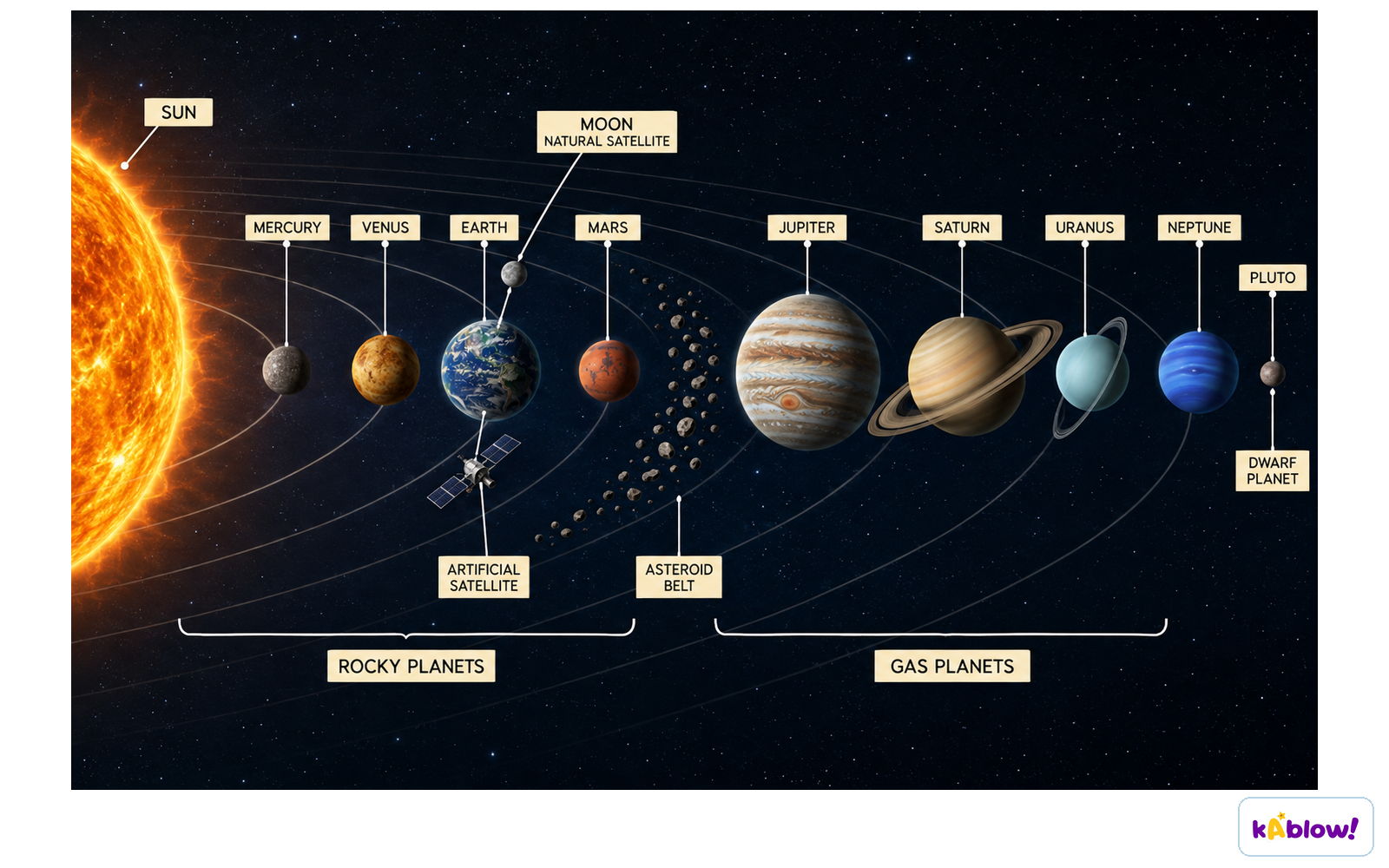
The Solar System
- The Solar System consists of the Sun, eight planets, dwarf planets, moons, asteroids, and comets.
- Planets in order from Sun: Mercury, Venus, Earth, Mars, Jupiter, Saturn, Uranus, Neptune.
- Inner planets (Mercury, Venus, Earth, Mars) are rocky and small; outer planets (Jupiter, Saturn, Uranus, Neptune) are gaseous and large.
- Asteroids are rocky objects found mainly in the Asteroid Belt between Mars and Jupiter.
- Comets are icy objects with highly elliptical orbits; they develop a tail when near the Sun.
- Dwarf planets (e.g., Pluto) have weaker gravity and cannot clear their orbits of debris.
The Solar System
Formation of the Solar System
- The Solar System formed about 4.5 billion years ago from a nebula (cloud of dust and gas).
- Gravity pulled the nebula together; the Sun formed at the centre, and an accretion disc of leftover matter formed around it.
- In the hot inner region, only metals and rocky materials could solidify → inner rocky planets.
- In the cool outer region, light gases (H, He) condensed → outer gas giants.
- Accretion is the process where particles stick together under gravity to form larger objects.
Light Speed Calculations
- Light travels at 3 × 10⁸ m/s in a vacuum.
- Time for light to travel a distance: time = distance / speed of light.
- Light from Sun takes 8 minutes to reach Earth, ~3 minutes to Mercury, ~5 hours to outer Solar System.
- Light from the nearest star (Proxima Centauri) takes 4 years to reach Earth.
Gravitational Field Strength
- Gravitational field strength at a planet's surface depends on its mass and radius.
- Greater mass → stronger gravitational field; greater distance from planet → weaker field.
- The Sun contains >99% of the Solar System's mass, so its gravity keeps planets in orbit.
- As distance from Sun increases, orbital speed decreases and orbital period increases.
Orbital Speed Equation
- For a circular orbit, orbital speed v = 2πr / T, where r is orbital radius and T is orbital period.
- Orbital radius is measured from the centre of the orbited body.
- Ensure units: convert km to m, minutes to seconds as needed.
- Example: Earth's orbital speed ≈ 30 km/s (from data table).
Elliptical Orbits
- Planets have slightly elliptical orbits; comets have highly elliptical orbits.
- The Sun is at one focus of the ellipse (not the centre).
- As a comet approaches the Sun, its speed increases (KE increases, GPE decreases).
- As it moves away, its speed decreases (GPE increases, KE decreases); energy is conserved.
Think like a scientist
- Analyse planetary data to compare orbital periods at different average distances from the Sun; never look directly at the Sun.
- Comparison: the planet's average orbital distance. Outcome: the orbital period.
- Control: compare planets orbiting the same central star. Explain why this makes the comparison fairer.
- Evidence: Use a consistent method, repeated observations where appropriate and a table with labelled quantities and units. Keep unexpected results and investigate their cause.
- Safety: Practical activities need teacher supervision and an appropriate risk assessment. Use the provided data or simulation where the investigation specifies it.
- Inquiry task: State a testable question, predict the outcome using the science, then explain how your observations would support or challenge the prediction.
Evaluate the science
- Orbital models help predict satellite and planetary motion.
- Real orbits are often elliptical, so a circular-orbit approximation has limits.
- Evaluation task: Link your conclusion to evidence, identify a limitation and suggest a specific improvement. Distinguish a measured result from an explanation of its cause.
投影片
練習題
免費預覽——52 題中的 8 題。註冊即可查看全部。
1.Which of the planets listed is the gaseous planet which is closest to the Sun?
Easy- AJupiter
- BMars
- CSaturn
- DUranus
2.Which of the following objects are described as orbiting the Sun? 1. Asteroids 2. Comets 3. Galaxies 4. Moons
Easy- A1 and 2 only
- B1, 2 and 3
- C1, 2, and 4
- D1, 2, 3 and 4
3.What creates the periodic nature of the seasons?
Medium- AThe tilting of the Earth's axis
- BThe orbiting of the Earth around the Sun
- CThe combination of the orbiting of the Earth around the Sun and the Earth's tilting axis
- DThe change in temperature of the Sun
4.Which of the following statements about the strength of a gravitational field is correct?
Medium- AAt the surface of a planet it depends on the diameter of the planet
- BAround a planet it decreases as the distance from the planet increases
- CAround a planet it increases as the distance from the planet increases
- DAt the surface of a planet it depends on the mass of the planet
5.Which type of object orbits the Sun?
Easy- Aan interstellar cloud of gas and dust
- Ba comet
- Ca galaxy
- Danother star
- 6.Medium
Which line in the table best describes the angle of the Earth’s axis from the vertical, and the effect of this tilt?
Angle of tilt Effect of tilt A 23.4° Rising and setting of the Sun B 23.4° Changing of the seasons C 66.6° Rising and setting of the Sun D 66.6° Changing of the seasons - AA
- BB
- CC
- DD
- 7.Easy
Which line in the table correctly identifies the length of one year, one day and daylight hours during an equinox, all as experienced on Earth?
One Earth year / days One Earth day / hours Daylight hours during an equinox / hours A 356 8 8 B 364 12 12 C 365 12 8 D 365 24 12 - AA
- BB
- CC
- DD
8.Extended tier only Which of the following statements about orbits is true?
Medium- AAll planets, minor planets and comets have elliptical orbits
- BThe Sun is at the centre of an elliptical orbit
- COnly comets and minor planets have elliptical orbits
- DAn object in an elliptical orbit has a constant orbital radius
歷屆試題
這個主題的歷屆試題練習即將推出。
即將推出