Mass, weight, density and model limits
邊玩邊學
回答這些題目賺取能量,接著就能釣魚、探索。不需要帳號。
給教育者: 為 Mass, weight, density and model limits(MYP Physics、Year 5)準備好可直接使用的課程投影片, 複習筆記——用於你的課程,或把這個主題當成互動班級活動,讓學習者以即時遊戲的方式進行。
課程筆記
Big idea: mass, weight, density and model limits
- Key concept: Relationships. Density equals mass divided by volume. Weight equals mass times gravitational field strength; mass is not changed by moving to a different gravitational field.
- Related concepts: Models and evidence. Use a scientific explanation to make predictions, then test it against observations.
- Global context: Scientific and technical innovation. Density measurements support material identification and design choices.
Mass & Weight
- Mass is a measure of the quantity of matter in an object; it is a scalar quantity measured in kg (or g).
- Weight is the gravitational force on an object with mass; it is a vector quantity measured in N.
- Mass is constant everywhere; weight depends on gravitational field strength.
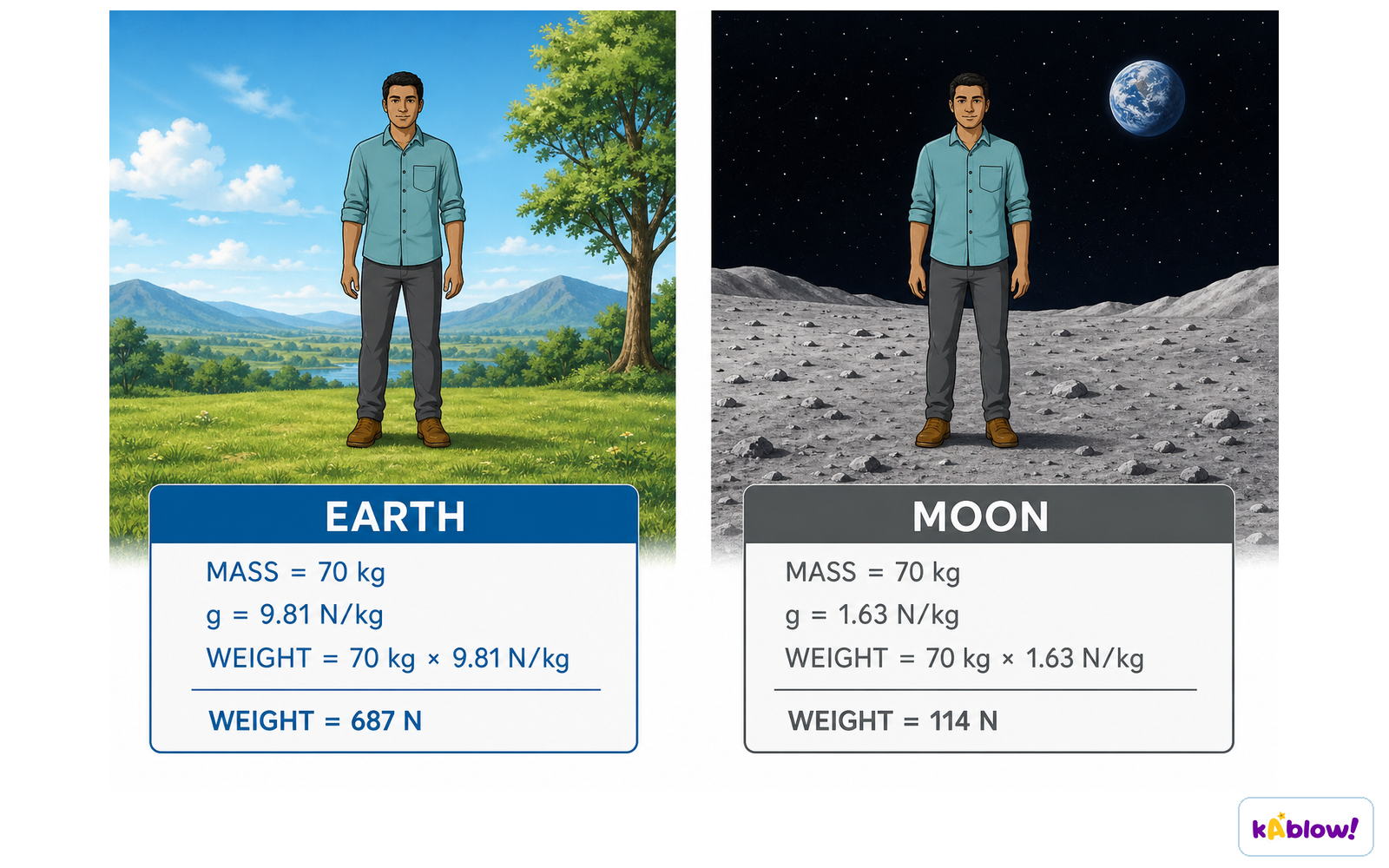
- Equation: W = m × g, where g = gravitational field strength (N/kg).
- On Earth, g ≈ 9.8 N/kg; on the Moon, g ≈ 1.6 N/kg.
- A balance measures mass (kg); a force meter (newton meter) measures weight (N).
Comparing a person's mass and weight on Earth and on the Moon; mass stays the same but weight is much lower on the Moon.
Density
- Density is the mass per unit volume of a material: ρ = m / V.
- Units: kg/m³ or g/cm³ (1 g/cm³ = 1000 kg/m³).
- Low-density materials have low mass for a given volume; high-density materials have high mass.
- Gases are less dense than solids/liquids because particles are more spread out.
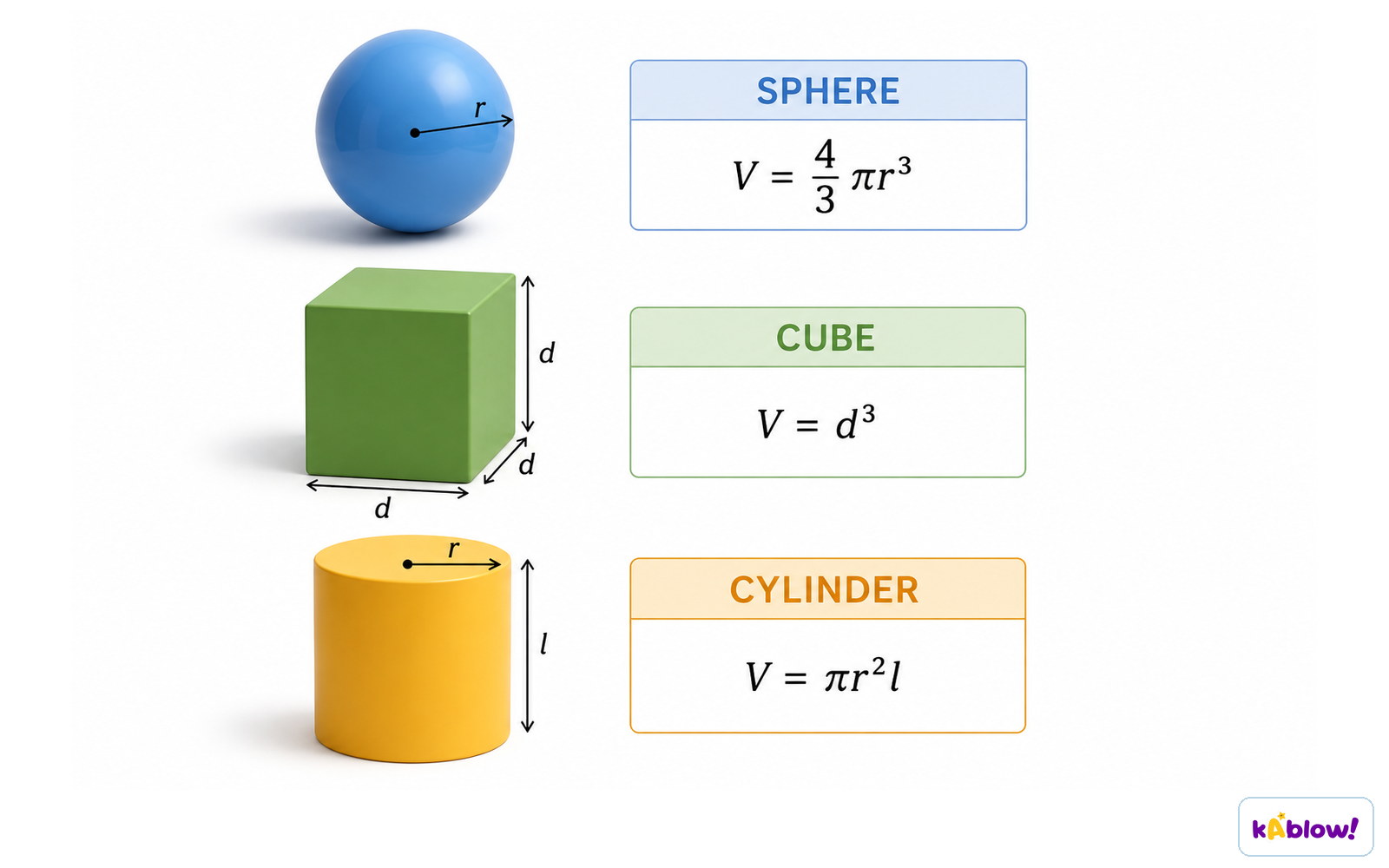
- Volume of regular shapes: cube (side³), sphere (4/3πr³), cylinder (πr²h).
Volume formulas for a sphere, a cube and a cylinder, used to find volume before calculating density.
Measuring Density of Regular Solids
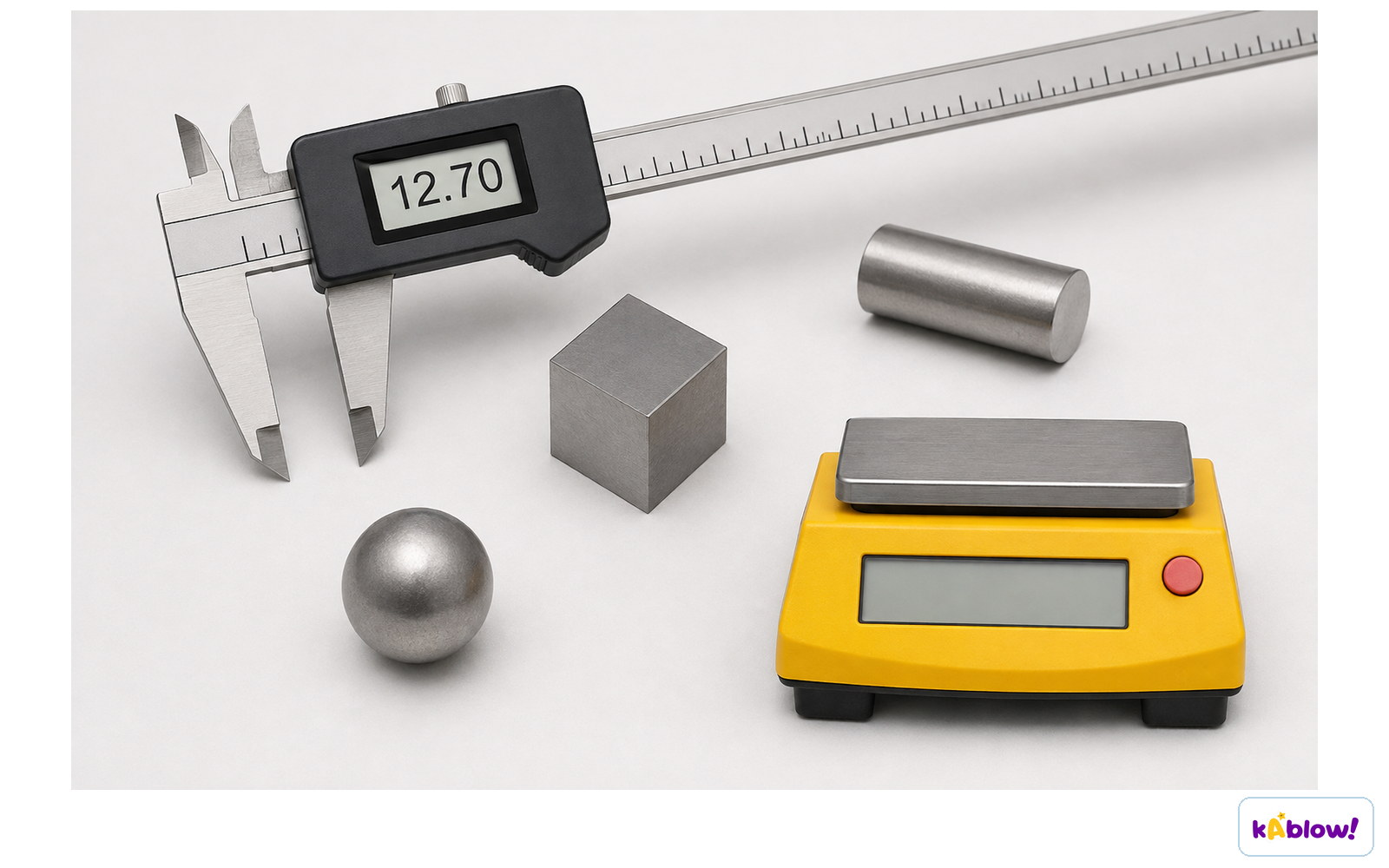
- Use a digital balance to measure mass.
- Measure dimensions with a ruler, Vernier calipers, or micrometer.
- Calculate volume from dimensions, then density = mass / volume.
- Repeat measurements and take averages to reduce random errors.
Equipment for measuring density of regular solids
Measuring Density of Irregular Solids
- Use a eureka can (displacement can) and measuring cylinder.
- Fill the can above the spout, then wait until excess water stops dripping before placing the empty measuring cylinder under the spout.
- Lower object gently; collect displaced water; volume = volume of object.
- Alternatively, submerge object in measuring cylinder with water; rise in level = volume.
- Density = mass / displaced volume.
Measuring Density of Liquids
- Place empty measuring cylinder on digital balance; record mass.
- Add known volume of liquid; record new mass.
- Mass of liquid = (mass of cylinder + liquid) – (mass of empty cylinder).
- Density = mass of liquid / volume.
Floating & Sinking
- An object floats if its density is less than the fluid's density; sinks if greater.
- Upthrust is an upward force on a submerged object, opposite to weight.
- Object floats when upthrust = weight; sinks when upthrust < weight.
- Upthrust depends on fluid density and volume of fluid displaced.
- Example: polystyrene (0.05 g/cm³) floats on water (1.0 g/cm³); iron (7.9 g/cm³) sinks.
Floating Liquids
- A less dense liquid floats on a denser liquid if they do not mix.
- For an object to sink in a liquid, object density must be greater than liquid density.
- Example: potassium (0.862 g/cm³) sinks in liquid paraffin (0.825 g/cm³) but floats in denser oils.
Think like a scientist
- Compare density estimates for safe irregular solid objects using mass measurements and displaced water volume.
- Comparison: the solid material tested. Outcome: density in kilograms per cubic metre.
- Control: use the same displacement method and temperature. Explain why this makes the comparison fairer.
- Evidence: Use a consistent method, repeated observations where appropriate and a table with labelled quantities and units. Keep unexpected results and investigate their cause.
- Safety: Practical activities need teacher supervision and an appropriate risk assessment. Use the provided data or simulation where the investigation specifies it.
- Inquiry task: State a testable question, predict the outcome using the science, then explain how your observations would support or challenge the prediction.
Evaluate the science
- Density measurements support material identification and design choices.
- Trapped air, water absorption and reading uncertainty can affect displacement measurements and the inferred density.
- Evaluation task: Link your conclusion to evidence, identify a limitation and suggest a specific improvement. Distinguish a measured result from an explanation of its cause.
投影片
練習題
免費預覽——52 題中的 8 題。註冊即可查看全部。
1.Which of the following quantities is weight an example of?
Easy- AForce
- BMass
- CAcceleration
- DField strength
2.Which of the following statements about mass or weight is true?
Easy- AWeight is measured in Newtons
- BWeight is measured in kilograms
- CMass = weight × gravitational field strength
- DMass is a force
3.How is the weight of an object defined?
Easy- AThe gravitational force acting on an object with mass
- BThe force of the ground pushing on an object
- CA measure of the quantity of matter of an object at rest to the observer
- DThe mass per unit volume of an object
4.Which row in the table gives the correct units for mass and for weight?
Easy- AMass kg, Weight kg
- BMass N, Weight kg
- CMass N, Weight N
- DMass kg, Weight N
5.Which of the following quantities is measured in kilograms?
Easy- Amass
- Bweight
- Cpressure
- Ddensity
6.Which statement about the mass and the weight of an object is correct?
Easy- AThey have different units.
- BThey are both affected by changes in the acceleration of free fall.
- CThey are both forces.
- DWeight is calculated by dividing mass by the acceleration of free fall.
7.The gravitational field strength on the Moon is 1.6 N/kg. An astronaut has a mass of 75 kg. What is the weight of the astronaut on the Moon?
Easy- A120 N
- B47 N
- C75 N
- D740 N
8.Which unit is a unit of weight?
Easy- Akilonewton
- Bkilogram
- Ckilojoule
- Dkilometre
歷屆試題
這個主題的歷屆試題練習即將推出。
即將推出