Chemical Signalling
邊玩邊學
回答這些題目賺取能量,接著就能釣魚、探索。不需要帳號。
課程筆記
Cell Signalling and Ligands
- Cell signalling is the process by which messages are sent to cells, allowing multicellular organisms to control and coordinate their bodies and respond to their environments.
- Signalling pathways coordinate the activities of cells, even if they are far apart within the organism.
- The basic stages of a cell signalling pathway are: a stimulus or signal is received by a receptor; the signal is converted (transduction); the signal is transmitted to a target (effector); an appropriate response is made.
- Signalling molecules are often called ligands; examples include proteins and amino acids, nucleotides, steroids, and amines.
- Ligands are secreted from a sending cell into the extracellular space, transported to a target cell, and bind to specific surface receptors (e.g., glycoproteins).
- The message carried by the ligand is relayed through a chain of chemical messengers inside the cell, triggering a response.
How hormones work
Quorum Sensing in Bacteria
- Bacteria communicate with each other using ligands, allowing a bacterial colony to respond to changes in population size by altering gene expression.
- Quorum sensing is the concept that a bacterial colony monitors its size to assess when a threshold has been reached; a quorum is the minimum number of individuals required for a process to take place.
- Ligands released by bacteria bind to receptors on the surface of other bacteria; the more bacteria present, the more ligands are released.
- When a threshold number of receptors are occupied, a change in gene expression is triggered, leading to a change in activity that signals a quorum has been met.
- Vibrio fischeri is a bacterium found in marine environments that forms mutualistic associations with some squid, e.g., the bobtail squid.
- The bacteria emit light by bioluminescence, lighting up the squid's underside and making it less visible against the bright sky from underneath (increased camouflage).
- In return, the bacterial colony receives amino acids and sugar from the squid's metabolic processes.
- In Vibrio fischeri, autoinducer binds to the LuxR receptor in the cytoplasm; when enough autoinducer-LuxR complexes form, transcription of DNA leads to synthesis of luciferase, which catalyses an oxidation reaction releasing energy as bioluminescence.
Categories of Signalling Molecules
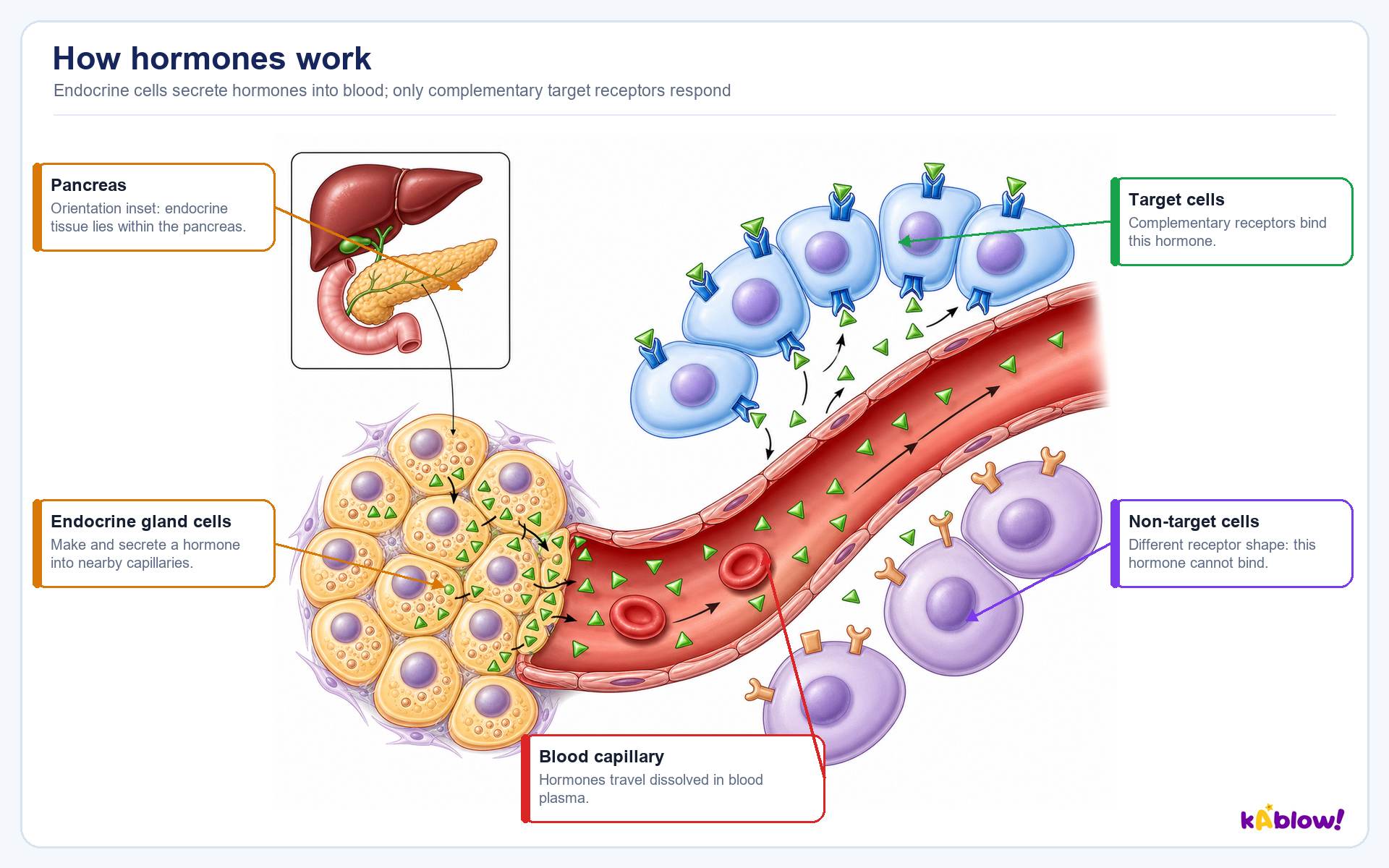
- Hormones are chemical substances produced by glands and carried by the blood, altering the activity of specific target organs; they are transported to target cells and only affect cells with complementary target receptors.
- Neurotransmitters are chemicals that transmit signals across the synaptic cleft from the presynaptic neurone to the postsynaptic neurone; they diffuse across the cleft and bind to receptors on the postsynaptic membrane.
- Neurotransmitter binding causes associated sodium ion channels on the postsynaptic membrane to open, allowing sodium ions to diffuse into the postsynaptic cell; if enough neurotransmitter molecules bind, a nerve impulse is generated.
- Neurotransmitters are then broken down to prevent continued stimulation of the postsynaptic neurone.
- Cytokines are proteins released by nearly all cells in the human body; they bind to receptors on the cell surface membrane and cannot enter the cytoplasm.
- Cytokine binding leads to a cascade of events inside the cell which impacts gene expression and cell activity; they are involved in signalling between white blood cells during an immune response and in regulating the cell cycle during embryonic development.
- Calcium ions (Ca²⁺) are involved in many signalling pathways, e.g., during muscle contraction an influx of Ca²⁺ initiates a change in shape of specific proteins allowing contraction; at a synapse, Ca²⁺ movement into the presynaptic knob triggers vesicles to release neurotransmitters.
- Calcium ions are pumped back out, making responses rapid and short-lived; they sometimes act as second messengers in the cascade of reactions inside a cell.
The major endocrine glands
Chemical Diversity of Hormones and Neurotransmitters
- Hormones fit into three categories: amines, peptides (proteins), or steroids.
- Amines and proteins are hydrophilic, making it difficult to cross phospholipid bilayers, so they function by binding to external membrane receptors.
- Steroid hormones are hydrophobic so can cross cell membranes and bind to receptors inside cells.
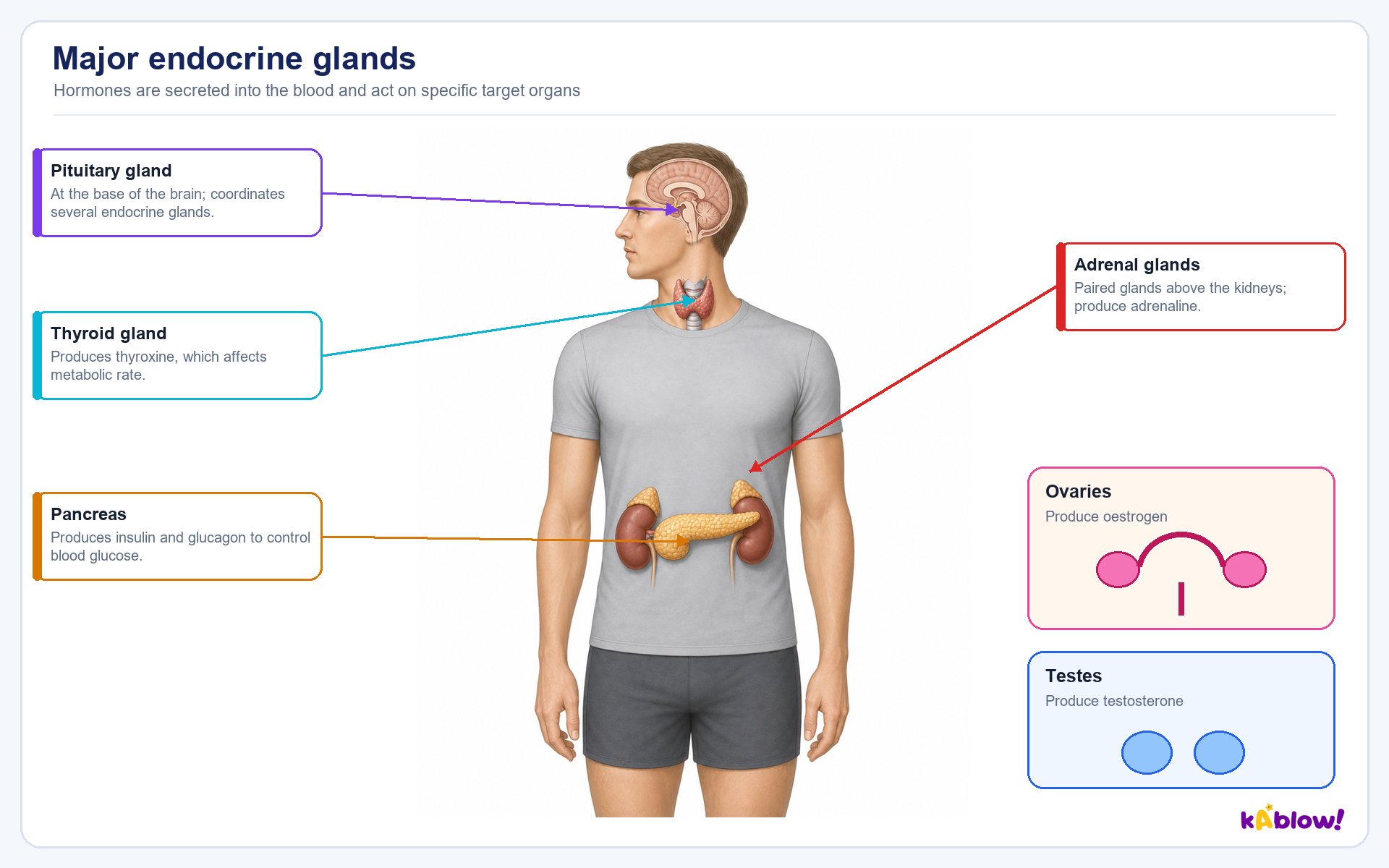
- Examples of amine hormones: melatonin, thyroxin, epinephrine; protein hormones: insulin, glucagon, ADH; steroid hormones: oestradiol, progesterone, testosterone.
- Neurotransmitter categories include amines, gases, amino acids, and peptides; most are hydrophilic and bind to receptors on cell surface membranes.
- Examples of neurotransmitters: amines (dopamine, epinephrine), gases (nitrous oxide), amino acids (glutamate, glycine), peptides (endorphins).
- Some neurotransmitters also act as hormones, e.g., epinephrine (adrenaline).
- Some neurones produce only one type of neurotransmitter, others produce multiple which can be released simultaneously, stimulating several different outcomes at the same time.
Effects of Signalling Molecules
- Neurotransmitters have a localised effect; there is a very short distance for them to diffuse from the presynaptic to the postsynaptic membrane (average 20 nanometres).
- Hormones may have a more distant effect; they travel in the blood to cells with the correct receptors, which could be located very close to the gland or at the furthest point of the body.
- Signals from neurotransmitters are short-lived and localised compared to hormones.
Transmembrane and Intracellular Receptors
- Transmembrane receptor proteins are located in the cell membrane, with an external binding site and an internal region extending into the cytoplasm.
- Transmembrane receptors are characterised by hydrophilic amino acid regions at either end (in contact with aqueous solutions inside and outside the cell) and a hydrophobic amino acid region within the membrane (in contact with hydrophobic phospholipid tails).
- Some ligands bind to these receptors instead of entering the cell cytoplasm.
- Intracellular receptors are used by non-polar, hydrophobic ligands, e.g., steroid hormones, which can diffuse through the phospholipid bilayer and bind to receptors in the cytoplasm or on the DNA in the nucleus.
- Steroid hormones such as oestradiol bind to the receptor molecule and activate it so that protein synthesis is initiated.
Signal Transduction Pathways
- When a ligand binds to either a transmembrane receptor or an intracellular receptor, a cascade of events follows, leading to a change in cell activity; this sequence is called the signal transduction pathway.
- For a transmembrane receptor: the ligand binds to the extracellular region, causing a change in shape of the internal region; the transmembrane protein initiates a pathway involving phosphorylation events and a second messenger.
- For an intracellular receptor: the ligand binds to an intracellular receptor, forming a ligand-receptor complex; the complex is activated to follow a signal transduction pathway.
- Cellular responses may include: regulation of gene expression through control of transcription or translation; change in metabolic activity; regulation of enzyme activity; cell death; rearrangement of the cytoplasm; regulation of proteins, e.g., channels in the plasma membrane.
Transmembrane Receptors: Acetylcholine, G Proteins, and Tyrosine Kinases
- Acetylcholine (ACh) is a key neurotransmitter used throughout the nervous system; synapses using ACh are known as cholinergic synapses.
- ACh can bring about a change in membrane potential (the voltage across a membrane): it binds to ligand-gated sodium ion channels in the postsynaptic membrane, causing a shape change that opens the channels, allowing Na⁺ to diffuse in and reverse the charge, initiating a new nerve impulse.
- ACh is broken down by acetylcholinesterase to prevent continued stimulation; the products are absorbed back into the presynaptic membrane, recycled, and packaged into vesicles.
- G-protein-coupled receptors (GPCRs) are transmembrane receptor proteins that activate a G-protein; they are the largest and most diverse group of membrane receptors in eukaryotes and are not found in prokaryotes.
- G-proteins bind either GTP (active) or GDP (inactive); when a non-steroid ligand binds to the GPCR, a conformational change activates the attached G-protein, GTP replaces GDP, and the G-protein dissociates into a GTP-bound α subunit and a β-gamma dimer.
- These subunits can interact with other membrane proteins, causing the release of second messengers; targets include enzymes and ion channels. G-proteins return to inactive state when GTP is hydrolysed to GDP.
- Receptor tyrosine kinases (RTKs) are transmembrane receptors activated by a ligand on the external region; after binding, the intracellular portion becomes phosphorylated using phosphate groups from ATP.
- The activated RTK stimulates assembly of relay proteins for onward signal transduction; one RTK can trigger multiple different pathways simultaneously.
- Insulin triggers increased glucose uptake in target cells (fat storage cells, adipose cells, muscle cells, liver cells) by activating RTKs, leading to phosphorylation of tyrosine, production of relay proteins, and fusion of vesicles containing glucose transporter proteins with the cell surface membrane, increasing permeability to glucose and the rate of facilitated diffusion.
Epinephrine Receptors and the Second Messenger Model
- Epinephrine (adrenaline) increases blood glucose concentration in response to biological stress; it binds to receptors on the outside of a cell and brings about an intracellular response using the second messenger model.
- Second messengers are molecules or ions inside cells that relay signals received by cell-surface receptors.
- Epinephrine binds to specific receptors on the membrane of liver cells, causing the enzyme adenylyl cyclase to change shape and become activated.
- Active adenylyl cyclase catalyses the conversion of ATP to the second messenger cyclic AMP (cAMP).
- cAMP binds to protein kinase A enzymes, activating them; active protein kinase A activates phosphorylase kinase by adding phosphate groups.
- Active phosphorylase kinase activates glycogen phosphorylase, which catalyses the breakdown of glycogen to glucose (glycogenolysis).
- The enzyme cascade results in the release of glucose by liver cells, increasing blood glucose concentration; the effect is amplified so each molecule can stimulate many molecules of cAMP, which in turn activate many enzymes.
Intracellular Receptors and Gene Expression
- Eukaryotes use transcription factors to control gene expression; a transcription factor is a protein that controls transcription by binding to a specific region of DNA.
- Steroid hormones are small, hydrophobic, lipid-based hormones that diffuse through the cell membrane and pass directly into the nucleus through nuclear pores, where they bind to intracellular receptors.
- Steroid hormones such as testosterone, progesterone, and oestradiol are ligands responsible for the expression of many genes; oestradiol controls up to 100 different genes.
- Oestradiol stimulation pathway: oestradiol diffuses through the cell surface membrane into the cytoplasm, then through a nuclear pore into the nucleus.
- Within the nucleus, oestradiol attaches to an ERα oestradiol receptor held in a protein complex, causing a conformational change.
- The new shape allows the receptor to detach from the protein complex and diffuse towards the gene to be expressed.
- The ERα oestradiol receptor binds to a cofactor, enabling it to bind to the promoter region of the gene, stimulating RNA polymerase binding and gene transcription.
Effects of Oestradiol and Progesterone
- Oestradiol is a steroid hormone responsible for regulation of female sexual characteristics; it is produced in the ovaries, placenta, and testes but is regulated by hormones from the hypothalamus.
- Gonadotropin releasing hormone (GnRH) is released from the hypothalamus, stimulating release of luteinising hormone (LH) and follicle stimulating hormone (FSH) from the pituitary gland.
- These hormones control the menstrual cycle with target cells in the uterus, breasts, and bone marrow of females.
- Oestradiol can either inhibit or promote the release of GnRH throughout the menstrual cycle, resulting in either positive or negative feedback.
- Progesterone is a steroid hormone responsible for maintenance of the endometrial lining in preparation for implantation of a fertilised ovum and development of a foetus; it also prevents further ovulation during pregnancy.
- Progesterone is produced by the corpus luteum and placenta.
- On entering the cytoplasm of a target cell, progesterone forms a ligand-receptor complex, leading to expression of a range of genes; one example is a growth factor promoting cell proliferation to replenish endometrial cells.
Regulating Cell Signalling: Feedback
- Negative feedback is used by most homeostatic control mechanisms to maintain physiological factors within certain limits.
- Negative feedback control loops involve: a receptor detects a stimulus; a coordination system (nervous or hormonal) transfers information; an effector (muscle or gland) carries out a response.
- The outcome of negative feedback: if a factor increases, the body responds to decrease it; if a factor decreases, the body responds to increase it, reversing the change to bring it back within normal limits.
- Positive feedback loops enhance the effect of the original stimulus, causing the factor to deviate even more from the normal range.
- An example of positive feedback is dilation of the cervix during labour: stretch receptors send impulses to the brain, the pituitary gland releases oxytocin, increasing uterine contractions, which stretches the cervix further.
- Positive feedback is useful to quickly activate a process, e.g., blood clotting: activated platelets release chemicals that activate more platelets until a clot forms; the body then reverts to negative feedback.
- Positive feedback may also occur when homeostatic mechanisms break down, e.g., during prolonged exposure to extreme cold, hypothermia can occur as body temperature drops, decreasing metabolism and causing temperature to drop further; such mechanisms are not involved in homeostasis.
投影片
練習題
免費預覽——62 題中的 8 題。註冊即可查看全部。
1.Which of the following signalling molecules functions as a neurotransmitter?
Easy- ACalcium ions
- BCytokines
- CAmines
- DSteroids
2.In the cascade triggered by adrenaline binding to a liver cell surface receptor, which molecule acts as the second messenger?
Easy- AATP
- BcAMP
- CAdrenaline
- DAdenylyl cyclase
3.Which of the following gives an example of positive feedback?
Easy- AThermoregulation
- BRegulation of blood glucose
- COsmoregulation
- DCervix dilation during childbirth
4.Which of the following correctly describes the order of events after acetylcholine successfully binds to a receptor on the postsynaptic membrane?
Medium- ACalcium ion channels open and calcium moves across the postsynaptic membrane triggering an action potential.
- BPositively charged ions diffuse through ion channels across the membrane causing a change in voltage across the plasma membrane.
- CAn action potential is triggered when a threshold level of acetylcholine receptors are occupied.
- DSodium ions are actively pumped across the membrane to initiate an action potential in the postsynaptic neurone.
5.Which of the following statements correctly describes the mechanism of action and effects of the steroid hormones oestradiol and progesterone on their respective target cells?
Medium- AOestradiol binds to receptors in hypothalamic cells, activating gonadotropin-releasing hormone (GnRH) secretion, by preventing the receptor from binding to specific DNA sequences and halting transcription of inhibitory genes.
- BProgesterone binds to intracellular receptors in endometrial cells, promoting gene transcription that supports endometrial thickening by binding to specific DNA sequences.
- COestradiol binds to receptors in endometrial cells, activating gene transcription to promote thickening of the uterine lining.
- DProgesterone binds to hypothalamic cells, promoting the release of GnRH by directly activating receptors on the plasma membrane.
6.Which of the following are characteristic of transmembrane receptor proteins? (select all that apply)
Medium- AAn external ligand binding site
- BHydrophilic amino acid regions in contact with the aqueous solutions inside and outside the cell
- CA hydrophobic amino acid region in contact with the hydrophobic phospholipid tails
- DNon-polar intracellular domains
- EThey are found only in prokaryotic cells
7.Steroid hormones are hydrophobic, so they can cross cell membranes and bind to receptors inside cells.
EasyTrue or false?
8.Which of the following are functional categories of signalling chemicals in animals? (select all that apply)
Medium- AHormones
- BNeurotransmitters
- CCytokines
- DCalcium ions
- EEnzymes