Water Potential
邊玩邊學
回答這些題目賺取能量,接著就能釣魚、探索。不需要帳號。
課程筆記
Osmosis and Solvation
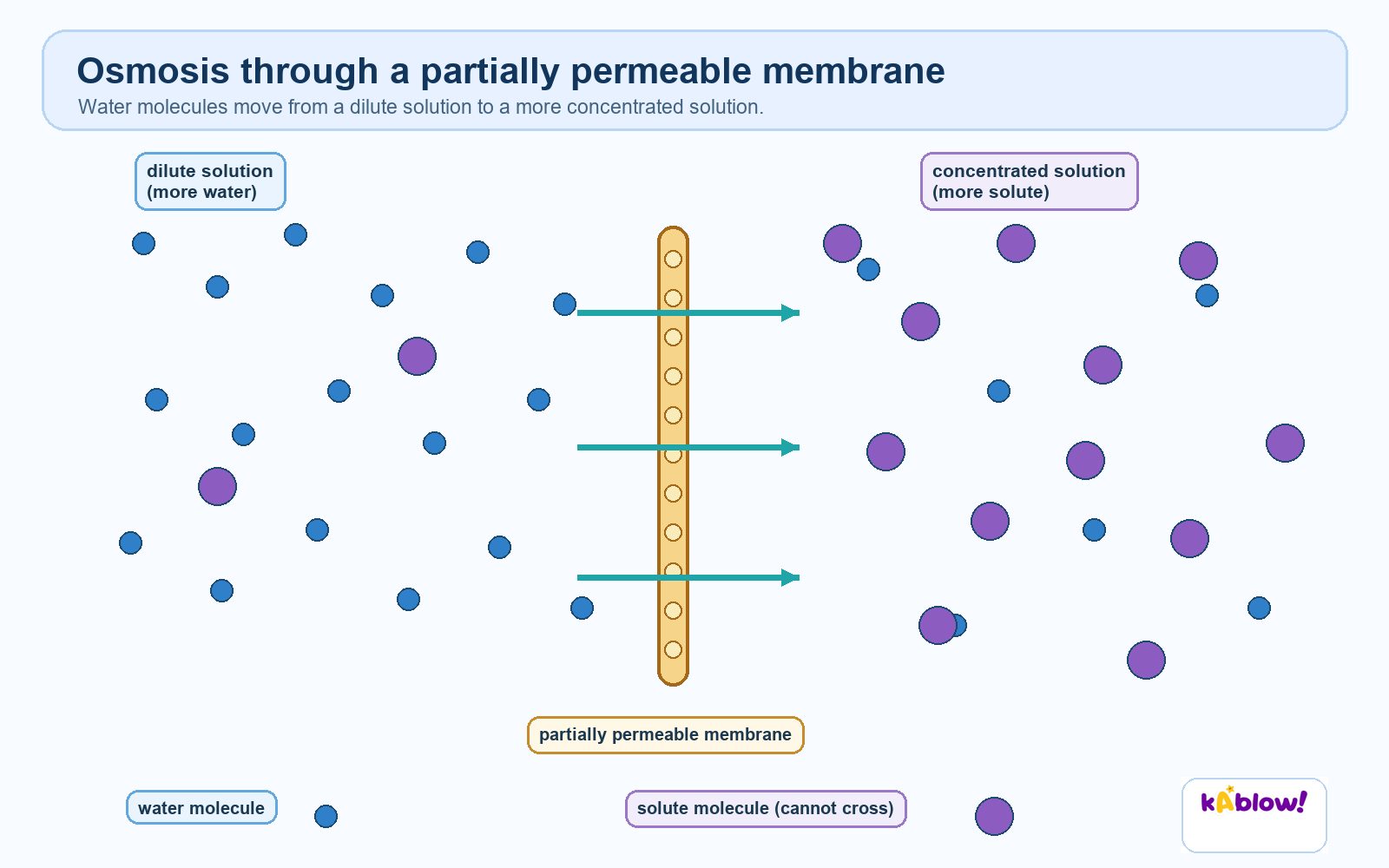
- Osmosis is the diffusion of water molecules from a less concentrated (dilute) solution to a more concentrated solution across a partially permeable membrane.
- Water moves down its concentration gradient during osmosis.
- The cell membrane is partially permeable: it allows small molecules like water through but not larger solute molecules.
- Water is a good solvent because it is dipolar – the hydrogen side is slightly positive and the oxygen side slightly negative.
- This enables water to form hydrogen bonds with polar solute molecules and ions, creating hydration shells around each solute particle.
- The interaction between a solvent (water) and a solute is known as solvation.
Osmosis through a partially permeable membrane
Tonicity and Water Movement
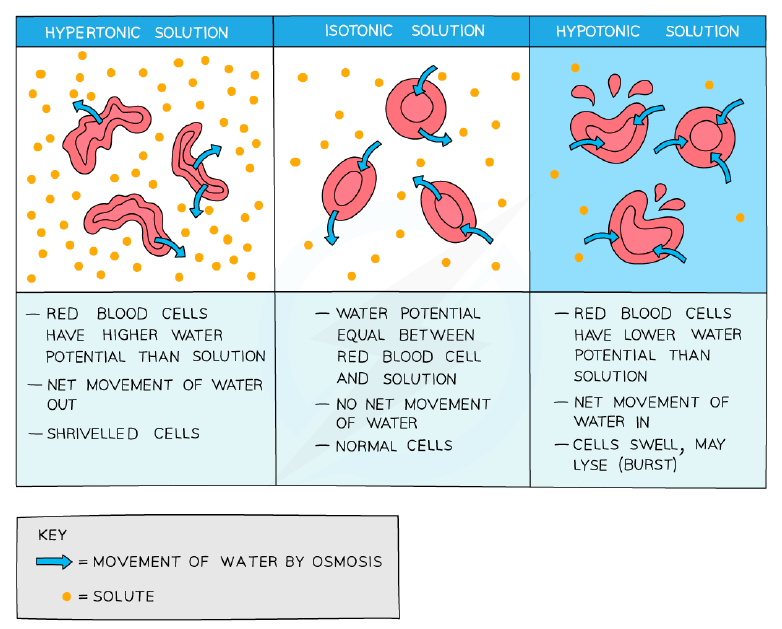
- Hypotonic solution: lower solute concentration (more dilute) than the cell cytoplasm → net movement of water into the cell.
- Hypertonic solution: higher solute concentration (more concentrated) than the cell cytoplasm → net movement of water out of the cell.
- Isotonic solution: same solute concentration as the cytoplasm → no net movement of water into or out of the cell.
- Water molecules are always moving into and out of cells due to kinetic energy; in an isotonic solution there is no net movement in a particular direction.
- The cell is in dynamic equilibrium with an isotonic solution.
Effect of osmosis on animal cells
Effects of Osmosis on Animal Cells
- Animal cells have no cell wall, so the effects of water movement are more severe than in plant cells.
- In a hypertonic solution, an animal cell loses water and becomes crenated (shrivelled); crenated red blood cells may become stuck in capillaries and form blood clots.
- In a hypotonic solution, an animal cell gains water and, lacking a cell wall to create turgor pressure, will continue to swell until the cell membrane bursts.
- Multicellular organisms must maintain isotonic tissue fluid around their cells to prevent these harmful changes.
- Some unicellular organisms like Amoeba live in freshwater (hypotonic to their cytoplasm) and use contractile vacuoles to pump out excess water and prevent bursting.
Effects of Osmosis on Plant Cells
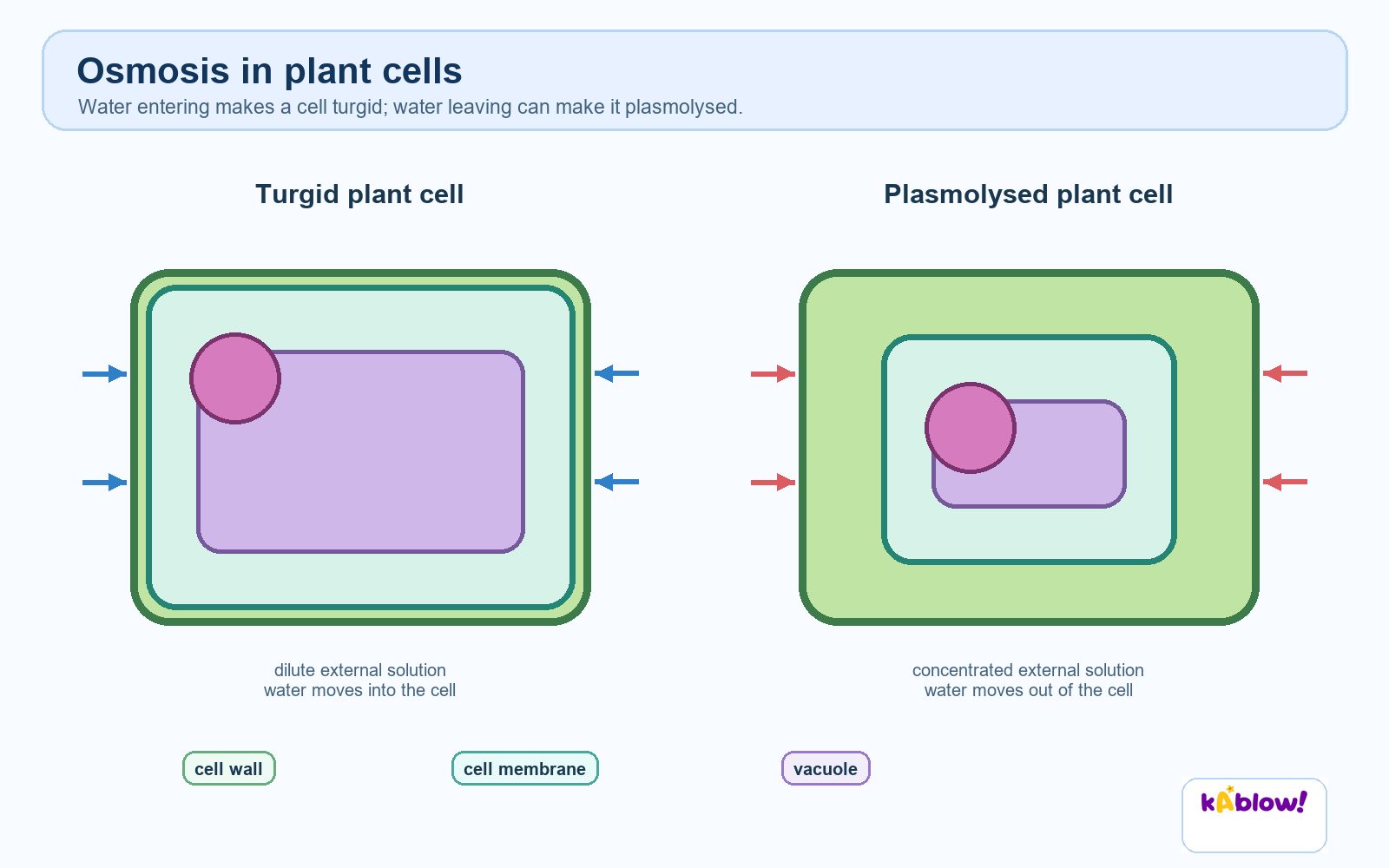
- In a hypotonic solution, water enters the plant cell by osmosis; the expanding protoplast pushes against the cell wall, building turgor pressure.
- The inelastic cell wall prevents the cell from bursting and stops too much water entering.
- A plant cell fully inflated with water is fully turgid; turgidity provides support and strength, keeping the plant upright with leaves held out to catch sunlight.
- If plants do not receive enough water, cells cannot remain turgid and the plant wilts.
- In a hypertonic solution, water leaves the plant cell; the protoplast shrinks and pulls away from the cell wall – this is plasmolysis, and the cell is flaccid.
- Plant cell walls are freely permeable, so in a plasmolysed cell the external solution exerts pressure on the protoplast (there is no empty space between wall and protoplast).
Effect of osmosis on plant cells
Medical Applications of Isotonic Solutions
- Intravenous (IV) drips must be isotonic to blood plasma, usually a 0.9% sterile saline solution.
- A hypotonic IV solution would cause water to move into red blood cells, making them burst and reducing the oxygen-carrying capacity of blood.
- A hypertonic IV solution would cause water to move out of red blood cells, making them shrivel and become crenated, increasing the risk of blood clots.
- Donated organs for transplant must be kept in an isotonic saline solution to prevent damage from net water movement by osmosis.
Water Potential
- Water potential (Ψ) is the potential energy of water, per unit volume, relative to pure water.
- The unit of water potential is usually kilopascals (kPa).
- Water potential is always stated relative to pure water at atmospheric pressure and 20 °C, where pure water has a value of 0 kPa.
- As solutes are added, water potential decreases into negative values; solutions with a high solute concentration have a lower water potential.
- Energy is stored in hydrogen bonds between solute and water molecules, so less energy is available as potential energy.
- Water molecules move from an area of high water potential to an area of low water potential (from higher to lower potential energy, or from low to high solute concentration).
Solute and Pressure Potential
- Solute potential (Ψs), also called osmotic potential, is the effect of solutes on water potential.
- Pure water has a solute potential of zero; adding solutes makes it more negative.
- Pressure potential (Ψp), also called turgor potential or turgor pressure, is the hydrostatic pressure to which water is subjected.
- Pressure potential inside plant cells is usually positive because the cytoplasm presses on the cell wall; negative pressure potential can occur in xylem vessels under tension.
- The total water potential is the sum of solute potential and pressure potential: Ψw = Ψs + Ψp.
- As a plant cell fills with water, pressure potential increases until it cancels out the effect of solute potential.
Water Movement in Plant Tissue
- In a hypotonic solution, the plant cell cytoplasm has dissolved substances that lower its solute potential and water potential; water moves in down the water potential gradient.
- The inward movement of water increases cytoplasm volume and pressure potential as the cytoplasm presses against the cell wall.
- Water stops entering when pressure potential makes the water potential equal inside and outside the cell; the cell is then turgid and provides structural support.
- In a hypertonic solution, the surrounding solution has a lower solute potential and lower water potential than the cytoplasm; water moves out of the cell down its water potential gradient.
- Water loss reduces cytoplasm volume and decreases pressure potential; cells lose turgor and the plant wilts.
Estimating Osmotic Concentration in Plant Tissue
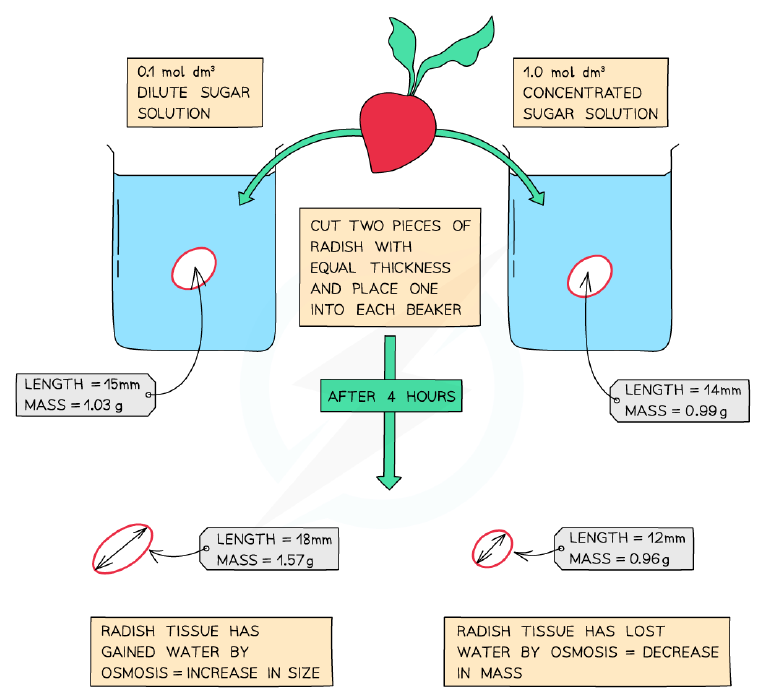
- The osmotic concentration of plant tissue can be estimated by bathing samples in solutions of different tonicity.
- A hypotonic solution causes tissue to increase in mass or length; a hypertonic solution causes it to decrease; an isotonic solution leaves mass or length unchanged.
- A common practical uses potato cylinders placed in a range of sucrose solutions (at least 5 concentrations, e.g. 0, 0.25, 0.5, 0.75, 1.00 mol/dm³).
- Cylinders are cut to the same length, blotted dry, weighed, left in solution for a set time (e.g. 30 minutes in a water bath at ~30 °C), then removed, dried and reweighed.
- Percentage change in mass = (change in mass ÷ initial mass) × 100.
- A positive percentage change means the potato gained water (solution had lower osmotic concentration); a negative change means it lost water (solution had higher osmotic concentration).
- The point where the line of best fit crosses the x-axis gives the sucrose concentration inside the potato cells (no net water movement).
Investigating osmosis in plant tissue
Experimental Design and Data Analysis
- Preliminary research and studies help identify variables, decide how to control them, choose apparatus and techniques, and determine quantities needed; without them an experiment is likely to be invalid.
- Quantitative data allows more valid conclusions; qualitative data can support conclusions.
- Repeats are needed for reliable results; the mean is more informative when given alongside standard deviation, which measures spread of data around the mean.
- Standard error (SE) = S ÷ √n, where S is standard deviation and n is sample size; a larger sample gives a smaller standard error and a sample mean closer to the true population mean.
- Error bars on graphs show standard error; overlapping error bars suggest no significant difference between means, while non-overlapping bars indicate a significant difference.
- Blotting potato cubes before weighing removes excess surface liquid so mass measurements reflect water movement into or out of the tissue.
投影片
練習題
免費預覽——61 題中的 8 題。註冊即可查看全部。
1.Which of the following is the correct equation used to calculate water potential?
Easy- AΨw = Ψs + Ψp
- BΨw = Ψs - Ψp
- CΨw = Ψp - Ψs
- DΨw = Ψs ÷ Ψp
2.A student places an animal cell and a plant cell into distilled water and notes the following observations. Animal cell: swells and then bursts. Plant cell: swells. What is the reason for this difference?
Easy- APlant cell surface membranes are partially permeable
- BAnimal cells have no vacuole
- CAnimal cells have no cell wall
- DPlant cell walls are freely permeable
3.What will happen to a plant cell placed in a hypotonic solution?
Easy- AIt will burst
- BIt will swell with water and become turgid
- CNothing will happen
- DIt will shrink and shrivel and become flaccid
4.The diagram shows red blood cells that have been bathed in solutions of different solute concentrations. Healthy red blood cells have a biconcave appearance. Which row of the table correctly describes the three solutions that these red blood cells have been bathed in?
Easy- AI: Isotonic, II: Hypotonic, III: Isotonic
- BI: Isotonic, II: Hypertonic, III: Hypotonic
- CI: Isotonic, II: Hypotonic, III: Hypertonic
- DI: Hypertonic, II: Hypotonic, III: Isotonic
5.When investigating osmosis in plant tissue, any changes to mass and length are recorded over a period of time. What are the most appropriate units of measurement for mass and length during this investigation?
Easy- Akg and cm
- Bg and cm
- Cg and mm
- Dkg and mm
6.A plant cell is placed in a solution with a lower water potential than the cell itself. What happens to the cell?
Medium- AWater enters the cell and it becomes turgid
- BWater leaves the cell and the protoplast pulls away from the cell wall
- CWater leaves the cell and the cell wall pulls away from the protoplast
- DThere is no net movement of water and the cell stays the same
7.Which of the following statements about water potential are correct? (select all that apply)
Medium- APure water at atmospheric pressure and 20 °C has a water potential of 0 kPa.
- BWater potential is measured in kilopascals (kPa).
- CAdding solutes increases the water potential of a solution.
- DWater moves from a region of higher water potential to a region of lower water potential.
- EWater potential is the potential energy of water per unit volume relative to pure water.
8.Which of the following correctly describe the effects of placing an animal cell in a hypertonic solution? (select all that apply)
Medium- AThere is a net movement of water out of the cell.
- BThe cell becomes crenated (shrivelled).
- CThe cell swells and may burst.
- DThe cytoplasm is more dilute than the outside solution.
- EThere is no net movement of water into or out of the cell.