Neural Signalling
邊玩邊學
回答這些題目賺取能量,接著就能釣魚、探索。不需要帳號。
課程筆記
The Nervous System
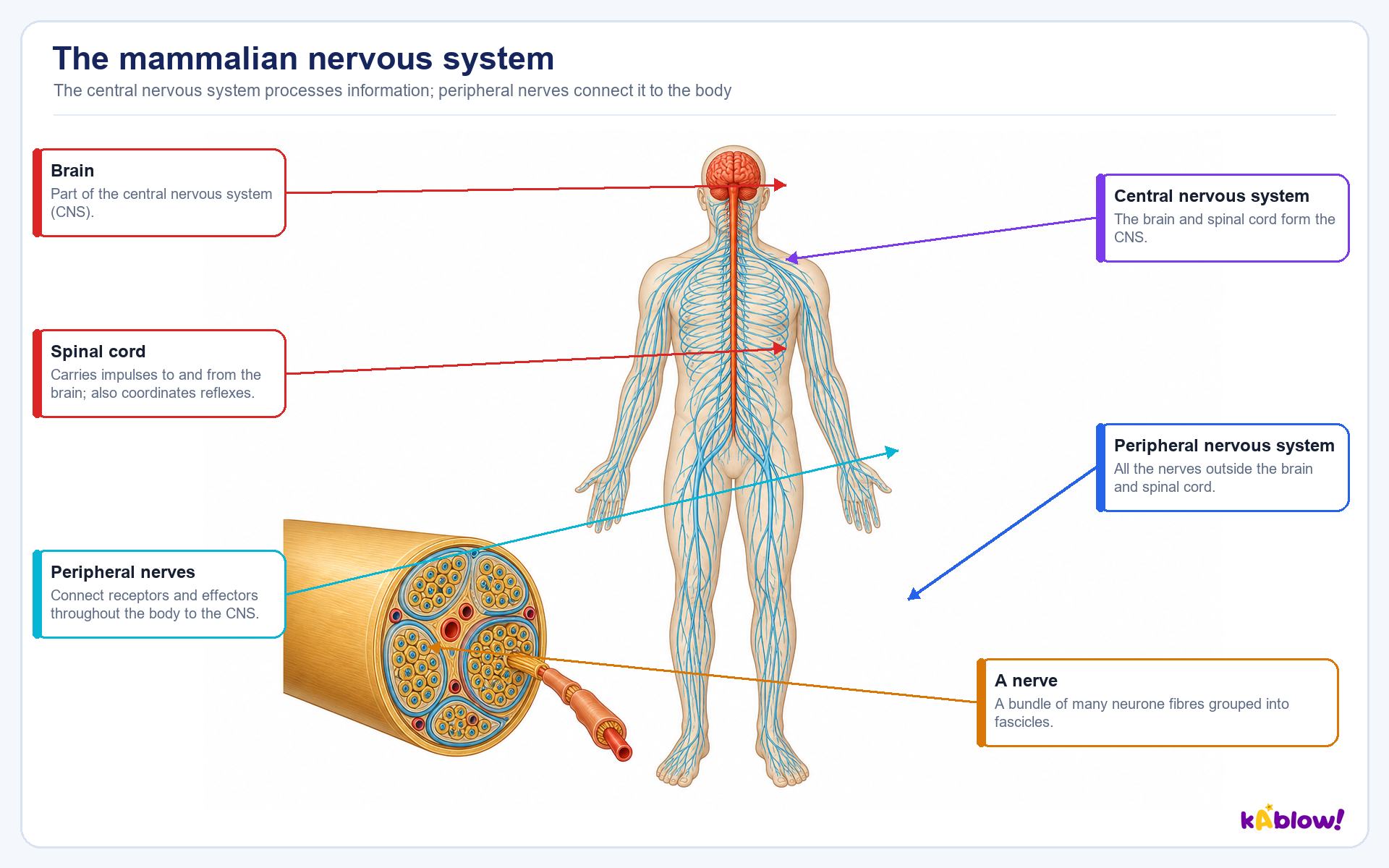
- The human nervous system consists of the central nervous system (CNS) – the brain and spinal cord – and the peripheral nervous system (PNS) – all of the nerves in the body.
- It allows us to make sense of our surroundings and respond to them, and to coordinate and regulate body functions.
- Information is sent through the nervous system in the form of electrical impulses – electrical signals that pass along nerve cells known as neurones.
- A bundle of neurones is known as a nerve.
- The nerves spread out from the CNS to all other regions of the body and importantly, to all of the sense organs.
- The CNS acts as a central coordinating centre for the impulses that come in from, and are sent out to, any part of the body.
The central and peripheral nervous systems
Neurone Structure
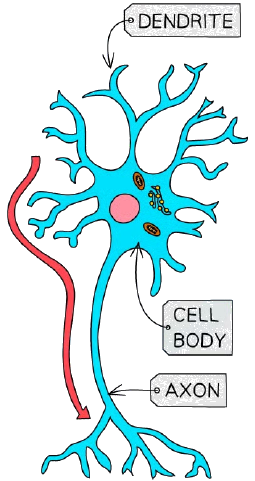
- Neurones have a main, long, fibre known as an axon.
- The axon is often insulated by Schwann cells which form the myelin sheath which prevents loss of nerve impulses along the axon.
- They have a cell body that contains the nucleus and other cellular structures.
- Their cell bodies and axon terminals contain many extensions called dendrites.
- These dendrites allow them to connect to many other neurones and receive impulses from them, forming a network for easy communication.
- Neurones have a characteristically elongated structure which allows them to transfer information between the central nervous system and the rest of the body.
Structure of a neurone
Types of Neurone
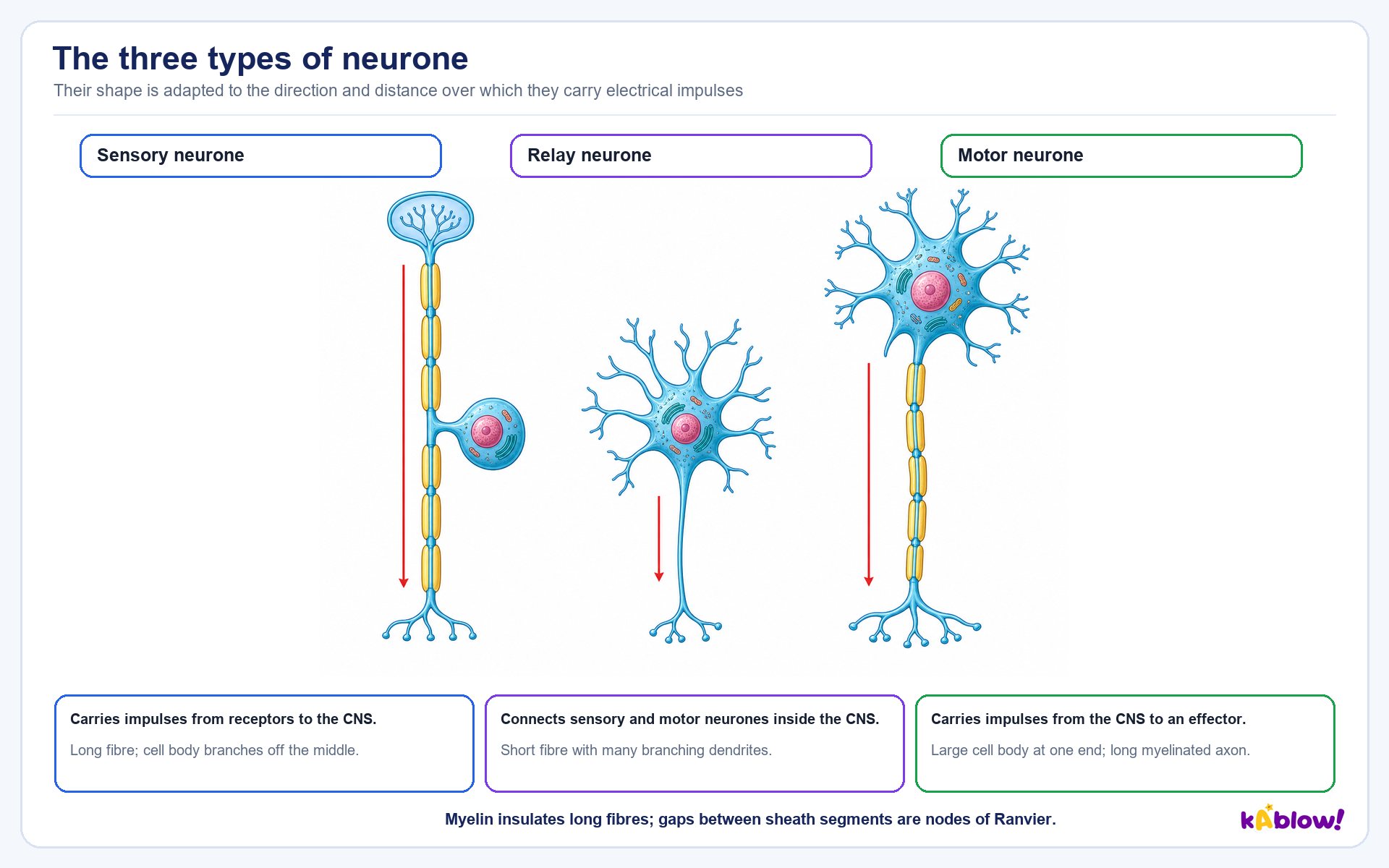
- There are three main types of neurone: sensory, relay and motor.
- Sensory neurones carry impulses from receptors to the CNS (brain or spinal cord).
- Relay (intermediate) neurones are found entirely within the CNS and connect sensory and motor neurones.
- Motor neurones carry impulses from the CNS to effectors (muscles or glands).
- Motor neurones have a large cell body at one end that lies within the spinal cord or brain, a nucleus that is always in its cell body, and many highly-branched dendrites extending from the cell body, providing a large surface area for the axon terminals of other neurones.
- Relay neurones have short, but highly branched, axons and dendrites.
- Sensory neurones have a cell body that branches off in the middle of the cell, a single long dendron that carries impulses to the cell body and a single long axon that carries impulses away from the cell body.
The three types of neurone
Resting Potential
- In an axon that is not transmitting an impulse the inside of the axon always has a negative electrical potential, or charge, compared to outside the axon, which has a positive electrical potential.
- This membrane potential in a resting neurone is known as resting potential and is usually about -70 millivolts (mV).
- Two main processes contribute to establishing and maintaining resting potential: the active transport of sodium ions and potassium ions and a difference in rates of diffusion of sodium ions and potassium ions.
- Negatively charged proteins inside the axon also contribute to the negative resting potential.
- Sodium-potassium pumps are carrier proteins in the cell surface membranes of neurones that use ATP to actively transport sodium ions (Na⁺) out of the axon and potassium ions (K⁺) into the axon.
- The two types of ion are pumped at an unequal rate; for every 3 sodium ions that are pumped out of the axon, only 2 potassium ions are pumped in.
- This creates a concentration gradient across the membrane for both sodium ions and potassium ions.
- The neurone membrane is much less permeable to sodium ions than potassium ions, so potassium ions inside the neurone can diffuse out at a faster rate than sodium ions can diffuse back in, generating a negative charge inside the neurone in relation to the outside.
Action Potential
- Once resting potential is reached, the neurone membrane is said to be polarised.
- To initiate a nerve impulse in a neurone, the neurone membrane needs to be depolarised.
- Depolarisation is the reversal of the electrical potential difference across the membrane.
- The depolarisation of the membrane occurs when an action potential is generated.
- Action potentials lead to the reversal of resting potential from around -70 mV to around +40 mV.
- Action potentials involve the rapid movement of sodium ions and potassium ions across the membrane of the axon.
- An action potential is the potential electrical difference produced across the axon membrane when a neurone is stimulated e.g. when an environmental stimulus is detected by a receptor cell.
Speed of Nerve Impulses
- There are well documented correlations between specific structural features of neurones and the speed of transmission.
- Two key features that should be considered include myelination of the neurone and diameter of the neuron.
- Myelinated neurones conduct electrical impulses much more quickly than unmyelinated fibres because of the insulation offered by the myelin sheath which allows faster saltatory conduction along the neurone.
- An axon with a wider diameter conducts an electrical impulse more quickly than a narrow axon because a wider axon offers less resistance to the action potential.
- Squid have giant axons which are unmyelinated and can be up to 1 mm wide, whereas the average diameter of a human neurone is somewhere between 4 and 100 μm.
- Despite the axon being significantly wider, the speed of transmission is much faster in the axon which is insulated by a myelin sheath.
Myelination
- The axons of neurones are surrounded by specialised cells called Schwann cells.
- Schwann cells wrap themselves around the axon, forming a structure known as a myelin sheath.
- Myelin contains the phospholipids of the Schwann cell membranes; it is built up in layers as the Schwann cells grow around the axon.
- The lipid content of the myelin sheath gives it a high electrical resistance.
- The myelin sheath acts as an electrical insulator; impulses cannot pass through the myelin sheath.
- The myelin sheath has small, uninsulated sections in the gaps between the individual Schwann cells; these gaps are called nodes of Ranvier.
- Electrical impulses effectively jump from one node of Ranvier to the next; this process is known as saltatory conduction.
- It greatly speeds up the rate of transmission of impulses along myelinated neurones; in non-myelinated neurones the axon is not insulated by myelin, so the impulse travels more slowly.
Synapses: Structure and Transmission
- Where two neurones meet, they do not actually come into physical contact with each other; instead, a very small gap, known as the synaptic cleft, separates them.
- The ends of the two neurones, along with the synaptic cleft, form a structure known as a synapse.
- Synapses act as the junctions between any cells in the nervous system, e.g. in the sense organs, there are synapses between sensory receptor cells and sensory neurones; in muscles, there are synapses between motor neurones and muscle fibres.
- Electrical impulses cannot ‘jump’ across the synaptic cleft.
- When an electrical impulse arrives at the end of the axon on the presynaptic neurone, the membrane of the presynaptic neurone becomes depolarised, triggering an influx of calcium ions into the presynaptic cell via calcium ion channels in the membrane.
- The calcium ions cause vesicles in the presynaptic neurone to move towards the presynaptic membrane where they fuse with it and release chemical messengers called neurotransmitters into the synaptic cleft.
- The neurotransmitters diffuse across the synaptic cleft and bind with receptor molecules on the postsynaptic membrane; this causes associated sodium ion channels on the postsynaptic membrane to open, allowing sodium ions to diffuse into the postsynaptic cell.
- If enough neurotransmitter molecules bind with receptors on the postsynaptic membrane then an action potential is generated, which then travels down the axon of the postsynaptic neurone.
Neurotransmitters and Unidirectionality
- A common neurotransmitter is acetylcholine, or ACh.
- The neurotransmitters are broken down to prevent continued stimulation of the postsynaptic neurone.
- The enzyme that breaks down acetylcholine is acetylcholinesterase.
- Synapses ensure the one-way transmission of impulses.
- Impulses can only pass in one direction at synapses because neurotransmitter is released on one side and its receptors are on the other – chemical transmission cannot occur in the opposite direction.
- This prevents impulses from travelling the wrong way.
- There are over 40 different known neurotransmitters; examples include dopamine and noradrenaline.
- ACh is produced in the presynaptic neurone by combining choline with an acetyl group; synapses that use ACh are known as cholinergic synapses.
Postsynaptic Potential and Recycling
- ACh is released into the synaptic cleft when ACh-containing vesicles fuse with the presynaptic membrane, releasing ACh molecules into the synaptic cleft.
- ACh binds to specific receptors on the postsynaptic membrane, where it can generate an action potential in the postsynaptic cell by opening associated sodium ion channels to allow sodium ions into the cytoplasm of the postsynaptic neurone until the threshold level is achieved.
- To prevent the sodium ion channels staying permanently open and to stop permanent depolarisation of the postsynaptic membrane, the ACh molecules are broken down and recycled.
- The enzyme acetylcholinesterase catalyses the hydrolysis of ACh molecules into acetate and choline.
- The products of hydrolysis are then absorbed back into the presynaptic neurone, and the active neurotransmitter ACh is reformed.
投影片
練習題
免費預覽——58 題中的 8 題。註冊即可查看全部。
1.Between which structures do sensory neurones transmit electrical impulses?
Easy- AFrom receptors to the central nervous system (CNS).
- BFrom effectors to the central nervous system (CNS).
- CFrom effectors to receptors.
- DFrom receptors to effectors.
2.Where would myelin be found?
Easy- AWrapped around the axon of a neurone
- BInside the synaptic cleft
- CIn the cell body of a neurone
- DAt the nodes of Ranvier
3.Neurotransmitters leave the presynaptic neurone and enter the synaptic cleft. After this, they travel across the cleft to a receptor on the postsynaptic neurone membrane. Identify the processes that are required for this to occur.
Medium- AExocytosis; Diffusion
- BEndocytosis; Diffusion
- CEndocytosis; Active transport
- DExocytosis; Active transport
4.The diagram shows a sensory neurone connected to its associated receptor cells. Structure A is the cell body. Which best describes the function of the structure labelled A?
Medium- AContains most cellular structures
- BActs as an electrical insulator
- CTransmit impulses to the spinal cord
- DTransmit and receive impulses to other neurones
5.What is the role of active transport in the transmission of nerve impulses by neurones?
Medium- AEstablishes the resting potential needed for impulse transmission by pumping sodium ions out of the axon and potassium ions into the axon.
- BDepolarisation of the axon by moving sodium ions across the membrane into neurone.
- CEstablishes the resting potential needed for impulse transmission by moving sodium ions into the axon and potassium ions out of the axon.
- DInitiates the action potential needed for the transmission of an impulse by pumping calcium ions into the axon.
6.Which line of the table represents a neurone at its resting potential?
Medium- ASodium (Na⁺) high, Potassium (K⁺) low, Cell surface membrane permeability to Na⁺ high, Level of activity of Na⁺/K⁺ pump active
- BSodium (Na⁺) high, Potassium (K⁺) low, Cell surface membrane permeability to Na⁺ low, Level of activity of Na⁺/K⁺ pump inactive
- CSodium (Na⁺) low, Potassium (K⁺) high, Cell surface membrane permeability to Na⁺ high, Level of activity of Na⁺/K⁺ pump inactive
- DSodium (Na⁺) low, Potassium (K⁺) high, Cell surface membrane permeability to Na⁺ low, Level of activity of Na⁺/K⁺ pump active
7.Membrane channel proteins are essential for the normal functioning of nerves. Which process in nerves does not require a membrane protein?
Hard- ADiffusion of neurotransmitters
- BActive transport of sodium
- CDepolarisation during an action potential
- DBinding of neurotransmitters
8.Which of the following correctly describes the role of dendrites in a neurone?
Medium- AThey receive impulses from other neurones.
- BThey carry impulses away from the cell body.
- CThey insulate the axon.
- DThey release neurotransmitters into the synaptic cleft.