Ideal Gases
邊玩邊學
回答這些題目賺取能量,接著就能釣魚、探索。不需要帳號。
課程筆記
Kinetic Theory of Gases
- Gas molecules are in constant, rapid, random motion.
- The volume of individual gas molecules is negligible compared to the total volume of the gas.
- No intermolecular forces exist between gas particles; they do not attract or repel one another.
- All collisions between gas molecules are perfectly elastic (no kinetic energy is lost).
- The temperature of a gas is directly proportional to the average kinetic energy of its particles.
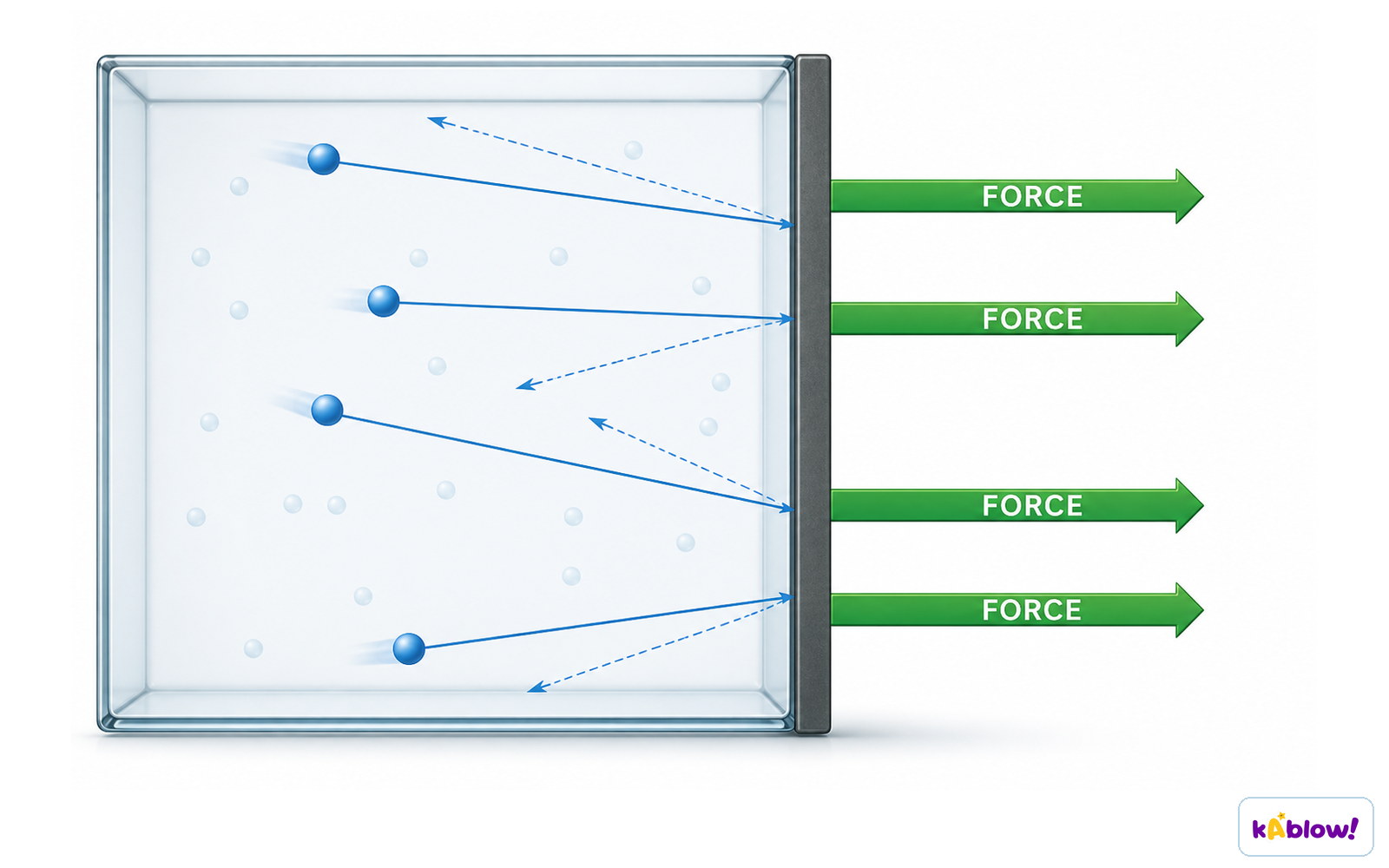
Gas particles and pressure
Ideal vs. Real Gases
- Ideal gases follow all assumptions of the kinetic theory.
- Real gases do not perfectly follow this model, but under low pressure and high temperature, they behave similarly to ideal gases.
- Real gases deviate from ideal behaviour especially at low temperatures (stronger attractions between particles) and high pressures (particle volume becomes significant).
- At high pressure, particles are close together, so their volume becomes significant, reducing available space for movement.
- At low temperatures, attractions between molecules become significant, reducing the frequency and force of collisions with container walls, leading to lower pressure than predicted.
Factors Affecting Gas Volume
- The volume that a gas occupies depends on pressure (P) and temperature (T).
- Gases in a container exert a pressure as the gas molecules are constantly colliding with the walls of the container.
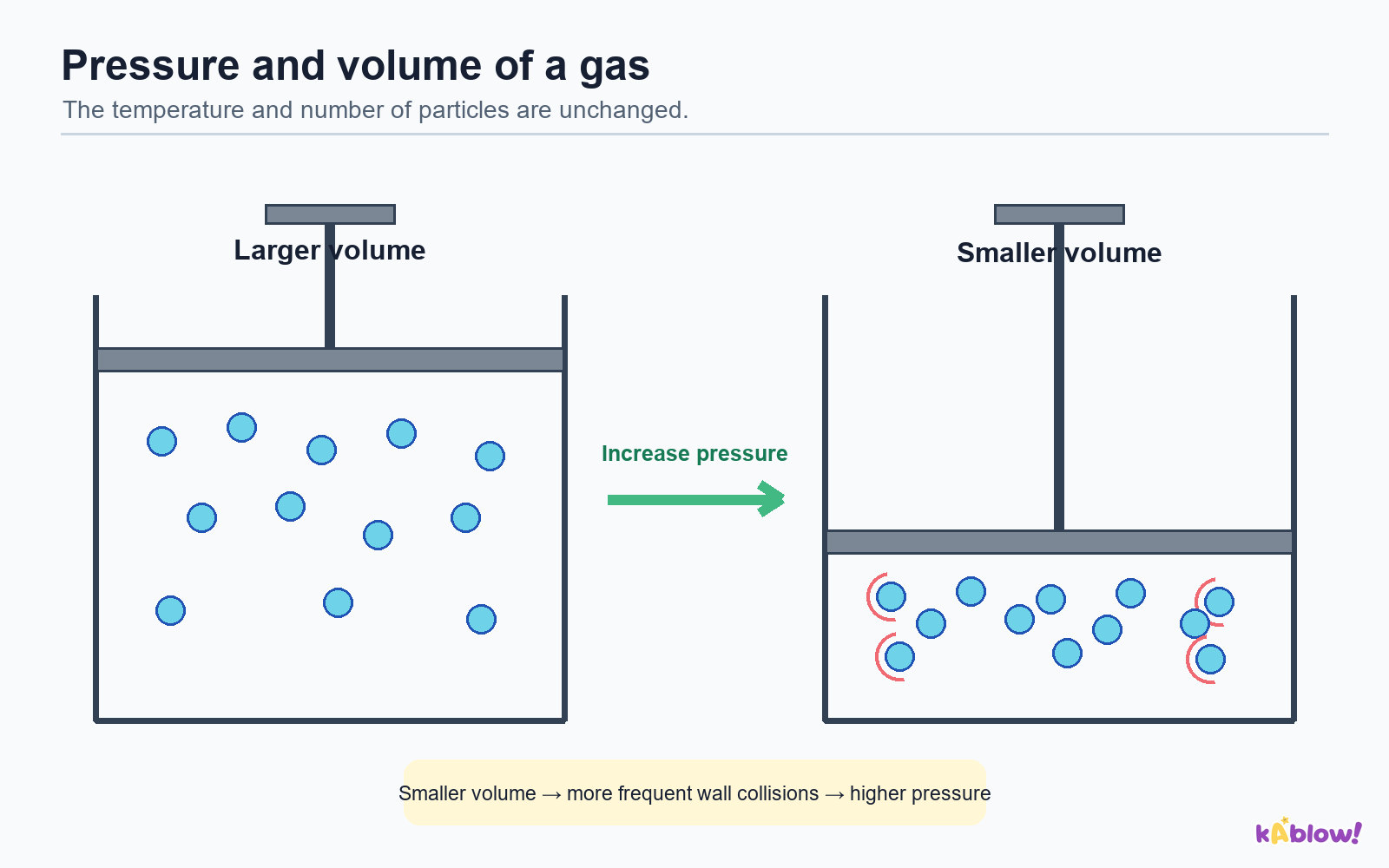
- Decreasing the volume (at constant temperature) causes molecules to be squashed together, resulting in more frequent collisions with the container wall.
- The pressure of the gas increases when volume decreases at constant temperature.
- Increasing the temperature (at constant volume) causes molecules to gain more kinetic energy, move faster, and collide more frequently with the container walls, leading to an increase in pressure.
Boyle's Law
- Pressure is inversely proportional to volume (when temperature is constant): P ∝ 1/V.
- PV = a constant (Boyle's Law).
- A graph of pressure against 1/volume gives a straight line.
- A graph of pressure against volume gives a curve.
- A graph of PV versus P gives a straight line.
Pressure and volume
Charles's Law
- When a gas is heated (at constant pressure), particles gain more kinetic energy, leading to more frequent collisions with container walls.
- To keep pressure constant, the gas must expand, so the volume increases.
- Volume is directly proportional to the temperature in Kelvin (at constant pressure): V ∝ T.
- V/T = a constant (Charles's Law).
- A graph of volume against temperature in Kelvin gives a straight line.
Pressure and Temperature Relationship
- Increasing the temperature (at constant volume) causes molecules to gain more kinetic energy, move faster, and collide more frequently with container walls.
- This leads to an increase in pressure.
- Pressure is directly proportional to temperature (in Kelvin) at constant volume: P ∝ T.
- P/T = a constant.
- A graph of temperature in Kelvin against pressure gives a straight line.
The Ideal Gas Equation
- Combining the gas laws gives PV = nRT.
- P = pressure (pascals, Pa); V = volume (m³); n = number of moles of gas (mol); R = gas constant (8.31 J K⁻¹ mol⁻¹); T = temperature (Kelvin, K).
- The ideal gas equation can also be used to calculate the molar mass (M) of a gas.
- When n and R are constant, the ideal gas law simplifies to P₁V₁/T₁ = P₂V₂/T₂.
- Temperature must be in Kelvin; add 273 to the Celsius temperature.
- To convert m³ to cm³, multiply by 10⁶; to convert cm³ to m³, divide by 10⁶ (or multiply by 10⁻⁶).
- Always check units before using the ideal gas equation; it requires volume in m³.
Molar Gas Volume
- Gases in a container exert a pressure as the gas molecules are constantly colliding with the walls of the container.
- Changing gas volume: decreasing the volume (at constant temperature) of the container causes the molecules to be squashed together which results in more frequent collisions with the container wall.
- The pressure of the gas increases.
- Gas particles exert a pressure by constantly colliding with the walls of the container.
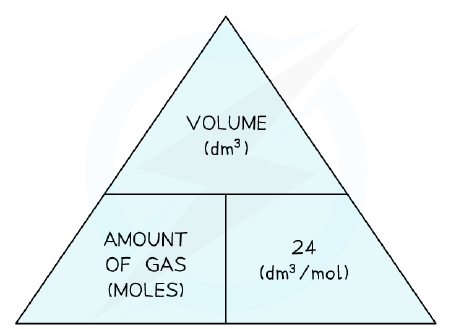
Molar gas volume formula triangle
投影片
練習題
免費預覽——64 題中的 8 題。註冊即可查看全部。
1.Which of the following is NOT an assumption of the kinetic theory of gases?
Easy- AGas molecules are in constant, rapid, random motion
- BThe volume of individual gas molecules is negligible compared to the total volume of the gas
- CIntermolecular forces between gas particles are significant
- DAll collisions between gas molecules are perfectly elastic
2.According to the kinetic theory, the temperature of a gas is directly proportional to:
Easy- AThe average kinetic energy of its particles
- BThe volume of the gas
- CThe pressure of the gas
- DThe number of moles of gas
3.Which of the following statements about real gases is correct?
Easy- AReal gases behave most like ideal gases at high pressure and low temperature
- BReal gases behave most like ideal gases at low pressure and high temperature
- CReal gases always behave exactly like ideal gases
- DReal gases never deviate from ideal gas behaviour
4.A gas is heated at constant volume. Which statement best explains the increase in pressure?
Medium- AThe gas particles expand and occupy more space
- BThe gas particles gain kinetic energy and collide more frequently with the container walls
- CThe gas particles become larger and hit the walls harder
- DThe number of gas particles increases
5.A sample of gas is compressed at constant temperature. Which of the following graphs would be a straight line through the origin?
Medium- APressure against volume
- BPressure against 1/volume
- CVolume against pressure
- DPV against 1/volume
6.Which of the following is the correct expression of Charles's Law?
Medium- AV ∝ 1/T
- BV ∝ T
- CV ∝ P
- DV ∝ 1/P
7.A fixed amount of gas undergoes a change where pressure and temperature both change. Which equation correctly relates the initial and final states?
Medium- AP1V1 = P2V2
- BV1/T1 = V2/T2
- CP1V1/T1 = P2V2/T2
- DP1T1 = P2T2
8.Which of the following is the correct unit for the gas constant R in the ideal gas equation?
Medium- AJ K mol
- BJ K⁻¹ mol⁻¹
- CPa m³ K⁻¹ mol⁻¹
- Ddm³ kPa K⁻¹ mol⁻¹