Proton Transfer Reactions
邊玩邊學
回答這些題目賺取能量,接著就能釣魚、探索。不需要帳號。
課程筆記
Brønsted–Lowry Acids and Bases
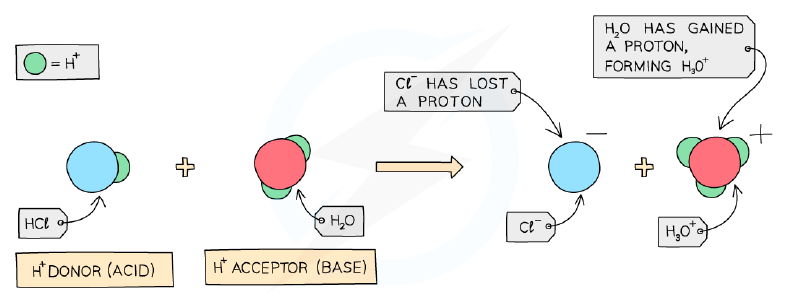
- A Brønsted–Lowry acid is a species that donates a proton (H⁺).
- A Brønsted–Lowry base is a species that accepts a proton using a lone pair of electrons.
- The theory applies to proton transfer in any solvent, including gas-phase reactions.
- In HCl(g) + H₂O(l) → H₃O⁺(aq) + Cl⁻(aq), HCl acts as the acid and water as the base.
- The formation of ions from a molecular acid or base is called dissociation or ionisation.
Proton transfer between an acid and a base
Conjugate Acids and Bases
- A conjugate acid–base pair consists of two species that differ by a single H⁺ ion.
- In CH₃COOH(aq) + H₂O(l) ⇌ CH₃COO⁻(aq) + H₃O⁺(aq), CH₃COOH/CH₃COO⁻ and H₂O/H₃O⁺ are conjugate pairs.
- The acid and its conjugate base are related by the loss of one proton; the base and its conjugate acid by the gain of one proton.
- Strong acids have weak conjugate bases; weak acids have strong conjugate bases.
- Strong bases have weak conjugate acids.
Amphiprotic Species
- An amphiprotic species can both donate and accept a proton (H⁺).
- Water is amphiprotic: it donates a proton to NH₃ and accepts a proton from HCl.
- An amphoteric substance can act as an acid or a base in a chemical reaction.
- All amphiprotic substances are amphoteric, but not all amphoteric substances are amphiprotic.
- Aluminium oxide, Al₂O₃, is amphoteric but not amphiprotic because it does not donate or accept protons.
The pH Scale
- pH is defined as pH = –log[H⁺], where [H⁺] is the concentration of hydrogen ions in mol dm⁻³.
- The hydrogen ion concentration can be found from pH using [H⁺] = 10^(–pH).
- The pH scale is logarithmic: a change of 1 pH unit corresponds to a tenfold change in [H⁺].
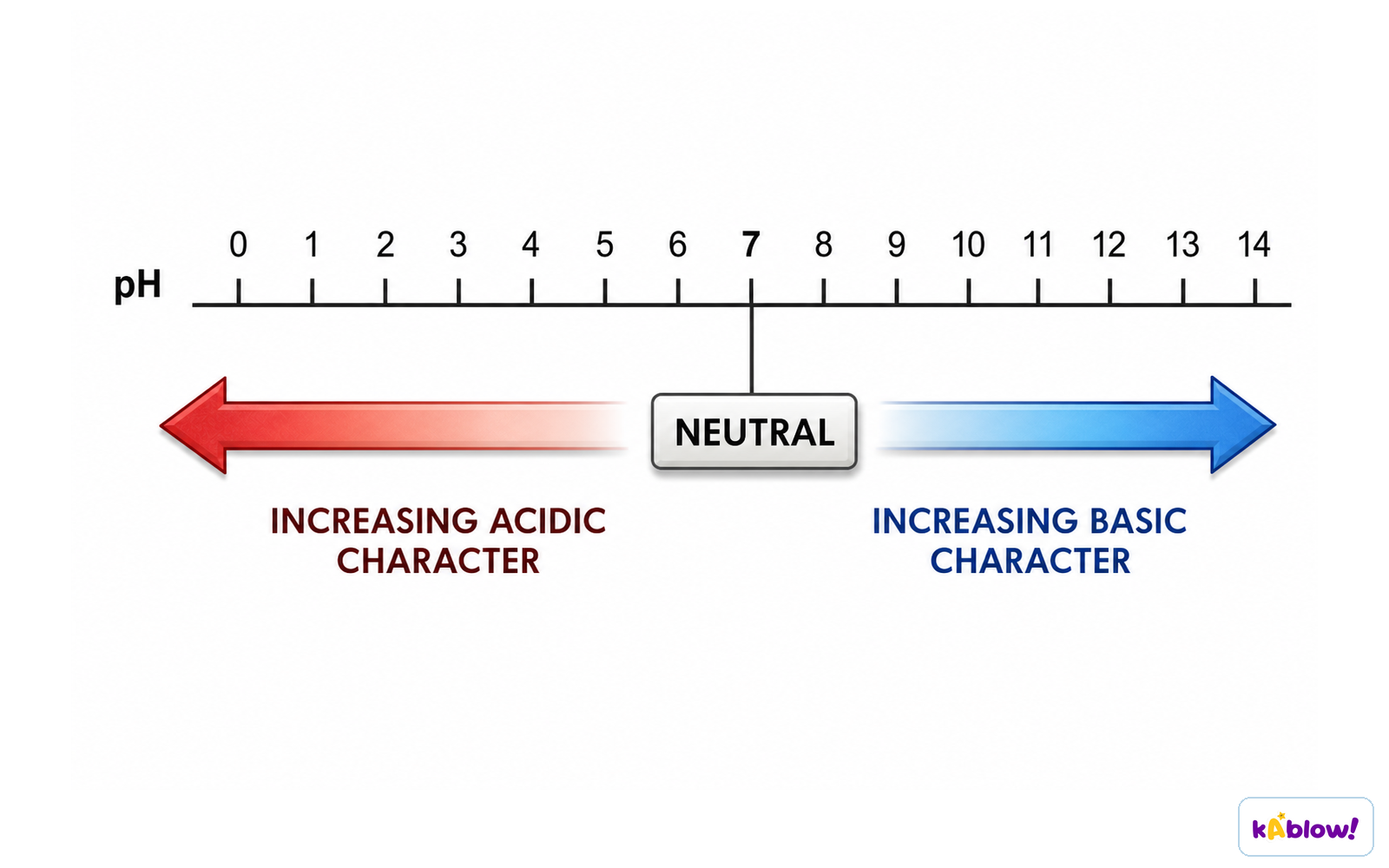
- Acidic solutions have pH < 7, basic solutions have pH > 7, and neutral solutions have pH = 7 at 298 K.
- The lower the pH, the more acidic the solution; the higher the pH, the more alkaline the solution.
- A pH meter gives the most accurate pH reading; universal indicator paper is less accurate.
The pH scale
The Ion Product of Water
- Water undergoes self-ionisation: H₂O(l) ⇌ H⁺(aq) + OH⁻(aq).
- The ion product of water, Kw, is defined as Kw = [H⁺][OH⁻].
- At 298 K, Kw = 1.00 × 10⁻¹⁴ mol² dm⁻⁶.
- In pure water at 298 K, [H⁺] = [OH⁻] = 1.00 × 10⁻⁷ mol dm⁻³, so pH = 7.
- The ionisation of water is endothermic; increasing temperature increases Kw and decreases the pH of pure water.
- Pure water remains neutral at any temperature because [H⁺] = [OH⁻].
Strong and Weak Acids and Bases
- A strong acid dissociates almost completely in aqueous solution (e.g. HCl, HNO₃, H₂SO₄).
- A weak acid dissociates only partially in aqueous solution (e.g. CH₃COOH, HCN, H₂CO₃).
- A strong base dissociates almost completely (e.g. Group 1 metal hydroxides).
- A weak base dissociates only partially (e.g. NH₃, amines).
- Strong acids have a higher [H⁺], lower pH, greater electrical conductivity, and react more vigorously with metals than weak acids of the same concentration.
- For hydrogen halides, acid strength increases down Group 17: HF < HCl < HBr < HI, because the H–X bond becomes longer and weaker.
Neutralisation Reactions
- A neutralisation reaction is: acid + base → salt + water.
- The essential reaction is H⁺(aq) + OH⁻(aq) → H₂O(l).
- The salt is formed from the spectator ions not involved in water formation.
- Acid + metal → salt + hydrogen; acid + metal oxide → salt + water; acid + metal hydroxide → salt + water.
- Acid + metal carbonate → salt + water + carbon dioxide; acid + metal hydrogencarbonate → salt + water + carbon dioxide.
- The salt produced depends on the acid used: hydrochloric acid forms chlorides, nitric acid forms nitrates, sulfuric acid forms sulfates.
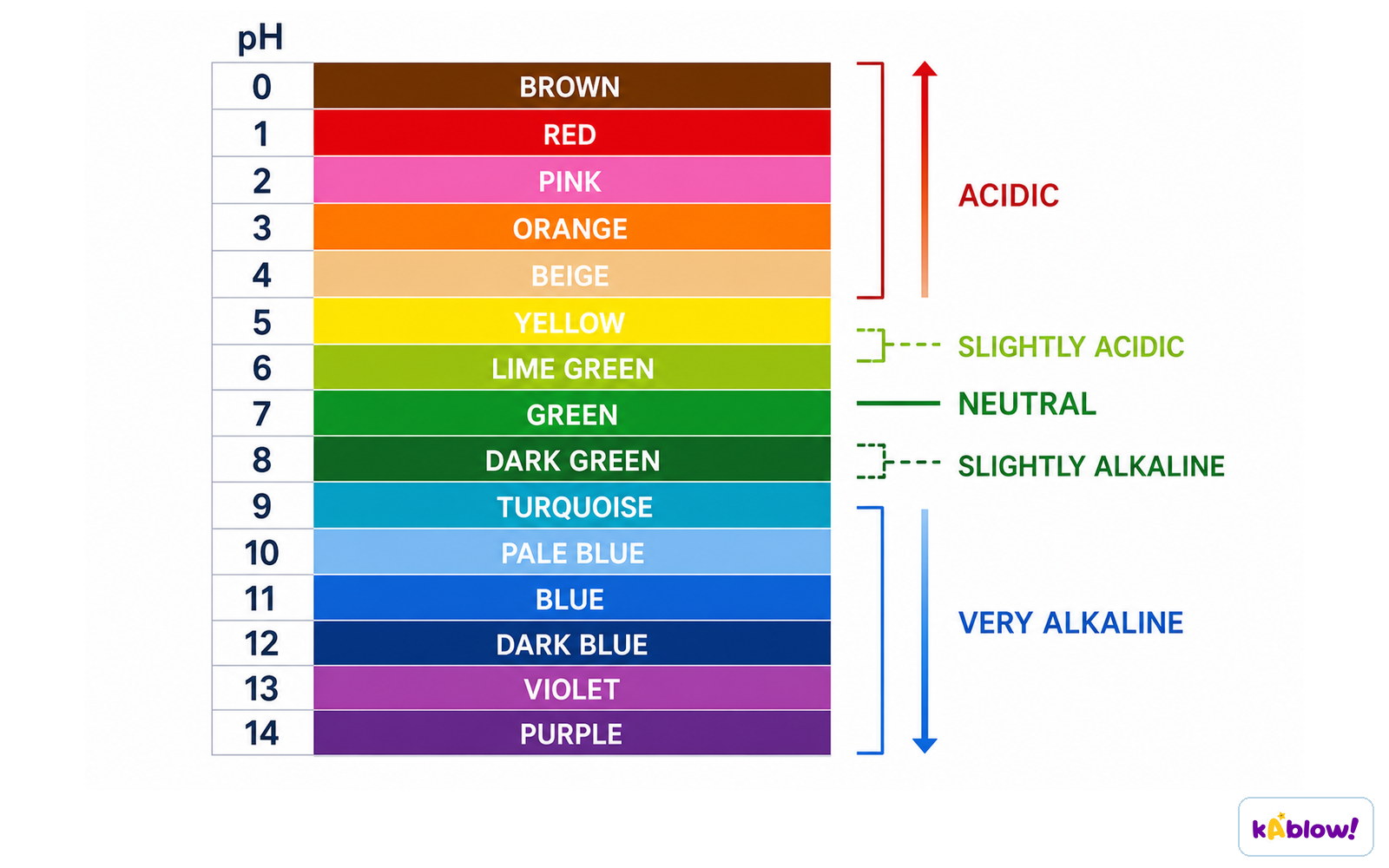
Universal indicator across the pH scale
pH Curves and Indicators
- A pH curve shows how pH changes as acid or base is added during a titration.
- All pH curves are S-shaped; the midpoint of the vertical section is the equivalence point.
- Strong acid–strong base: equivalence point at pH 7.
- Weak acid–strong base: equivalence point above pH 7; at half-equivalence, pH = pKa.
- Weak base–strong acid: equivalence point below pH 7; at half-equivalence, pOH = pKb.
- Weak acid–weak base: no sharp vertical section, so the equivalence point is difficult to determine and no suitable indicator exists.
The pOH Scale and Acid–Base Calculations (HL)
- pOH is defined as pOH = –log[OH⁻].
- The hydroxide concentration can be found from pOH using [OH⁻] = 10^(–pOH).
- At 298 K, pH + pOH = 14.
- The hydrogen ion concentration can be calculated from [OH⁻] using [H⁺] = Kw / [OH⁻].
- For a strong acid, pH = –log[acid] (for monoprotic acids).
- For a strong base, first find [OH⁻], then pOH, then pH = 14 – pOH.
Acid and Base Dissociation Constants (HL)
- The acid dissociation constant, Ka, for HA(aq) ⇌ H⁺(aq) + A⁻(aq) is Ka = [H⁺][A⁻] / [HA].
- The base dissociation constant, Kb, for B(aq) + H₂O(l) ⇌ BH⁺(aq) + OH⁻(aq) is Kb = [BH⁺][OH⁻] / [B].
- pKa = –log Ka and pKb = –log Kb.
- A larger Ka (smaller pKa) means a stronger acid; a larger Kb (smaller pKb) means a stronger base.
- For conjugate acid–base pairs, Ka × Kb = Kw.
- The range of pKa values for most weak acids is between 3 and 7.
投影片
練習題
免費預覽——58 題中的 8 題。註冊即可查看全部。
1.Using your knowledge of the Brønsted-Lowry theory, which of the following correctly describes ammonia?
Easy- Aneutral
- Bacid
- Cbase
- Damphoteric
2.In the Brønsted–Lowry theory of acids and bases, the difference between a conjugate acid and its conjugate base is the presence of which of the following?
Easy- Aa positive charge
- Ba pair of electrons
- Ca proton
- Da hydrogen atom
3.Which of the following ions or compounds is amphiprotic?
Medium- APO₄³⁻
- BHCO₃⁻
- CAl₂O₃
- DP₄O₁₀
4.In the following reaction, identify which two species are acting as Brønsted–Lowry acids: H₃PO₄(aq) + OH⁻(aq) ⇋ H₂PO₄⁻(aq) + H₂O(l)
Medium- AH₂PO₄⁻(aq) and OH⁻(aq)
- BH₃PO₄(aq) and H₂PO₄⁻(aq)
- CH₂PO₄⁻(aq) and H₂O(l)
- DH₃PO₄(aq) and H₂O(l)
5.Potassium hydrogen carbonate reacts vigorously with dilute sulfuric acid. Identify the correct formulas of the substances produced in the reaction.
Medium- AK₂SO₄ + H₂O + CO₂
- BK₂SO₄ + CO₂
- CKSO₄ + H₂O + CO₂
- DKSO₄ + H₂CO₃
6.Copper(II) sulfate can be made by the reaction between dilute sulfuric acid and which of the following? I. Cu II. CuO III. CuCO₃
Easy- AI and II only
- BI and III only
- CII and III only
- DI, II and III
7.Which statement is correct for the following equation? HSO₄⁻(aq) + OH⁻(aq) ⇌ SO₄²⁻(aq) + H₂O(l)
Medium- AOH⁻ and H₂O are an acid and conjugate base pair
- BSO₄²⁻ is acting as Brønsted–Lowry acid
- CHSO₄⁻ and SO₄²⁻ are a base and conjugate acid pair
- DOH⁻ and H₂O are a base and conjugate acid pair
8.Which of the following statements about amphiprotic species are correct? (select all that apply)
Medium- AThey can donate a proton.
- BThey can accept a proton.
- CAll amphiprotic species are also amphoteric.
- DAll amphoteric species are also amphiprotic.
- EThey must contain a metal ion.