The Covalent Model
邊玩邊學
回答這些題目賺取能量,接著就能釣魚、探索。不需要帳號。
給教育者: 為 The Covalent Model(Chemistry、HL)準備好可直接使用的課程投影片, 複習筆記——用於你的課程,或把這個主題當成互動班級活動,讓學習者以即時遊戲的方式進行。
課程筆記
Covalent Bonds
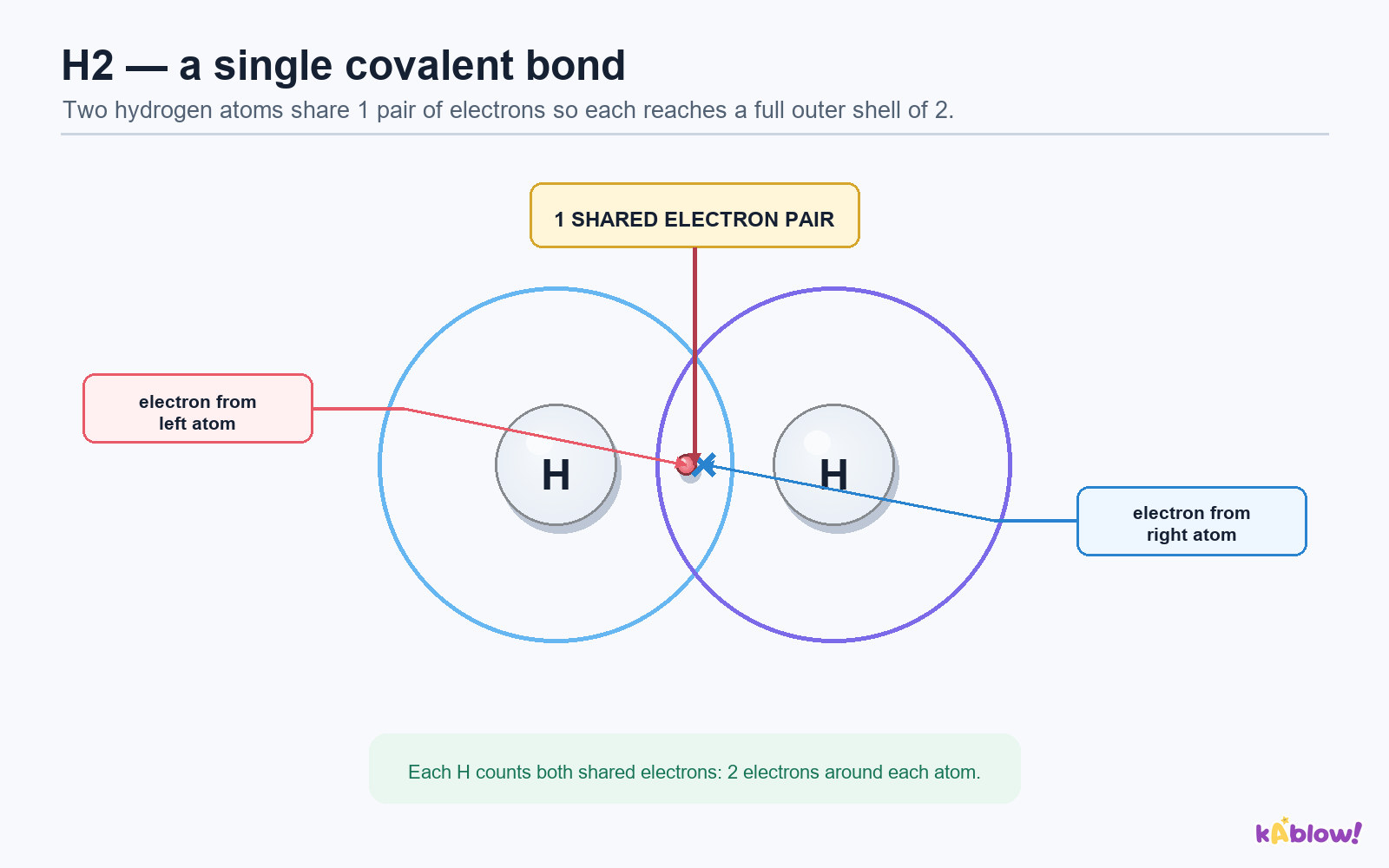
- Covalent bonding occurs between two non-metals and is the electrostatic attraction between a shared pair of electrons and the positively charged nuclei of two atoms.
- No electrons are transferred; electrons are shared between atoms, and each atom typically contributes one electron to the shared pair.
- When a covalent bond forms, two atomic orbitals overlap to form a molecular orbital.
- Covalent bonding occurs because electrons are more stable when shared between two nuclei than when held by one atom alone.
- By sharing electrons, both atoms achieve a noble gas configuration, making them more stable.
- A single covalent bond is represented by a short straight line, e.g. H–H, Cl–Cl, H–Br.
- Covalent bonds are not fixed lines; the shared electrons are constantly moving and are best represented as charge clouds.
- The octet rule refers to the tendency of atoms to gain a valence shell with a total of 8 electrons; exceptions include electron-deficient and expanded octet species.
A single covalent bond
Lewis Formulas
- Lewis formulas (electron dot diagrams) show all valence electrons in a covalently bonded species, including bonding pairs and lone pairs.
- Electron pairs can be represented by dots, crosses, a combination of dots and crosses, or a line.
- Steps for drawing Lewis formulas: count total valence electrons, draw skeletal positions with the central atom (usually least electronegative) in the middle, add bonding pairs then lone pairs, and check the structure.
- When adding electron pairs, first add bonding pairs between bonded atoms, then add lone pairs to complete octets (or duets for hydrogen), starting with outer atoms.
- For methane, CH₄: total valence electrons = (1 × 4) + (4 × 1) = 8; carbon has a full octet and each hydrogen has a duet.
- For ammonia, NH₃: total valence electrons = (1 × 5) + (3 × 1) = 8; nitrogen has a full octet and one lone pair.
- For tetrachloromethane, CCl₄: total valence electrons = (1 × 4) + (4 × 7) = 32; carbon has a full octet and each chlorine has three lone pairs.
- Exceptions to the octet rule include hydrogen (stable with 2 electrons), beryllium (4 valence electrons in BeCl₂), and boron (6 valence electrons in BF₃).
Multiple Bonds
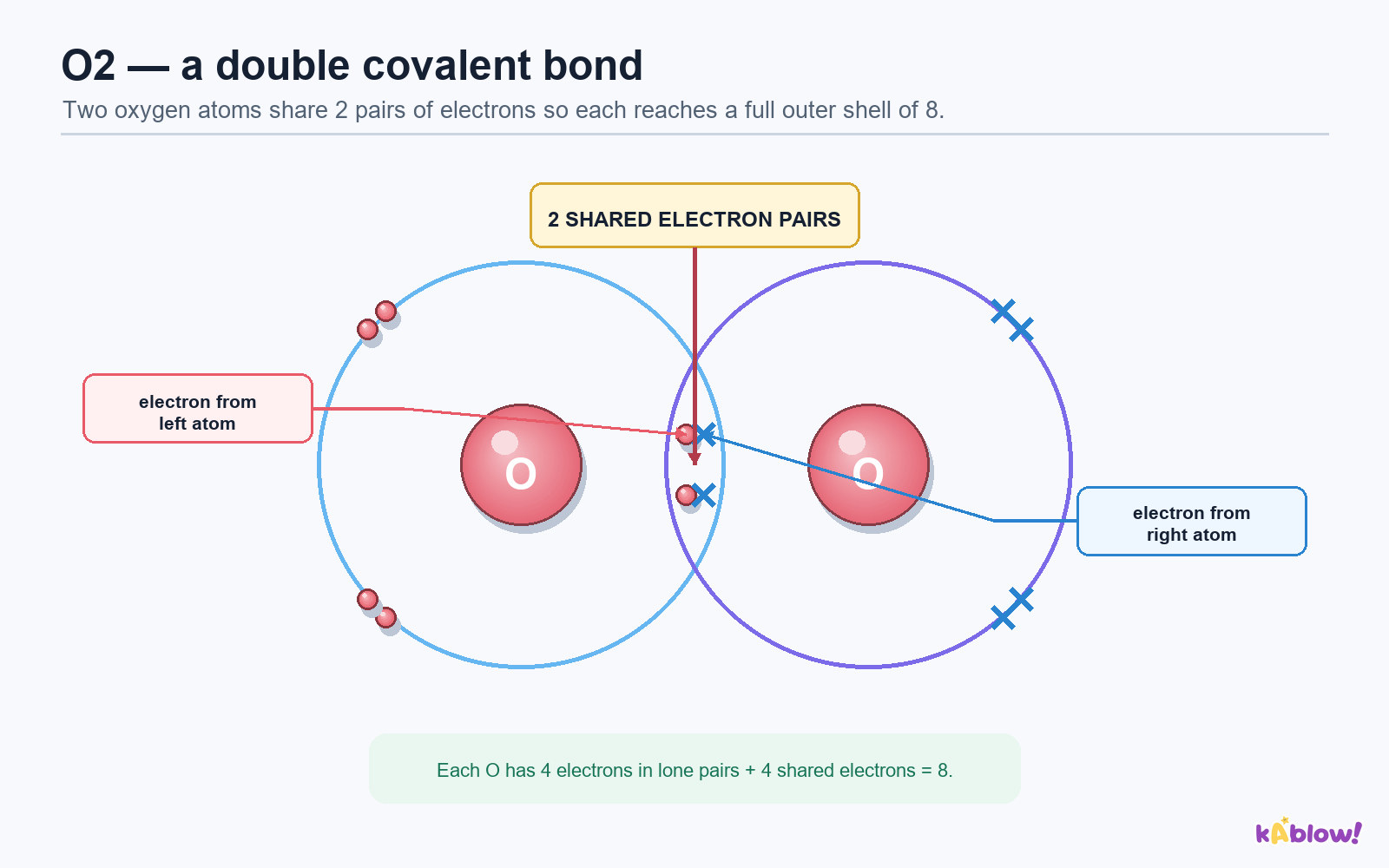
- Non-metal atoms can share more than one pair of electrons to form single, double, or triple covalent bonds.
- A single bond (C–C) has 2 shared electrons, a double bond (C=C) has 4 shared electrons, and a triple bond (C≡C) has 6 shared electrons.
- Quadruple covalent bonds are not possible because the repulsion between 8 electrons between the two nuclei is too great.
- Bond energy is the amount of energy required to break one mole of a covalent bond in the gaseous state, with units kJ mol⁻¹.
- The higher the bond energy, the stronger the bond.
- Bond length is the distance between the nuclei of two covalently bonded atoms.
- As more electrons are shared, electron density between the atoms increases, increasing electrostatic attraction and pulling atoms closer together.
- Triple bonds are the shortest and strongest covalent bonds; single bonds are the longest and weakest.
A double covalent bond
Coordinate Bonds
- In a regular covalent bond, each atom contributes one electron to the shared pair.
- In a coordinate bond, both electrons in the bond come from the same atom.
- Coordinate bonding typically occurs when one atom has a lone pair of electrons and the other atom is electron-deficient (has an unfilled outer shell).
- Example: the ammonium ion (NH₄⁺) forms when the nitrogen atom in ammonia (NH₃) donates a lone pair to an electron-deficient hydrogen ion (H⁺).
- Coordinate bonding also occurs in transition metal complexes, such as the aluminium(III) hexaaqua ion ([Al(H₂O)₆]³⁺).
- In [Al(H₂O)₆]³⁺, each oxygen atom in H₂O donates a lone pair to the Al³⁺ ion, forming six coordinate bonds.
Shapes of Molecules
- VSEPR theory states that bonding and non-bonding electron pairs around a central atom repel each other and arrange themselves as far apart as possible in three-dimensional space.
- VSEPR rules: all electron pairs spread out as far as possible; lone pairs repel more strongly than bonding pairs; multiple bonds behave like a single bond when determining shape.
- Each region of electron density around the central atom is called an electron domain; a domain may contain one, two, or three pairs of electrons.
- Two electron domains give a linear shape with a bond angle of 180° (e.g. BeCl₂, CO₂, HC≡CH).
- Three electron domains give a trigonal planar electron domain geometry with a bond angle of 120°; with one lone pair the molecular shape is bent with a bond angle of approximately 118° (e.g. SO₂).
- Four electron domains give a tetrahedral electron domain geometry with an ideal bond angle of approximately 109.5°.
- With one lone pair, the molecular shape is trigonal pyramidal with a bond angle of around 107° (e.g. NH₃); with two lone pairs, the shape is bent with a bond angle of approximately 104.5° (e.g. H₂O).
- The order of electron pair repulsion is: lone pair–lone pair > lone pair–bonding pair > bonding pair–bonding pair.
Bond and Molecular Polarity
- Electronegativity is the ability of an atom to attract the shared pair of electrons in a covalent bond; values are shown on the Pauling scale (Data Booklet Section 9).
- In diatomic molecules with identical atoms (e.g. H₂, O₂, Cl₂), electron density is shared equally, resulting in a nonpolar covalent bond.
- When two atoms have different electronegativities, the bonding electrons are drawn closer to the more electronegative atom, creating a polar covalent bond with δ⁺ and δ⁻ charges.
- The greater the difference in electronegativity, the more polar the bond and the greater the dipole moment.
- A dipole forms when there is a separation of charge across a covalent bond; the dipole arrow points toward the more electronegative atom (δ⁻).
- To determine molecular polarity, consider both the bond polarity and the arrangement of bonds in space (molecular geometry).
- Molecules with polar bonds can be nonpolar overall if the bond dipoles are arranged symmetrically and cancel out (e.g. CO₂, CCl₄).
- Molecules with polar bonds are polar overall if the bond dipoles are arranged asymmetrically and do not cancel (e.g. H₂O, NH₃, CH₃Cl).
Giant Covalent Structures
- Giant covalent structures (covalent network structures) are large networks of atoms joined by strong covalent bonds extending throughout the entire lattice.
- Examples include silicon, silicon dioxide, diamond, graphite, buckminsterfullerene, and graphene.
- In diamond, each carbon atom is covalently bonded to four others in a tetrahedral geometry with bond angles of approximately 109.5°; it is extremely hard and does not conduct electricity.
- In graphite, each carbon atom is bonded to three others in hexagonal rings arranged in flat layers with bond angles of 120°; the fourth electron is delocalised, so graphite conducts electricity and layers can slide (soft and slippery).
- Graphene is a single layer of carbon atoms in a hexagonal lattice with trigonal planar geometry and bond angles of 120°; it conducts electricity due to delocalised electrons and is strong and flexible.
- Buckminsterfullerene (C₆₀) is a molecular form of carbon made of 60 atoms in a spherical structure of interlocking hexagons and pentagons; it is a semiconductor.
- Giant covalent lattices have very high melting and boiling points because they contain a large number of strong covalent bonds requiring large amounts of energy to break.
- Most covalent network structures are insoluble in water; graphite and graphene conduct electricity due to delocalised electrons.
Intermolecular Forces
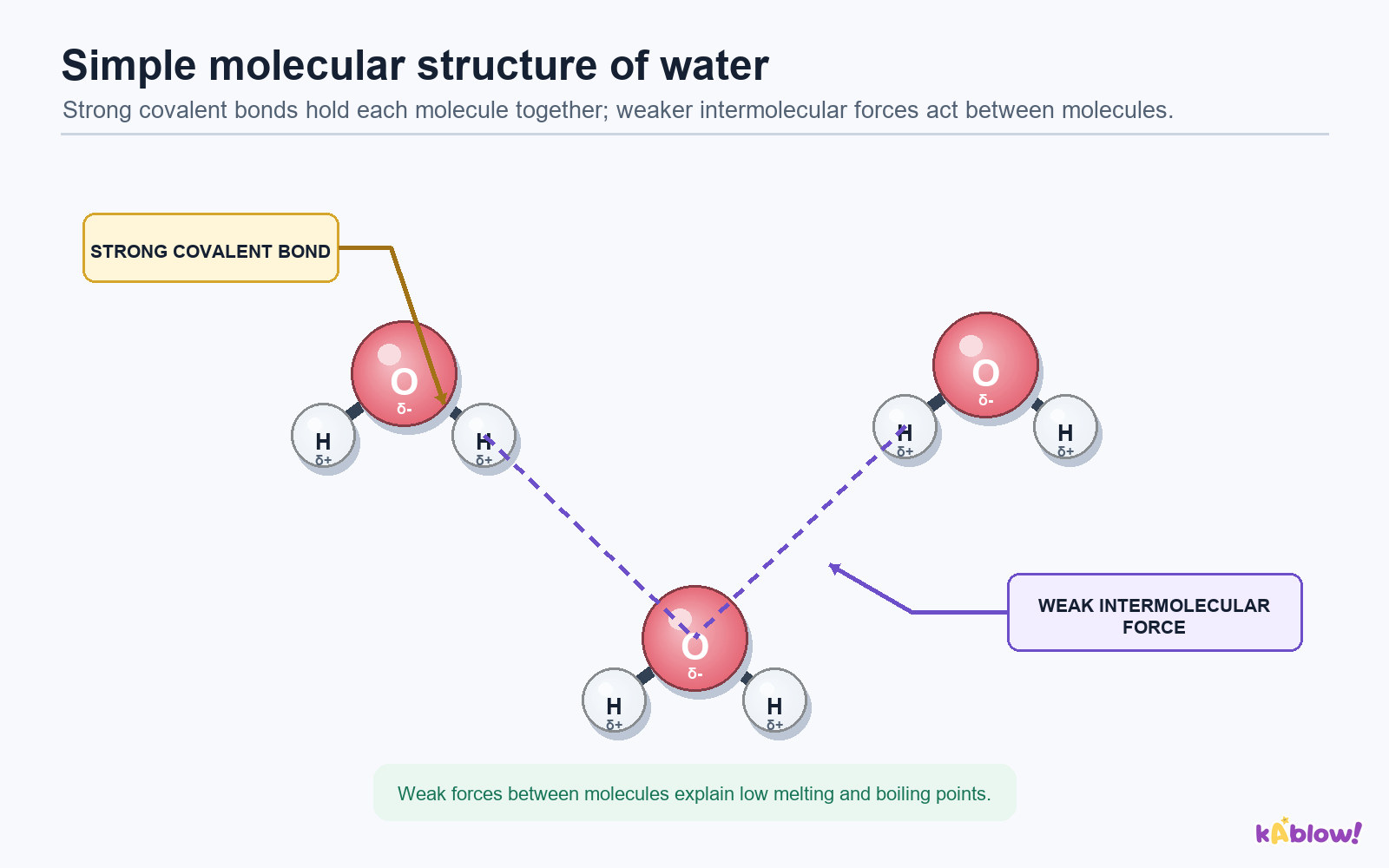
- Covalent molecular substances are held together by intermolecular forces, which are much weaker than covalent or ionic bonds.
- There are four types of intermolecular force: London (dispersion) forces, dipole–dipole attractions, dipole–induced dipole attractions, and hydrogen bonding.
- Van der Waals forces is a collective term that includes London (dispersion) forces, dipole–dipole attractions, and dipole–induced dipole attractions.
- London (dispersion) forces arise from temporary dipoles and induced dipoles; they are present between all atoms and molecules but are usually very weak (1–50 kJ mol⁻¹).
- The strength of London forces depends on the number of electrons and the surface area available for contact; more electrons and larger surface area increase the strength.
- Dipole–dipole attractions occur between the δ⁺ end of one polar molecule and the δ⁻ end of a neighbouring polar molecule, in addition to London forces.
- Dipole–induced dipole attractions occur when a polar molecule distorts the electron cloud of a nonpolar molecule, creating a temporary dipole.
- Hydrogen bonding is the strongest type of intermolecular force and requires a hydrogen atom covalently bonded to O, N, or F, and a lone pair on an O, N, or F atom in a neighbouring molecule.
Simple molecular structure of water: strong covalent bonds within each molecule, weak intermolecular forces between molecules.
Physical Properties of Covalent Substances
- The physical properties of molecular covalent compounds are largely influenced by their intermolecular forces.
- When molecular covalent substances change state, the intermolecular forces between their molecules are overcome, not the covalent bonds.
- The stronger the intermolecular forces, the higher the melting and boiling point; substances with low boiling points are described as volatile.
- The strength of intermolecular forces depends on the size (molar mass) of the molecule, the polarity of the molecule, and the type of intermolecular force present.
- The order of intermolecular force strength is: London < dipole–dipole < hydrogen bonding.
- The general rule for solubility is “like dissolves like”: nonpolar substances dissolve in nonpolar solvents, and polar substances dissolve in polar solvents.
- Most covalent network structures are insoluble in water and do not conduct electricity, except graphite and graphene which conduct due to delocalised electrons.
投影片
練習題
免費預覽——62 題中的 8 題。註冊即可查看全部。
1.Which statement best defines a covalent bond?
Easy- AThe electrostatic attraction between a shared pair of electrons and the positively charged nuclei of two atoms
- BThe transfer of electrons from a metal to a non-metal
- CThe attraction between oppositely charged ions in a lattice
- DA weak force of attraction between molecules
2.In a typical covalent bond, each atom contributes one electron to the shared pair.
EasyTrue or false?
3.Which of the following molecules contains a coordinate bond?
Easy- ANH4+
- BCH4
- CH2O
- DCO2
4.Which of the following statements about sigma (σ) and π (π) bonds are correct? (select all that apply)
Medium- AA sigma bond is formed by the end-on overlap of atomic orbitals.
- BA π bond is formed by the sideways overlap of p-orbitals.
- CA sigma bond is weaker than a π bond.
- DA π bond allows free rotation about the bond axis.
- EA sigma bond has electron density concentrated along the internuclear axis.
5.Match each molecule with its molecular geometry.
Medium- CH4
- NH3
- H2O
- CO2
- Tetrahedral
- Trigonal pyramidal
- Bent
- Linear
6.Arrange the following carbon-carbon bonds in order of increasing bond length.
Medium- C≡C (triple bond)
- C=C (double bond)
- C–C (single bond)
7.Which of the following molecules is polar overall?
Medium- ACCl4
- BCO2
- CCH3Cl
- DBF3
8.Graphite conducts electricity because each carbon atom forms four covalent bonds, leaving no free electrons.
MediumTrue or false?
歷屆試題
這個主題的歷屆試題練習即將推出。
即將推出