The Ionic Model
邊玩邊學
回答這些題目賺取能量,接著就能釣魚、探索。不需要帳號。
課程筆記
Forming Ions
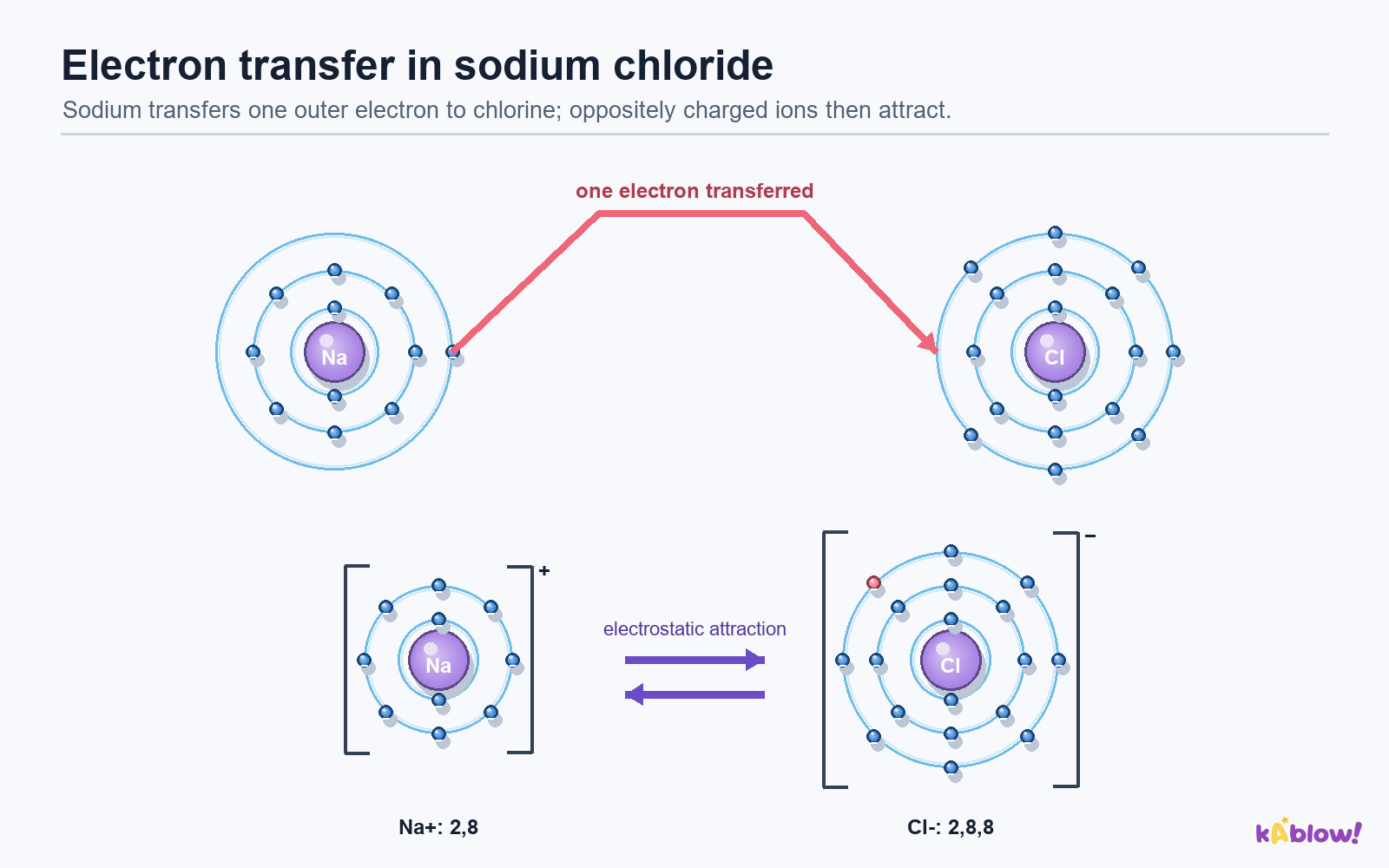
- Ionic bonds form by the transfer of electrons from a metallic element to a non-metallic element.
- Metals lose electrons from their valence shell to form positively charged cations.
- Non-metal atoms gain electrons to form negatively charged anions.
- Electron transfer usually gives both ions the electronic configuration of a noble gas.
- For example, Na⁺ has the same configuration as Ne ([2,8]) and Cl⁻ the same as Ar ([2,8,8]).
- The group of an element tells you how many electrons it is likely to lose or gain.
Formation of ions
Binary Ionic Compounds
- A binary ionic compound is composed of ions of two different elements: a metal cation and a non-metal anion.
- Ionic bonding is the force of attraction between oppositely charged species/ions.
- The electrostatic attractions between cations and anions are very strong and require a lot of energy to overcome, giving ionic compounds high melting points.
- Binary ionic compounds are named with the cation first, followed by the anion which takes the suffix -ide (e.g. sodium iodide).
- Ionic compounds are electrically neutral: the total positive charge equals the total negative charge.
Charges on Ions
- All metals form positive ions; some non-metals also form positive ions such as ammonium, NH₄⁺, and hydrogen, H⁺.
- Group 1, 2 and 13 metals form ions with charges of +1, +2 and +3 respectively.
- Transition elements can form ions with variable charges, shown using Roman numerals (Stock notation), e.g. copper(II) oxide has Cu²⁺ and copper(I) nitrate has Cu⁺.
- Non-metals in Groups 15–17 form negative ions with the suffix -ide: Group 17 gains 1 electron (1−), Group 16 gains 2 (2−), Group 15 gains 3 (3−).
- Examples: Br⁻, O²⁻, N³⁻.
Polyatomic Ions
- Polyatomic ions are ions made up of more than one type of atom; they are sometimes called compound negative ions.
- Most are negative, but some are positive, such as the ammonium ion, NH₄⁺.
- The seven polyatomic ions you need to know are: ammonium NH₄⁺, hydroxide OH⁻, nitrate NO₃⁻, hydrogencarbonate HCO₃⁻, carbonate CO₃²⁻, sulfate SO₄²⁻ and phosphate PO₄³⁻.
- When more than one polyatomic ion is needed in a formula, it is placed in brackets with the number outside, e.g. Ca(NO₃)₂.
Writing Formulae of Ionic Compounds
- To determine a formula, balance the positive and negative charges so they are equal.
- Magnesium chloride: Mg²⁺ and Cl⁻ → MgCl₂ (two chloride ions per magnesium ion).
- Aluminium oxide: Al³⁺ and O²⁻ → Al₂O₃ (two aluminium ions and three oxide ions).
- Ammonium sulfate: NH₄⁺ and SO₄²⁻ → (NH₄)₂SO₄ (two ammonium ions per sulfate ion).
Ionic Lattices
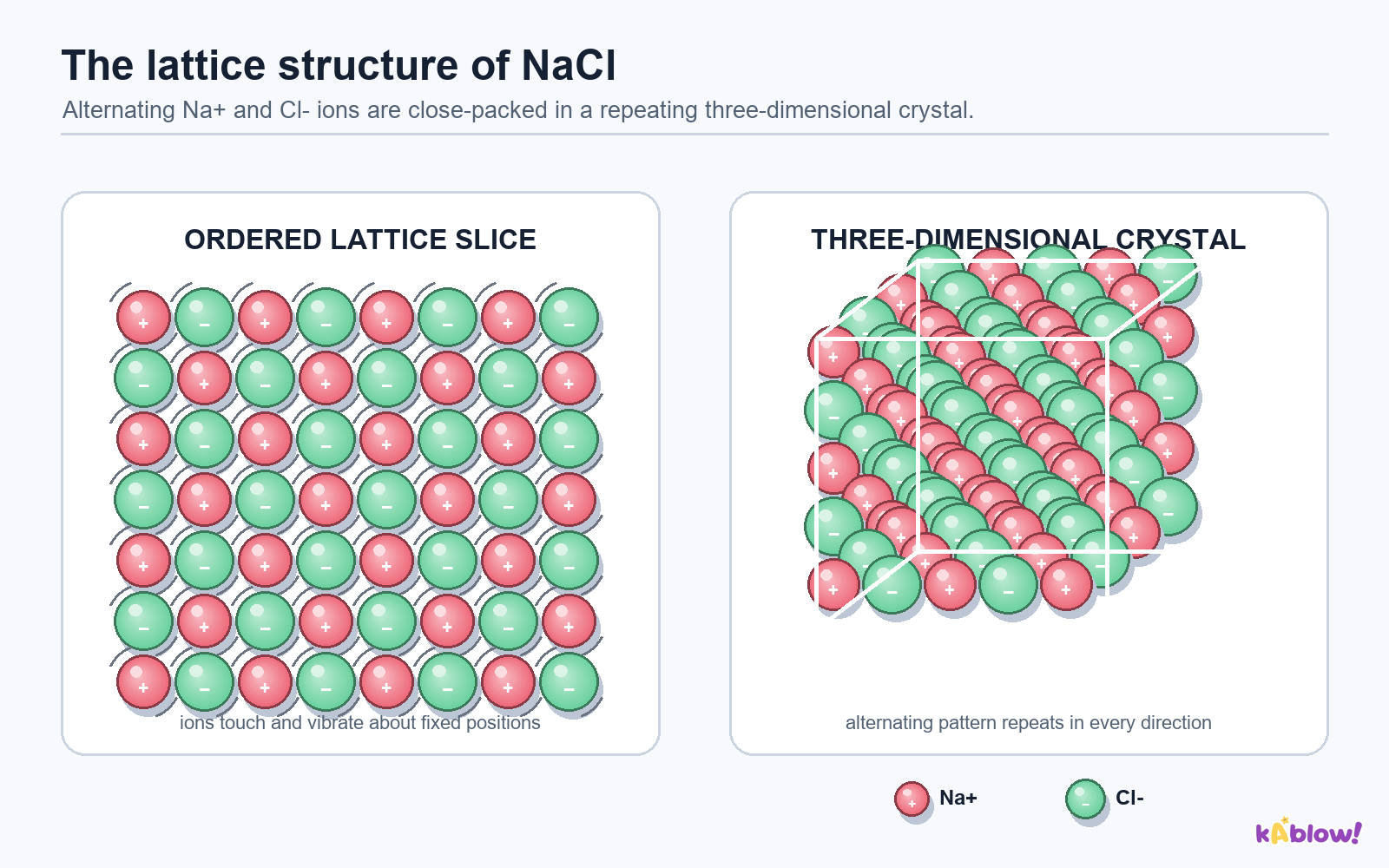
- An ionic lattice is a crystalline structure formed by ions in a regular, repeating pattern.
- The lattice consists of alternating cations and anions arranged so that positive and negative charges cancel out; the lattice is overall electrically neutral.
- Ionic compounds are represented using empirical formulas, which show the simplest whole-number ratio of ions.
- The strong electrostatic forces of attraction between the oppositely charged ions hold the lattice together — this is one definition of ionic bonding.
The lattice structure of sodium chloride
Lattice Enthalpy
- Lattice dissociation enthalpy (ΔHlatt) is the standard enthalpy change on the formation of 1 mole of gaseous ions from the solid lattice.
- Example: NaCl(s) → Na⁺(g) + Cl⁻(g) ΔHlatt = +790 kJ mol⁻¹.
- Lattice enthalpy increases as ionic charge increases and ionic radius decreases, due to stronger electrostatic attractions.
- The process is always endothermic (positive ΔH) because energy is always required to break the bonds between ions in the lattice.
Properties of Ionic Compounds
- Ionic compounds are strong and brittle: crystals shatter when layers shift and like charges align.
- They have high melting and boiling points because the strong electrostatic forces act in all directions; melting/boiling points increase with the charge density of the ions (e.g. MgO has a higher melting point than NaCl).
- Ionic compounds are not volatile — large amounts of energy are needed to overcome the strong electrostatic forces.
- They are generally soluble in water because polar water molecules hydrate the ions, forming ion–dipole interactions; lower solvent polarity reduces solubility.
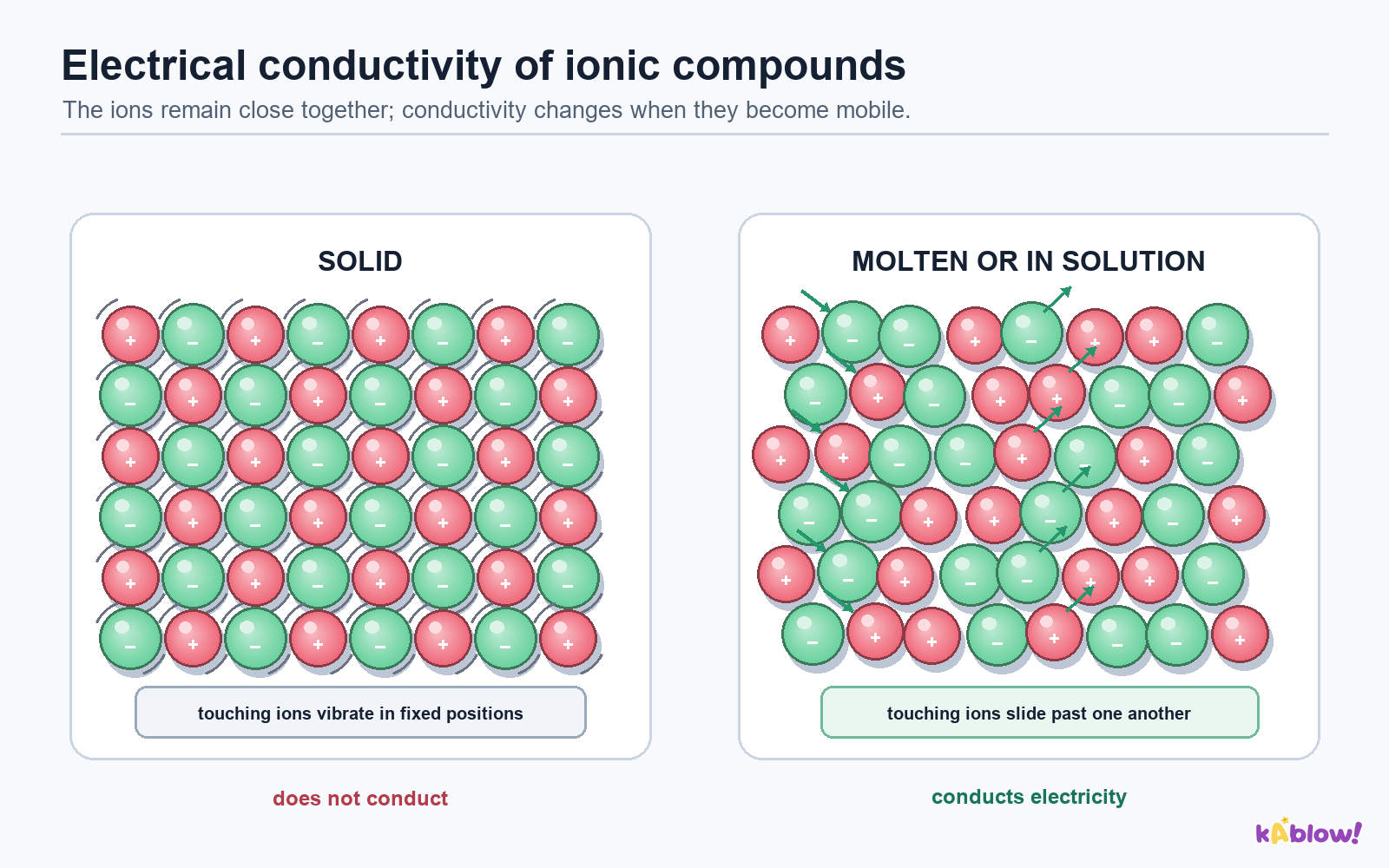
- They only conduct electricity when molten or in solution, because the ions are then free to move; as a solid the ions are in fixed positions.
Electrical conductivity of ionic compounds
Comparing Ionic Lattices with Other Structures
- Giant ionic: high melting/boiling points, conduct only when molten or in solution, generally soluble, hard and brittle, solid at room temperature; particles are ions held by electrostatic attraction.
- Giant metallic: moderately high to high melting/boiling points, conduct when solid or liquid, insoluble, hard and malleable; particles are positive ions in a sea of delocalised electrons.
- Simple covalent: low melting/boiling points, do not conduct electricity, usually insoluble unless polar, soft; particles are small molecules with weak intermolecular forces.
- Giant covalent: very high melting/boiling points, do not conduct electricity (except graphite), insoluble, very hard (diamond/silica) or soft (graphite); particles are atoms with covalent bonds between them.
投影片
練習題
免費預覽——61 題中的 8 題。註冊即可查看全部。
1.Which of the following statements about ions and ionic compounds are true? I. Nitrogen can form a 3− ion II. Potassium can form a cation III. The formula for aluminium chloride is AlCl2
Medium- AI and II only
- BI and III only
- CII and III only
- DI, II and III
2.What is the correct formula for ammonium carbonate?
Medium- ANH4CO3
- B(NH4)2CO3
- C(NH4)3CO3
3.Which crystal structure does not conduct electricity when solid, has a high melting point and can conduct electricity when molten?
Medium- AGiant metallic
- BGiant ionic
- CCovalent network
- DSimple molecular
4.Which of the following compounds is not bonded ionically?
Medium- ACaCO3
- BCH3OH
- CNaOH
- DBaCl2
5.Magnesium oxide has a very high melting temperature. Which of the following is the best description of its structure and bonding?
Medium- AGiant ionic
- BGiant metallic
- CNetwork covalent
- DSimple molecular
6.Which of the following compounds has both covalent and ionic bonds?
Medium- Acalcium bromide, CaBr2
- Bpotassium carbonate, K2CO3
- Cpropanoic acid, CH3CH2COOH
- Ddichloromethane, CH2Cl2
7.Which is the best description of ionic bonding?
Medium- Aelectrostatic attraction between cations and electrons
- Belectrostatic attraction between nuclei
- Celectrostatic attraction between oppositely charged ions
- Delectrostatic attraction of nuclei towards shared electrons in the bond between the nuclei
8.Potassium bromide is an ionic compound. When can potassium bromide conduct electricity? Solid | Molten | Aqueous
Medium- A✓ | ✓ | ✗
- B✓ | ✗ | ✓
- C✗ | ✓ | ✓
- D✗ | ✗ | ✓