Diffusion, Osmosis & Active Transport
邊玩邊學
回答這些題目賺取能量,接著就能釣魚、探索。不需要帳號。
給教育者: 為 Diffusion, Osmosis & Active Transport(Biology、CIE)準備好可直接使用的課程投影片, 複習筆記, 圖表——用於你的課程,或把這個主題當成互動班級活動,讓學習者以即時遊戲的方式進行。
課程筆記
Diffusion
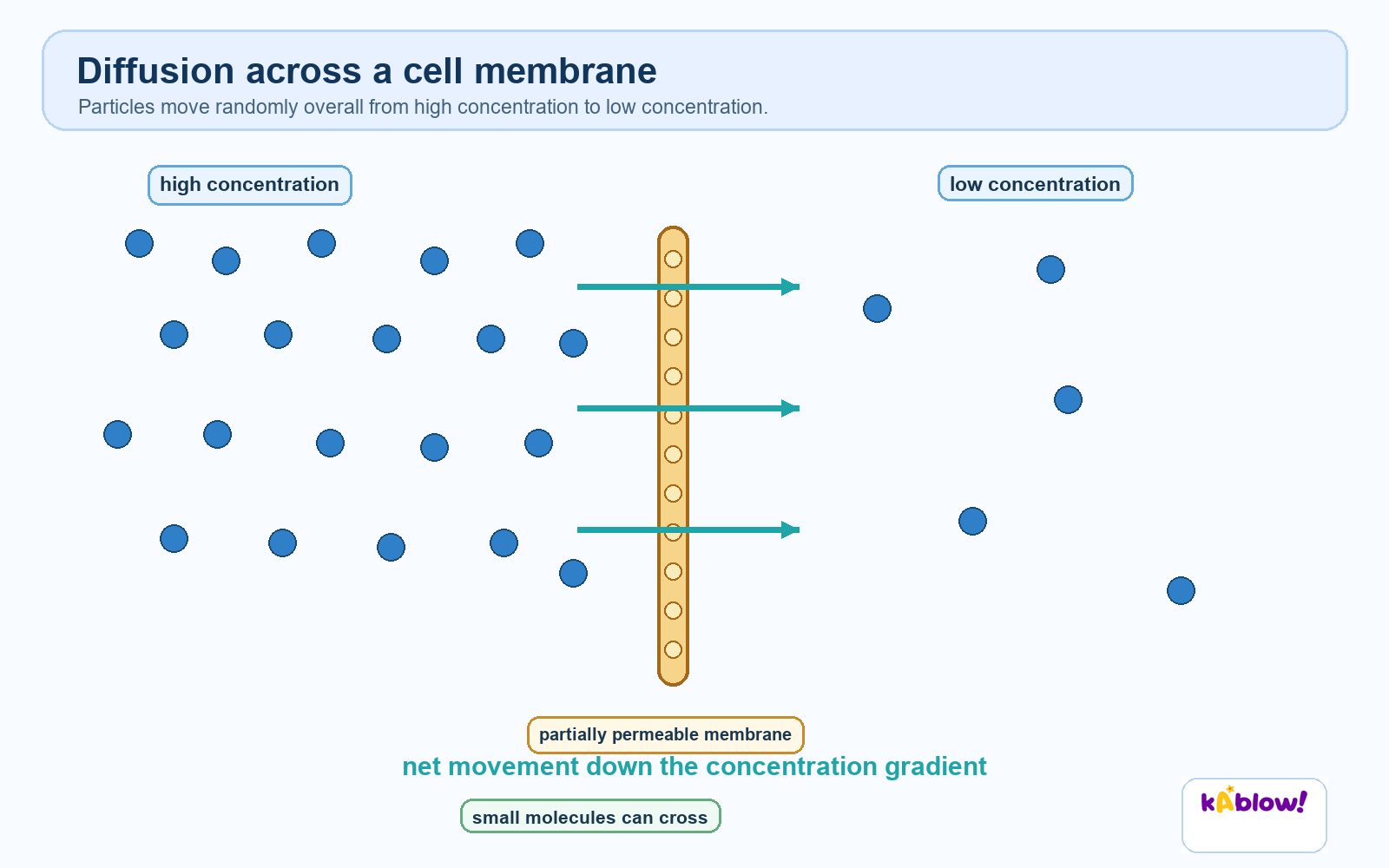
- Diffusion is the net movement of molecules from a region of higher concentration to a region of lower concentration, down a concentration gradient.
- It results from the random movement (Brownian motion) of particles; energy comes from their kinetic energy.
- The cell membrane is partially permeable, allowing only some molecules (e.g., small ones) to cross easily.
- Examples: O₂ and CO₂ move between cells and capillaries; CO₂ moves out of cells; water vapour diffuses out of leaves.
Diffusion across the cell membrane
Factors Affecting Diffusion Rate
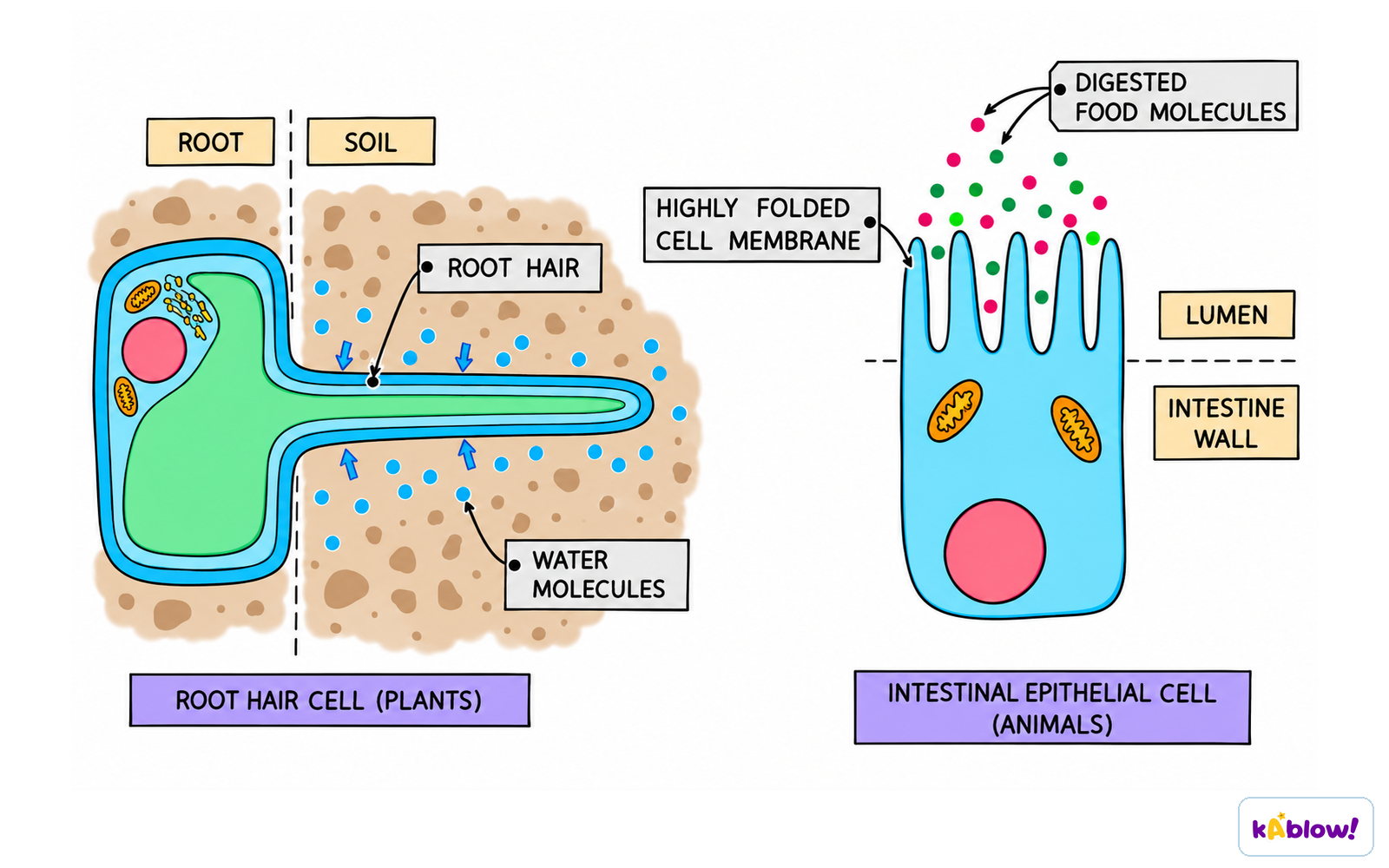
- Surface area to volume ratio: Larger SA:V increases rate; cells like root hair cells and ileum cells have folded surfaces to increase SA.
- Distance: Shorter distance (e.g., one-cell-thick walls of capillaries and alveoli) speeds up diffusion.
- Temperature: Higher temperature gives molecules more kinetic energy, increasing diffusion rate.
- Concentration gradient: A steeper gradient results in faster diffusion.
Cell adaptations for diffusion
Water as a Solvent
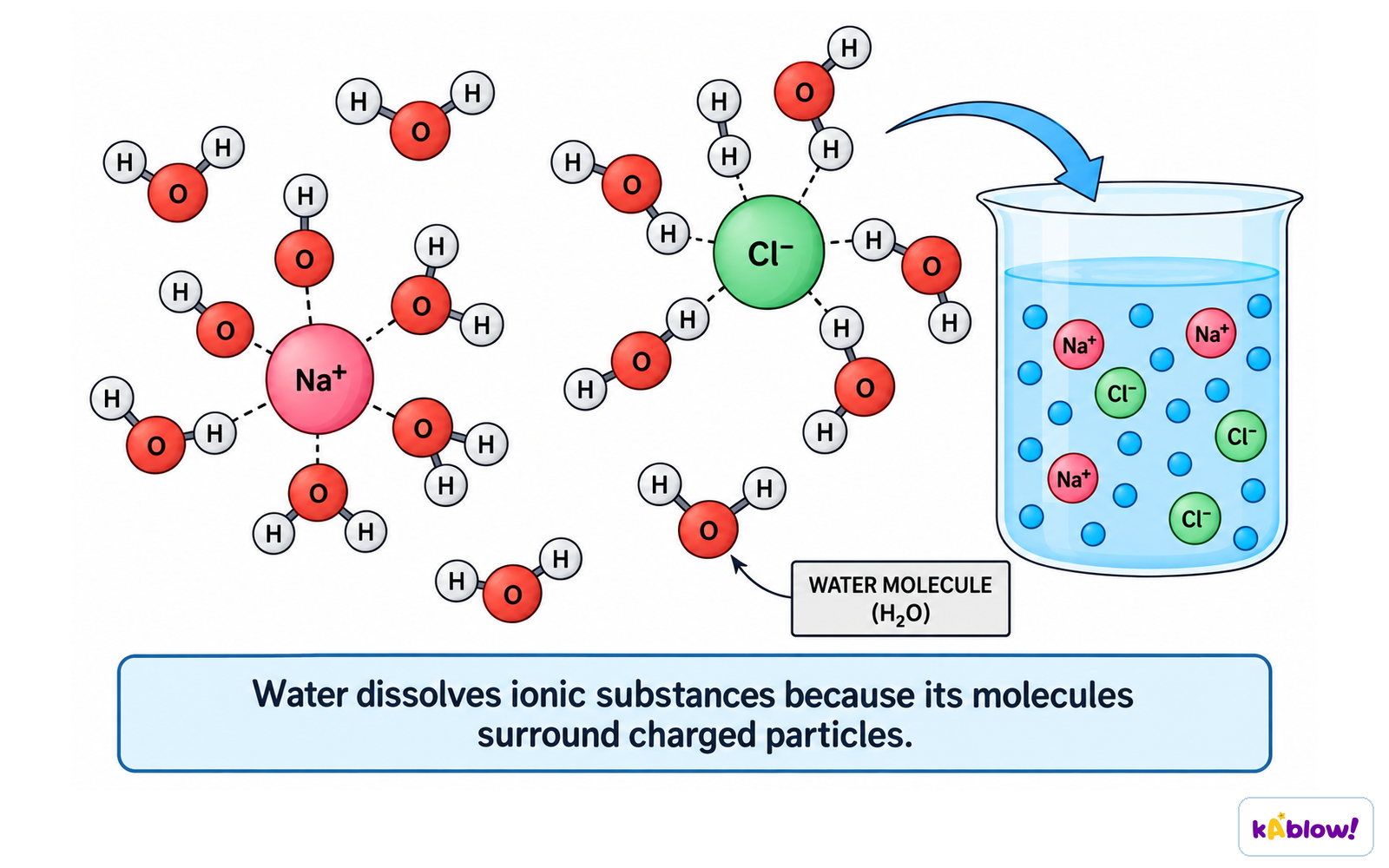
- Water is a solvent; many substances dissolve in it, enabling transport and reactions.
- Dissolved substances are transported in xylem/phloem (plants) and blood (animals).
- Digested food molecules dissolve in water for absorption; urea and excess salts dissolve for removal in urine.
- Water is a major component of cytoplasm, allowing metabolic reactions to occur.
Water as a solvent
Osmosis
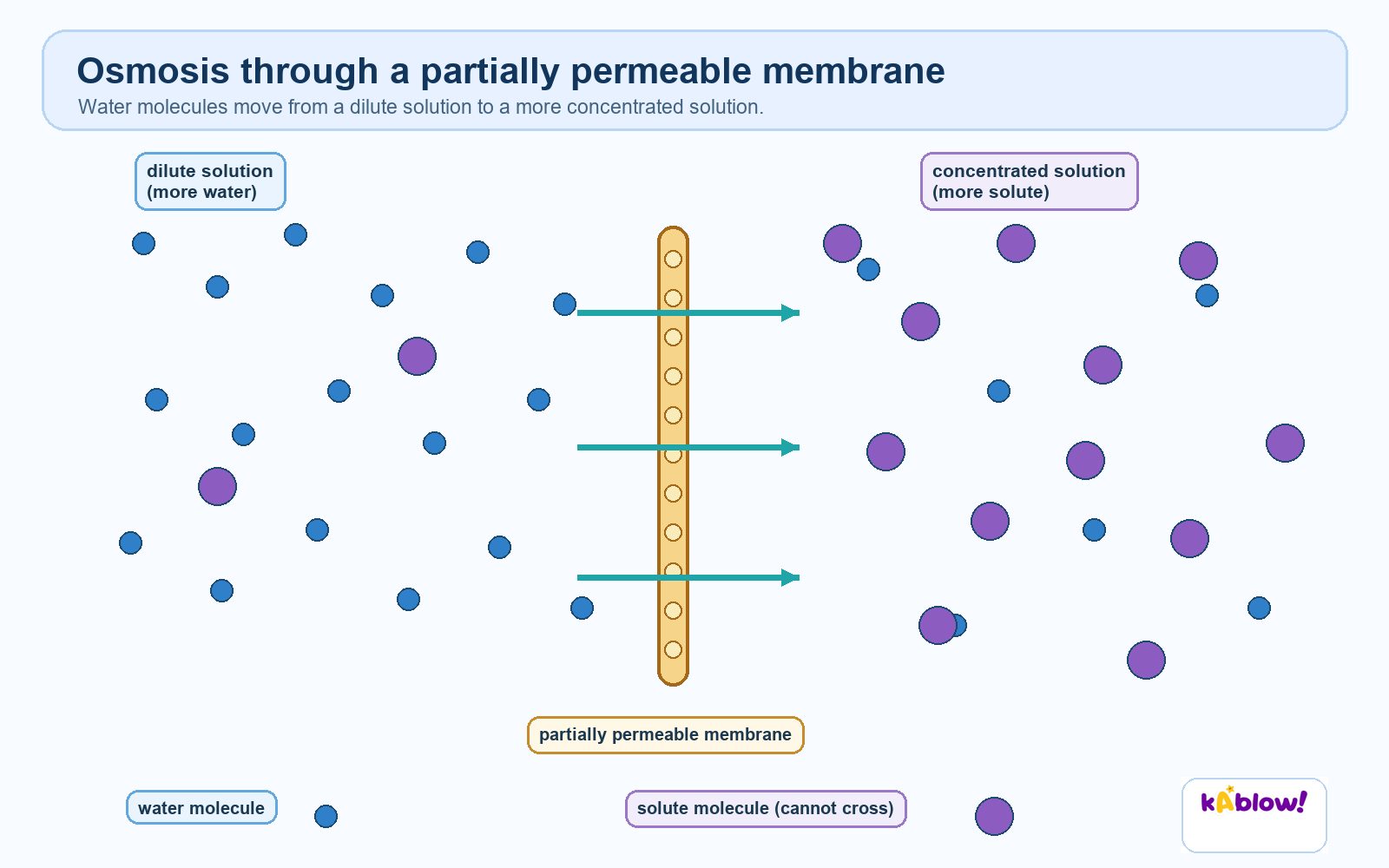
- Osmosis is the net movement of water molecules from a region of higher water potential (dilute solution) to a region of lower water potential (concentrated solution) through a partially permeable membrane.
- Water moves down its concentration gradient; the membrane allows water but not larger solute molecules to pass.
- In plant cells, water entry makes the cell turgid (firm), providing support; water loss makes it flaccid or plasmolysed (membrane pulls from wall).
- In animal cells, water entry can cause bursting (no cell wall); water loss causes crenation (shrivelling).
Osmosis and the partially permeable membrane
Osmosis Experiments
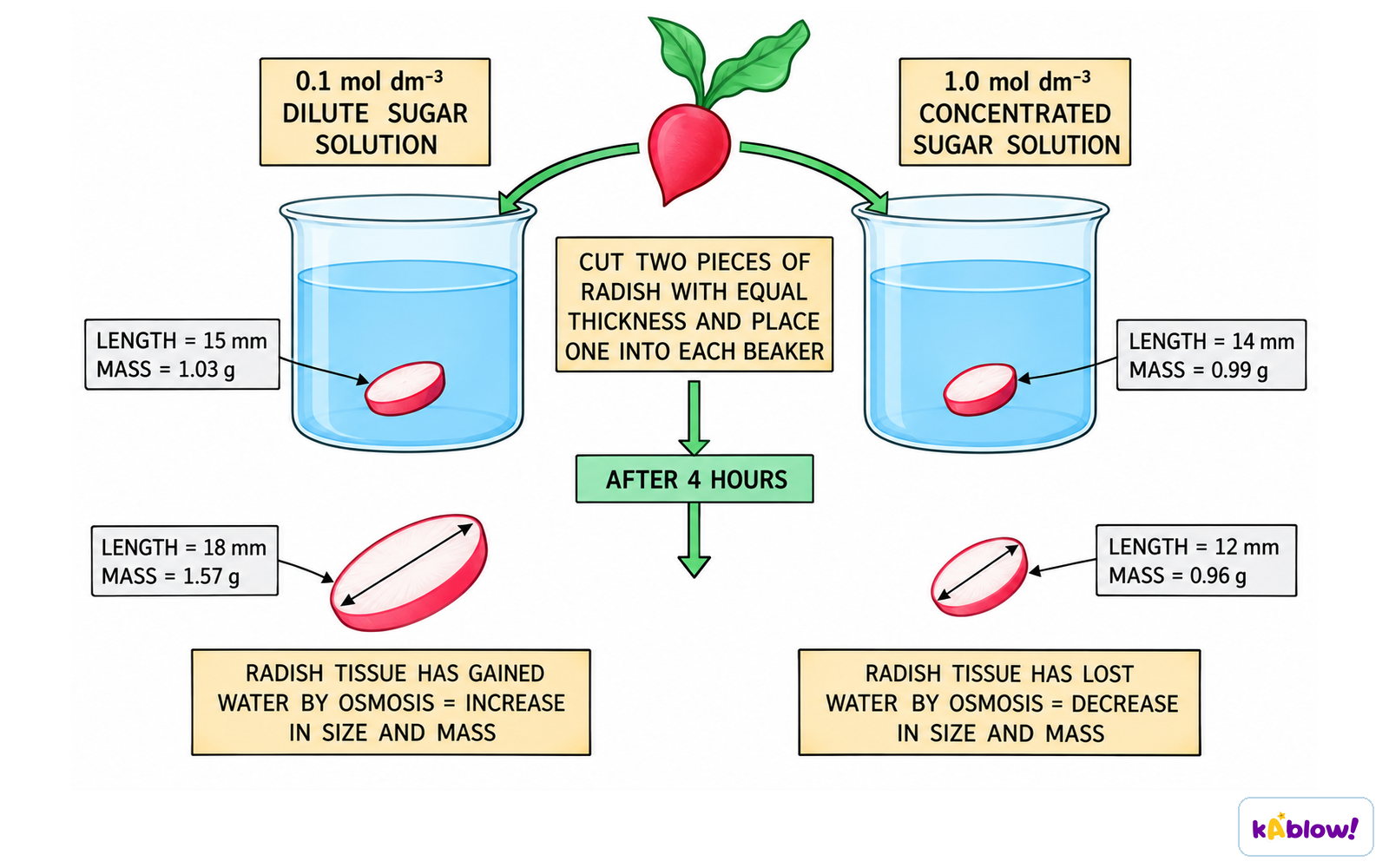
- Potato cylinder experiment: Cylinders are weighed, placed in solutions of different concentrations, then reweighed after 20–30 min.
- Mass gain → water moved into tissue (solution more dilute); mass loss → water moved out (solution more concentrated); no change → equal concentrations.
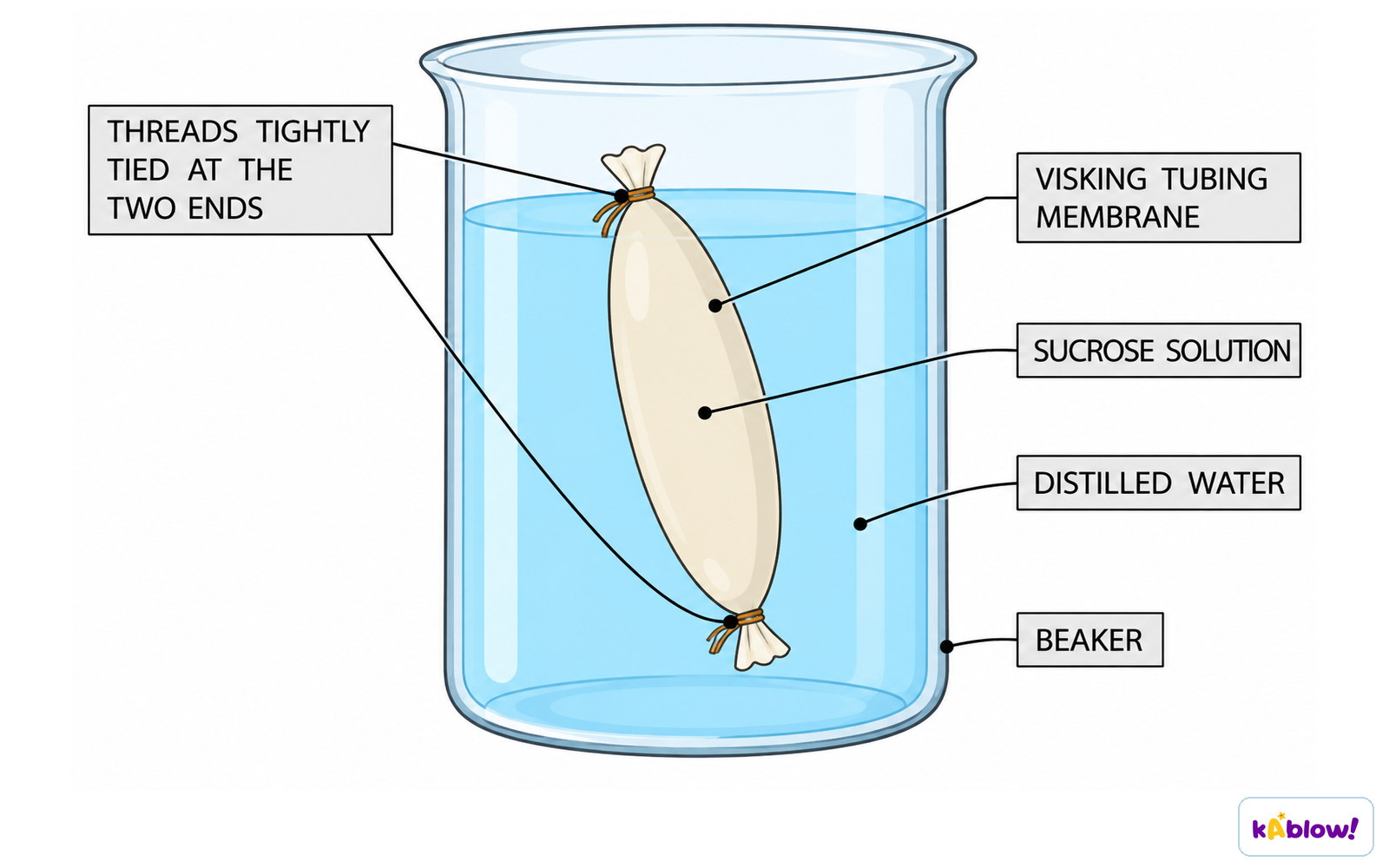
- Dialysis tubing experiment: Tubing filled with concentrated sucrose solution is placed in water; water moves in, causing the tubing to swell or the external water level to drop.
- Dialysis tubing is a non-living partially permeable membrane; it allows water and small molecules but not large solutes.
Investigating osmosis with plant tissue
Active Transport
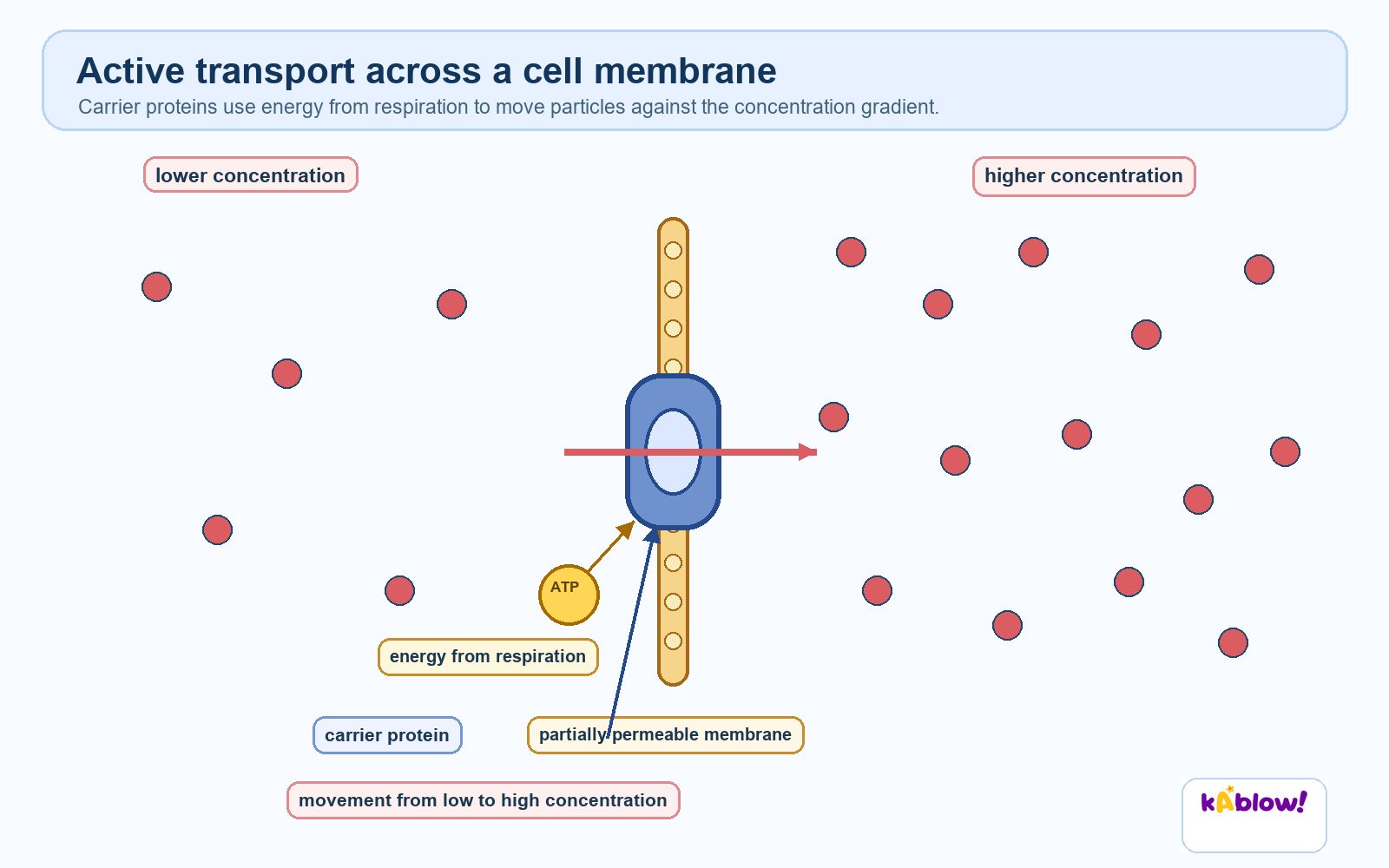
- Active transport is the movement of particles through a cell membrane from a region of lower concentration to a region of higher concentration, against a concentration gradient.
- It requires energy from respiration (ATP).
- Examples: uptake of glucose by epithelial cells of villi and kidney tubules; uptake of mineral ions by root hair cells.
- Carrier proteins in the membrane bind the substance, change shape using energy, and release it inside the cell.
The process of active transport
投影片
練習題
免費預覽——57 題中的 8 題。註冊即可查看全部。
1.What is diffusion?
Easy- AThe movement of molecules from a region of higher concentration to a region of lower concentration
- BThe movement of molecules from a region of lower concentration to a region of higher concentration
- CThe movement of water through a partially permeable membrane
- DThe movement of molecules using energy from respiration
2.Which process involves the movement of water through a partially permeable membrane from a more dilute to a more concentrated solution?
Easy- ADiffusion
- BActive transport
- COsmosis
- DTranspiration
3.What is the energy source for diffusion?
Easy- AATP from respiration
- BKinetic energy of random movement
- CLight energy
- DHeat energy from the environment
4.Which statement correctly describes active transport?
Easy- AMovement of particles down a concentration gradient using energy
- BMovement of particles against a concentration gradient using energy from respiration
- CMovement of water through a partially permeable membrane
- DMovement of particles from high to low concentration without energy
5.A potato cylinder is placed in a concentrated salt solution. After one hour, its mass has decreased. What is the correct explanation?
Medium- ASalt entered the potato cells by active transport
- BWater moved out of the potato cells by osmosis
- CWater moved into the potato cells by osmosis
- DSalt left the potato cells by diffusion
6.Which of the following is an example of active transport in plants?
Easy- AMovement of water into root hair cells
- BUptake of mineral ions from soil by root hair cells
- CMovement of carbon dioxide into leaf mesophyll cells
- DLoss of water vapour from leaves
7.A plant cell is placed in a concentrated sugar solution. Which of the following correctly describes the events that occur?
Medium- AWater enters the cell by osmosis, cell becomes turgid
- BWater leaves the cell by osmosis, cell becomes plasmolysed
- CWater enters the cell by active transport, cell bursts
- DWater leaves the cell by active transport, cell becomes flaccid
8.Which row correctly compares diffusion and osmosis?
Medium- ABoth require a partially permeable membrane and move particles down a concentration gradient
- BOnly osmosis requires a partially permeable membrane; both move particles down a concentration gradient
- CBoth require energy; diffusion moves particles down a gradient, osmosis moves water up a gradient
- DOnly diffusion requires a partially permeable membrane; osmosis moves water against a gradient
歷屆試題
這個主題的歷屆試題練習即將推出。
即將推出