Electrolysis
邊玩邊學
回答這些題目賺取能量,接著就能釣魚、探索。不需要帳號。
給教育者: 為 Electrolysis(Chemistry、CIE)準備好可直接使用的課程投影片, 複習筆記, 圖表——用於你的課程,或把這個主題當成互動班級活動,讓學習者以即時遊戲的方式進行。
課程筆記
Electrolysis Principles
- Electrolysis is the breakdown of a molten or aqueous ionic compound by an electric current.
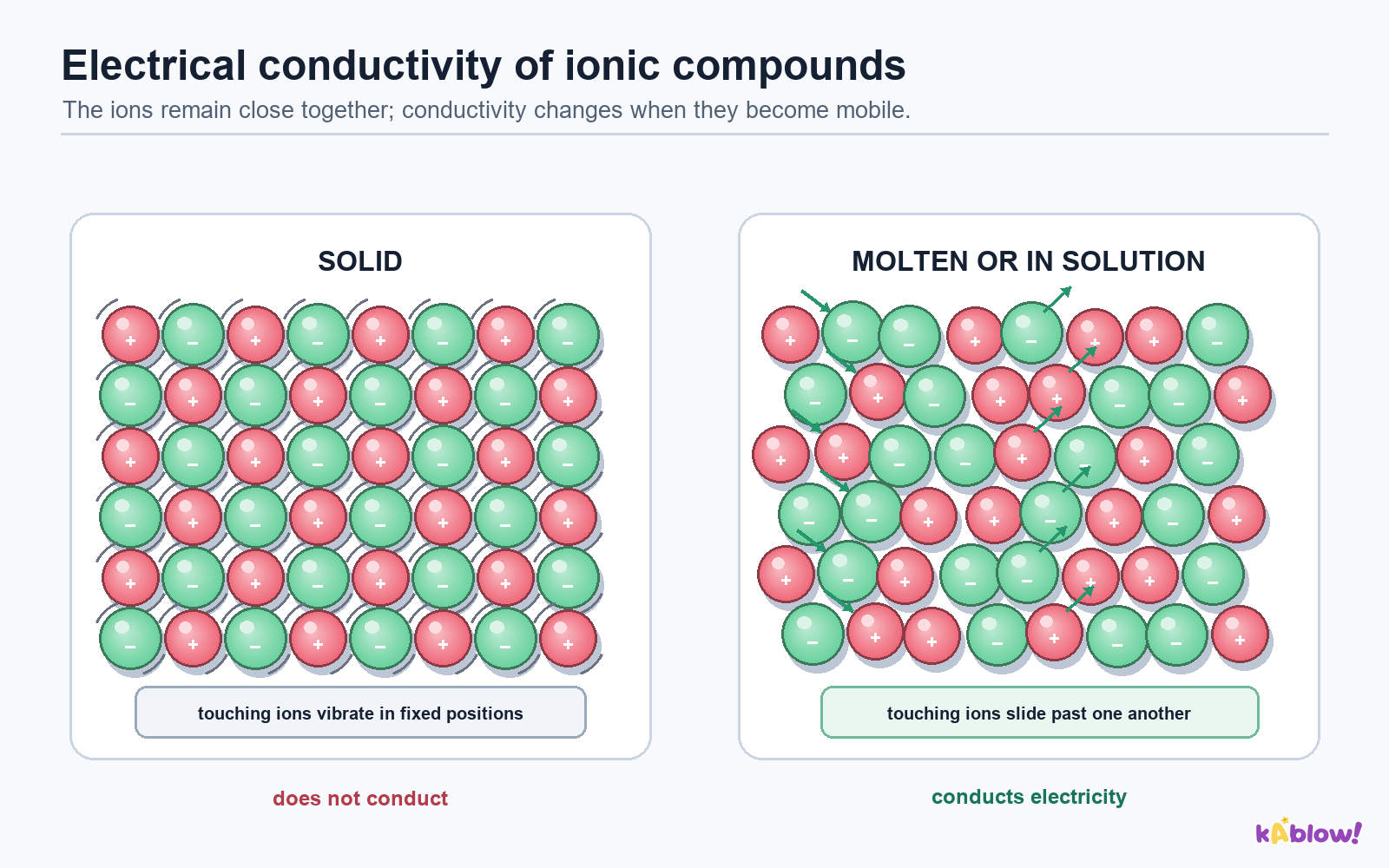
- Covalent compounds and solid ionic compounds cannot undergo electrolysis because they have no free mobile ions.
- Electrolyte: molten or dissolved ionic compound that conducts electricity.
- Anode (positive electrode) attracts anions (negative ions).
- Cathode (negative electrode) attracts cations (positive ions).
- Use PANIC: Positive is Anode, Negative Is Cathode.
- Electrons flow from the negative terminal of the power supply to the cathode; they do not pass through the electrolyte.
- Reduction (gain of electrons) occurs at the cathode; oxidation (loss of electrons) occurs at the anode.
Ionic conductivity: solid vs molten/dissolved
Electrolysis of Molten Compounds
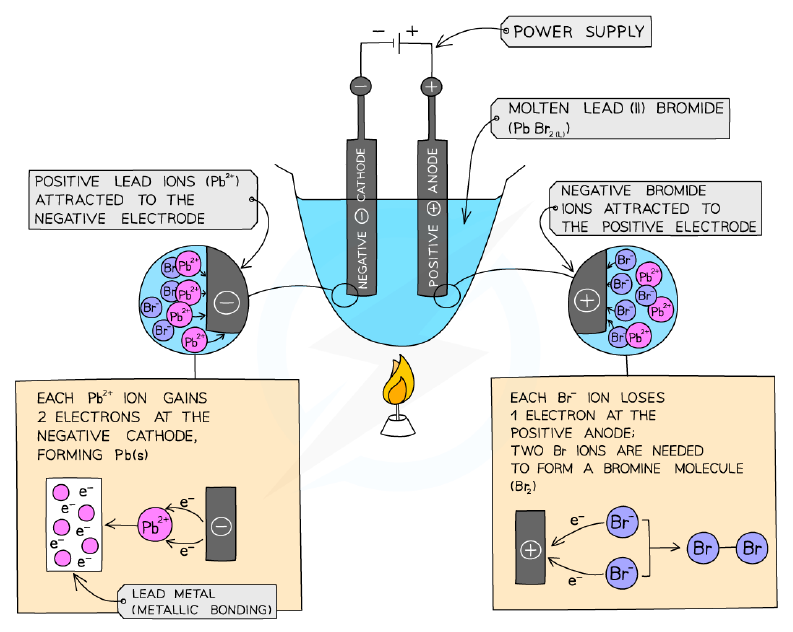
- Molten binary ionic compounds decompose into their elements: metal at cathode, non-metal at anode.
- Example: molten PbBr₂ → Pb (grey metal) at cathode, Br₂ (brown gas) at anode.
- Ions must be free to move – compound must be molten (or in solution).
- Electrodes must be inert (e.g., graphite or platinum) to avoid side reactions.
- Half-equation at cathode: Pb²⁺ + 2e⁻ → Pb.
- Half-equation at anode: 2Br⁻ → Br₂ + 2e⁻.
Electrolysis of molten lead(II) bromide
Electrolysis of Aqueous Sodium Chloride (Brine)
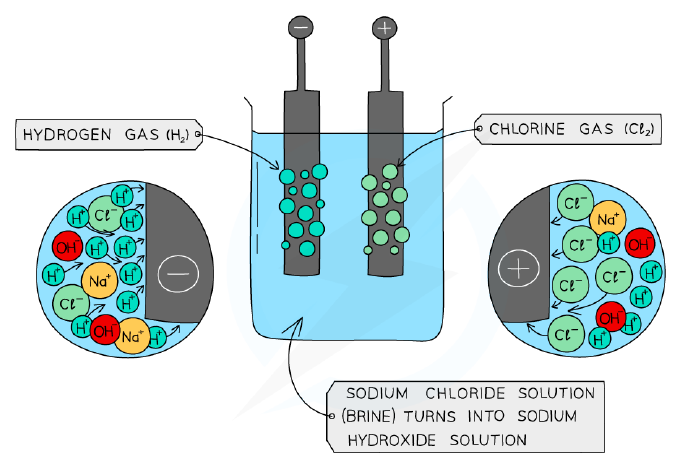
- Brine contains Na⁺, Cl⁻, H⁺, OH⁻ ions.
- At cathode: H⁺ is discharged (less reactive than Na⁺) → hydrogen gas.
- At anode: Cl⁻ is discharged → chlorine gas.
- Na⁺ and OH⁻ remain in solution → sodium hydroxide forms.
- Industrial uses: Cl₂ → bleach; H₂ → margarine; NaOH → soap and detergents.
Electrolysis of aqueous sodium chloride (brine)
Electrolysis of Dilute Sulfuric Acid
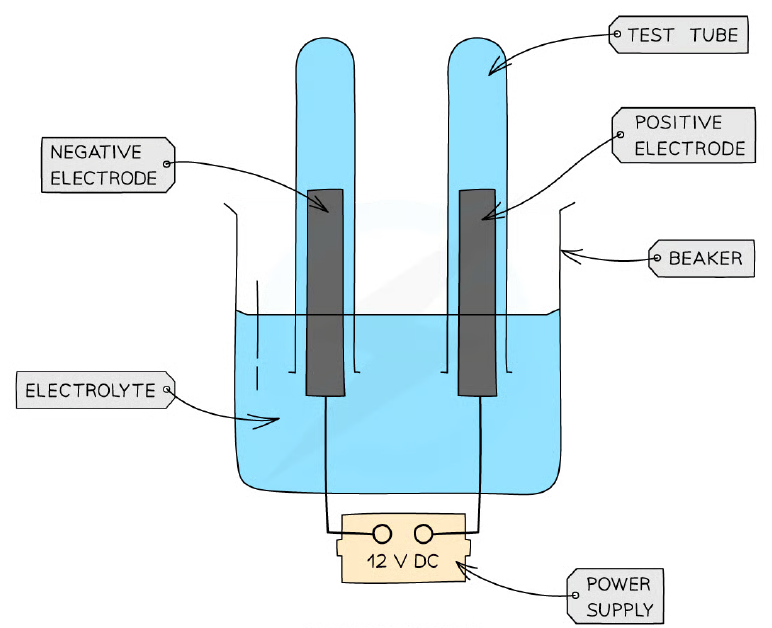
- Contains H⁺, SO₄²⁻, OH⁻ ions.
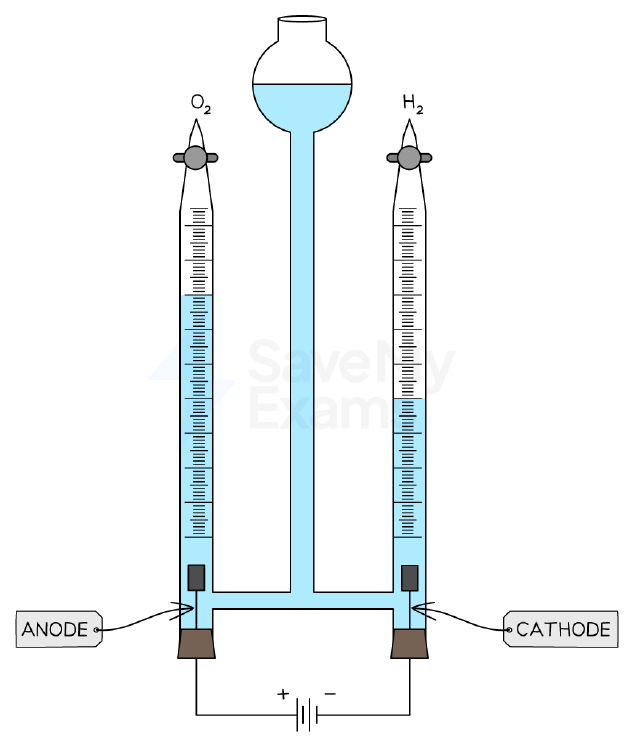
- At cathode: H⁺ gains electrons → hydrogen gas.
- At anode: OH⁻ loses electrons → oxygen gas (and water).
- Volume of H₂ produced is twice the volume of O₂.
- Gas tests: H₂ – lit splint gives 'squeaky pop'; O₂ – glowing splint relights.
Hoffman voltameter: dilute sulfuric acid
Electrolysis of Aqueous Solutions (Extended)
- Water dissociates: H₂O ⇌ H⁺ + OH⁻ – these ions compete with solute ions.
- At cathode: if metal is less reactive than hydrogen, metal is deposited; if more reactive, hydrogen gas is produced.
- At anode: if halide ions (Cl⁻, Br⁻, I⁻) are present, halogen forms; otherwise oxygen from OH⁻.
- Concentration matters: concentrated halide → halogen; dilute halide → oxygen.
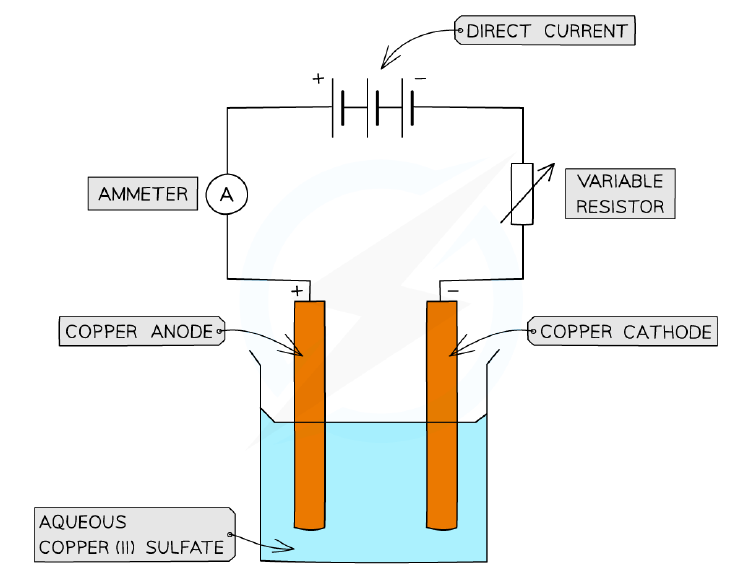
- Example: CuSO₄(aq) with graphite electrodes → Cu at cathode, O₂ at anode; blue colour fades.
- With copper electrodes: anode dissolves (Cu → Cu²⁺ + 2e⁻), cathode gains mass (Cu²⁺ + 2e⁻ → Cu); solution concentration remains constant.
Apparatus for the electrolysis of copper(II) sulfate (graphite electrodes)
Ionic Half-Equations (Extended)
- Oxidation Is Loss (of electrons), Reduction Is Gain (OIL RIG).
- REDuction at CAThode (RED CAT); ANode for OXidation (AN OX).
- Metal formation: Mⁿ⁺ + n e⁻ → M (reduction).
- Hydrogen formation: 2H⁺ + 2e⁻ → H₂.
- Halogen formation: 2X⁻ → X₂ + 2e⁻ (oxidation).
- Oxygen formation: 4OH⁻ → O₂ + 2H₂O + 4e⁻.
- Half-equations must balance atoms and charges.
Summary Table of Common Electrolyses
- Molten PbBr₂: anode – Br₂; cathode – Pb.
- Concentrated NaCl(aq): anode – Cl₂; cathode – H₂.
- Dilute H₂SO₄: anode – O₂; cathode – H₂.
- CuSO₄(aq) (inert electrodes): anode – O₂; cathode – Cu.
Summary of Common Electrolyses
投影片
練習題
免費預覽——48 題中的 8 題。註冊即可查看全部。
1.What is the name of the process in which a molten ionic compound is broken down by an electric current?
Easy- AElectrolysis
- BElectroplating
- CElectrorefining
- DElectrolysis of aqueous solutions
2.Which electrode is the positive electrode in an electrolysis cell?
Easy- AAnode
- BCathode
- CElectrolyte
- DTerminal
3.What type of ion is attracted to the cathode?
Easy- ACation
- BAnion
- CElectron
- DNeutral atom
4.During electrolysis, what happens at the anode?
Easy- AOxidation (loss of electrons)
- BReduction (gain of electrons)
- CNo reaction
- DFormation of metal
5.In the electrolysis of molten lead(II) bromide, what is produced at the cathode?
Easy- ALead
- BBromine
- COxygen
- DHydrogen
6.During the electrolysis of concentrated aqueous sodium chloride (brine), which gas is produced at the anode?
Easy- AChlorine
- BOxygen
- CHydrogen
- DNitrogen
7.In the electrolysis of dilute sulfuric acid, what is the volume ratio of hydrogen to oxygen produced?
Medium- A2:1
- B1:2
- C1:1
- D3:1
8.Which of the following is a suitable material for inert electrodes?
Easy- AGraphite
- BCopper
- CIron
- DZinc
歷屆試題
這個主題的歷屆試題練習即將推出。
即將推出