Group Properties And Trends
邊玩邊學
回答這些題目賺取能量,接著就能釣魚、探索。不需要帳號。
給老師: 為 Group Properties And Trends(Co-ordinated Sciences (Double Award) [CIE]、Chemistry)準備好可直接使用的課程投影片, 複習筆記——用於你的課程,或把這個主題當成互動班級活動,讓學生以即時遊戲的方式進行。
課程筆記
Group I Properties
- Group I metals are called alkali metals because they form alkaline solutions with water.
- They have one electron in their outer shell.
- Physical properties: soft, shiny when cut, good conductors of heat/electricity, low melting points (decrease down group), low densities.
- Stored under oil to prevent reaction with oxygen and water vapour in air.
- React with water to form metal hydroxide and hydrogen gas: 2M + 2H₂O → 2MOH + H₂.
- Reactivity increases down the group: Li fizzes slowly, Na more vigorous, K burns with lilac flame.
- Melting point decreases down group; density generally increases (exception early group).
- Predict properties of unknown alkali metals using trends: e.g., Rb reacts very violently, Cs may explode.
Electron configuration of sodium (Group I) showing one outer electron.
Group VII Properties
- Group VII elements are halogens: non-metals, poisonous, diatomic (F₂, Cl₂, Br₂, I₂, At₂).
- They have seven electrons in outer shell and gain one electron to form halide ions.
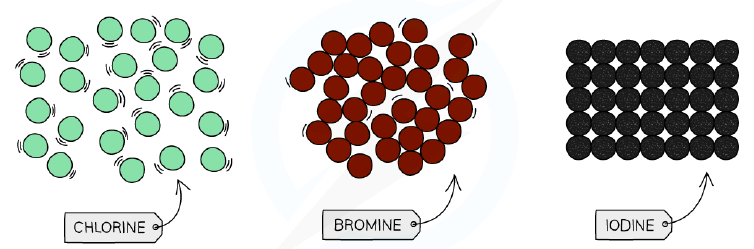
- Physical state changes down group: Cl₂ pale green gas, Br₂ red-brown liquid, I₂ grey-black solid.
- Density increases down group; melting/boiling points increase down group.
- Reactivity decreases down group (opposite to Group I).
- Reason: atomic radius increases and electron shielding increases, so attraction for an incoming electron weakens.
- Colour darkens down group: F₂ yellow, Cl₂ green, Br₂ red-brown, I₂ violet vapour, At₂ black.
Physical states of the halogens at room temperature
Group VII Displacement Reactions
- A more reactive halogen displaces a less reactive halogen from an aqueous halide solution.
- Reactivity order: Cl₂ > Br₂ > I₂.
- Chlorine displaces bromide: 2KBr + Cl₂ → 2KCl + Br₂ (solution turns orange/yellow).
- Chlorine displaces iodide: 2KI + Cl₂ → 2KCl + I₂ (solution turns brown).
- Bromine displaces iodide: MgI₂ + Br₂ → MgBr₂ + I₂ (solution turns brown).
- No reaction occurs if the halogen is less reactive than the halide (e.g., Br₂ with KCl).
- Aqueous colours: Cl₂ very pale green (dilute appears colourless), Br₂ orange, I₂ brown.
Summary table of displacement reactions
Transition Elements
- Transition elements are metals found in the centre of the Periodic Table between Group 2 and 3.
- Typical metallic properties: lustrous, hard, strong, good conductors, high melting points (except Hg).
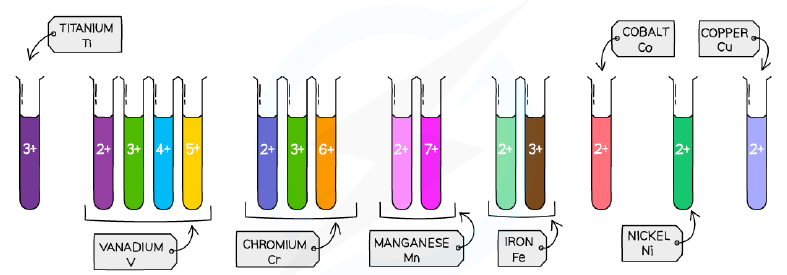
- Unique properties: form ions with different charges (e.g., Fe²⁺ and Fe³⁺).
- They are useful as catalysts (e.g., iron in Haber process).
- They form coloured compounds (e.g., copper sulfate blue, copper oxide black, copper carbonate green).
- Scandium and zinc are not considered transition elements because they do not form coloured compounds and have only one oxidation state.
Coloured compounds formed by transition metal ions
Noble Gases
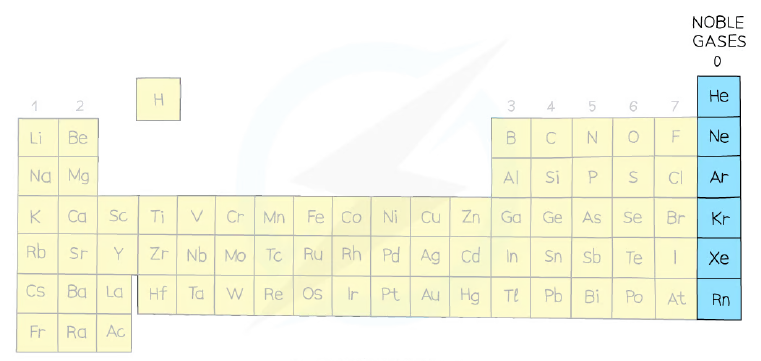
- Noble gases are in Group VIII (Group 18): non-metals, monatomic, colourless, gaseous.
- They have full outer electron shells (e.g., He: 2, Ne: 2,8, Ar: 2,8,8).
- Full outer shells make them unreactive (inert) – they do not easily form bonds.
- They have very low melting and boiling points.
The noble gases are located at the right of the Periodic Table
投影片
練習題
免費預覽——53 題中的 8 題。註冊即可查看全部。
1.Complete the sentence.
EasyGroup I metals are called the ____ metals because they form alkaline solutions when they react with water.
2.Which of the following is a physical property of Group I metals?
Easy- AThey are hard and brittle
- BThey have high melting points compared to other metals
- CThey are soft and can be cut easily
- DThey are gases at room temperature
3.The reactivity of Group I metals decreases as you move down the group.
EasyTrue or false?
4.State the colour of iodine in aqueous solution.
Easy5.Which halogen is a red-brown liquid at room temperature?
Easy- AChlorine
- BBromine
- CIodine
- DAstatine
6.How many electrons are in the outer shell of a halogen atom?
Easy- A7
- B6
- C9
- D8
7.Arrange the following halogens in order of increasing reactivity (least reactive first).
Medium- Iodine
- Bromine
- Chlorine
8.Predict the colour of astatine based on the trend in Group VII.
Medium
歷屆試題
這個主題的歷屆試題練習即將推出。
即將推出