Ions And Ionic Bonds
邊玩邊學
回答這些題目賺取能量,接著就能釣魚、探索。不需要帳號。
給教育者: 為 Ions And Ionic Bonds(Co-ordinated Sciences (Double Award) [CIE]、Chemistry)準備好可直接使用的課程投影片, 複習筆記——用於你的課程,或把這個主題當成互動班級活動,讓學習者以即時遊戲的方式進行。
課程筆記
Formation of Ions
- An ion is an electrically charged atom or group of atoms formed by loss or gain of electrons.
- Atoms gain or lose electrons to obtain a full outer shell (noble gas configuration).
- Positive ions (cations) form when atoms lose electrons (more protons than electrons). Metals form cations.
- Negative ions (anions) form when atoms gain electrons (more electrons than protons). Non-metals form anions.
- Group 1 elements form 1+ ions; Group 2 form 2+ ions; Group 6 form 2– ions; Group 7 form 1– ions.
Formation of a sodium ion (cation)
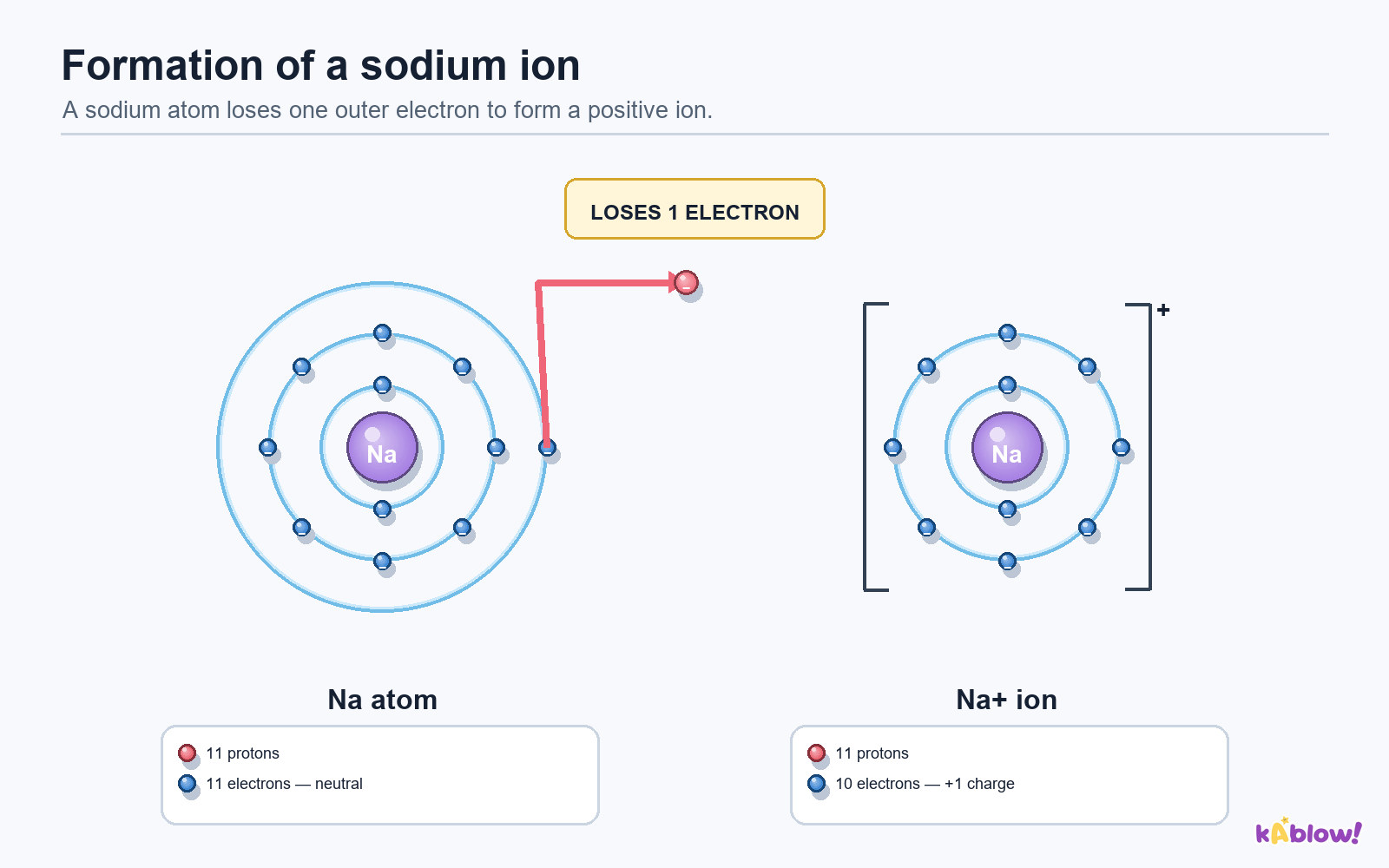
Ionic Bonding
- Ionic bonds form between metal and non-metal atoms via electron transfer.
- Metal atoms lose electrons to become positive ions; non-metal atoms gain electrons to become negative ions.
- The oppositely charged ions are held together by strong electrostatic forces of attraction – this is the ionic bond.
- Ionic compounds have no overall charge (total positive charge = total negative charge).
- Example: NaCl – Na loses one electron to form Na⁺, Cl gains one electron to form Cl⁻.
Sodium loses one electron and chlorine gains an electron
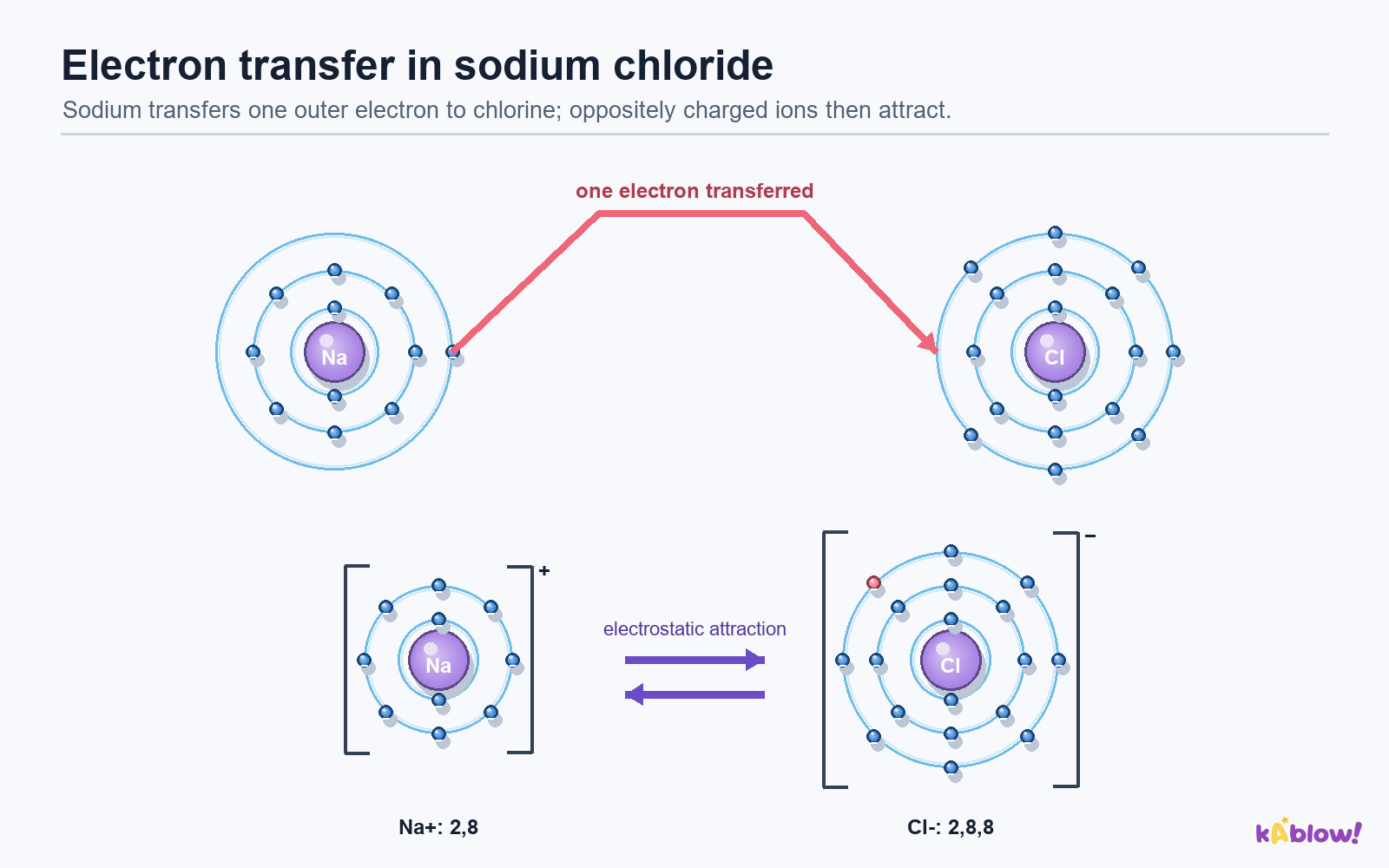
Dot-and-Cross Diagrams
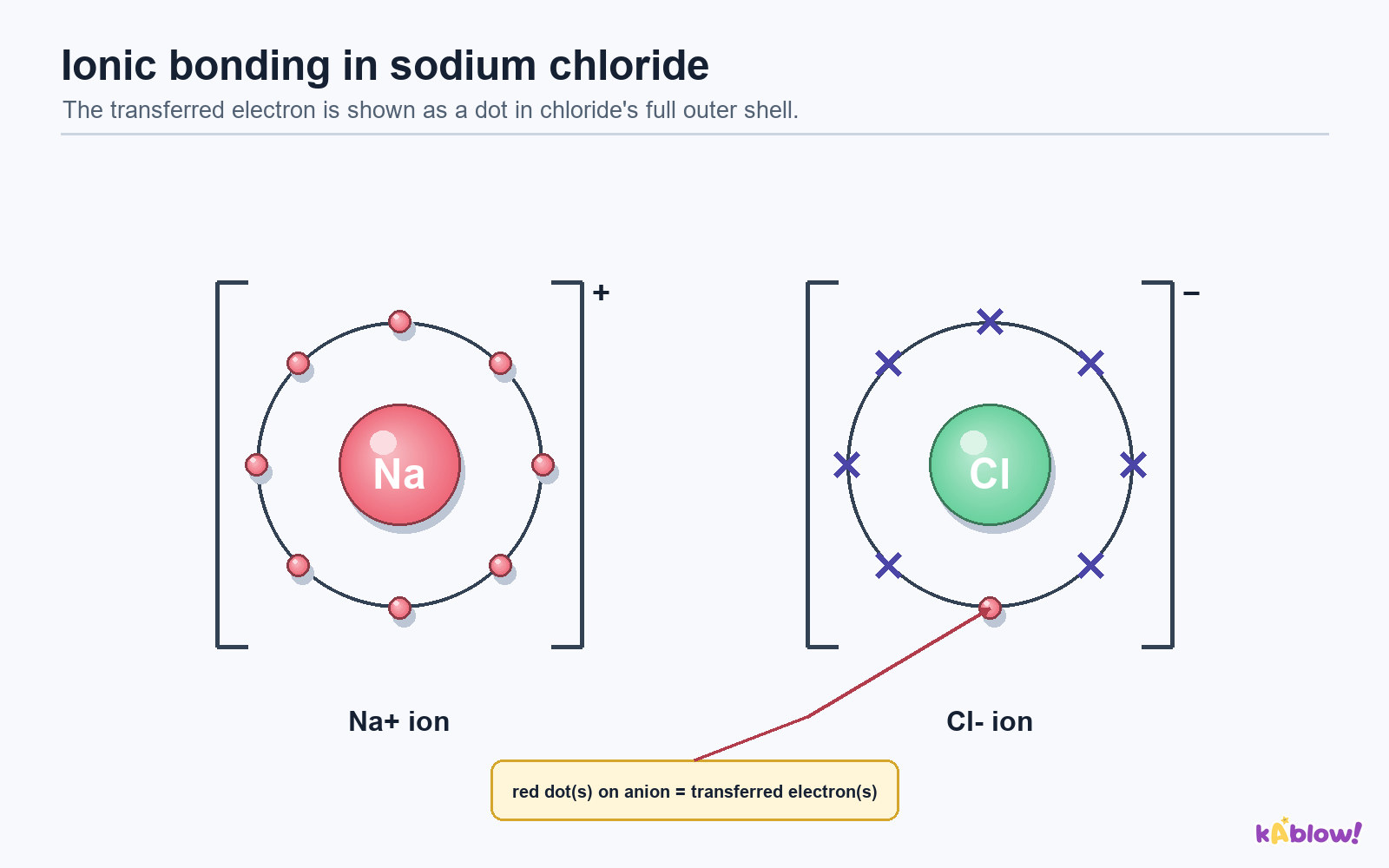
- Dot-and-cross diagrams show outer-shell electrons only (dots for one atom, crosses for the other).
- Each ion is enclosed in square brackets with the charge written at the top right.
- Example: NaCl – Na⁺ has no outer electrons; Cl⁻ has eight outer electrons.
- Example: MgO – Mg loses two electrons to form Mg²⁺; O gains two electrons to form O²⁻.
Ionic bonding in sodium chloride
Lattice Structure (Extended Tier)
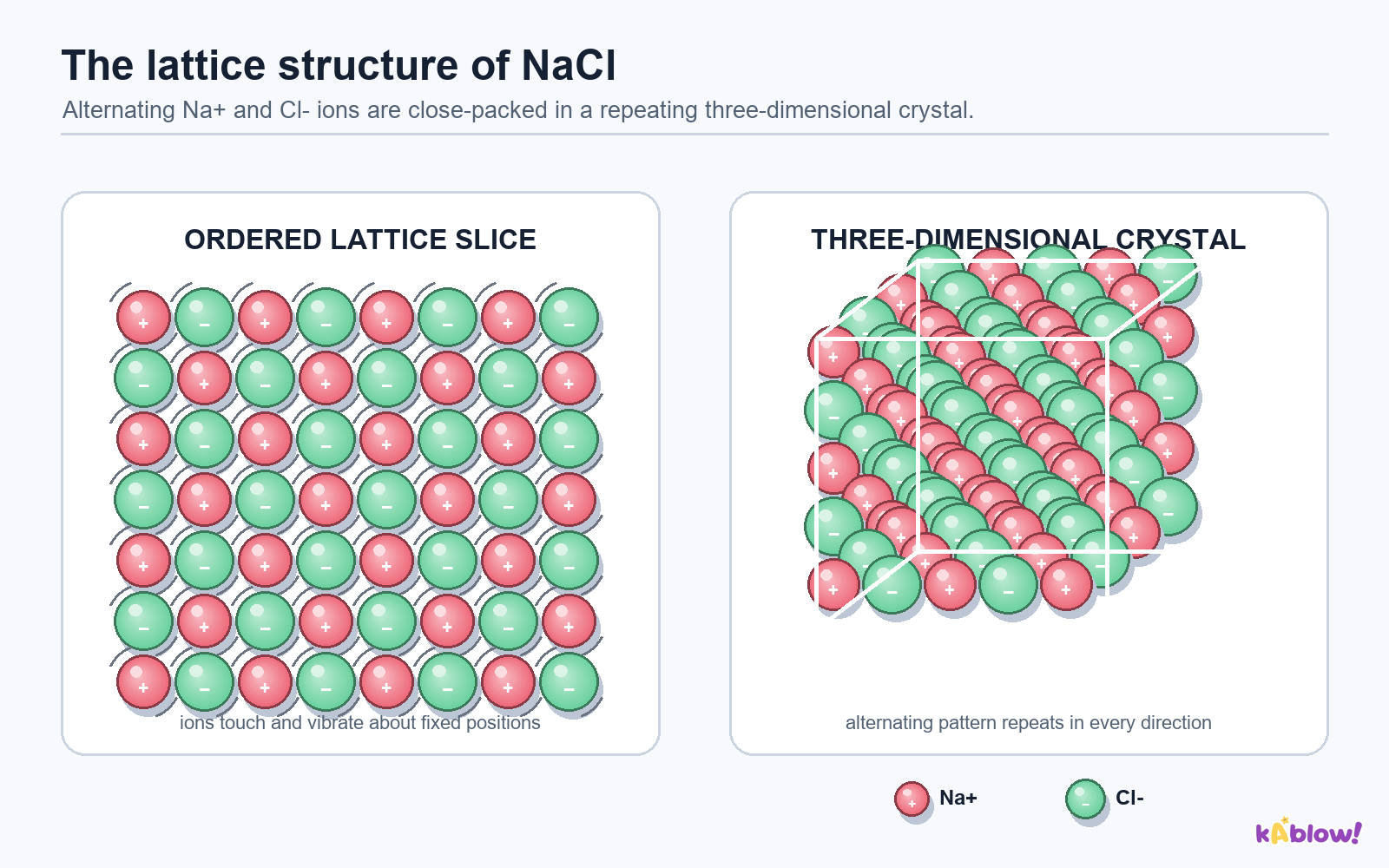
- Ionic compounds form a giant lattice structure – a regular, repeating 3D arrangement of alternating positive and negative ions.
- The lattice is held together by strong electrostatic forces in all directions.
- Example: NaCl lattice consists of Na⁺ and Cl⁻ ions arranged alternately.
The lattice structure of NaCl
Properties of Ionic Compounds
- Ionic compounds are solid at room temperature and have high melting and boiling points.
- High melting/boiling points are due to strong electrostatic forces in the giant lattice requiring much energy to overcome.
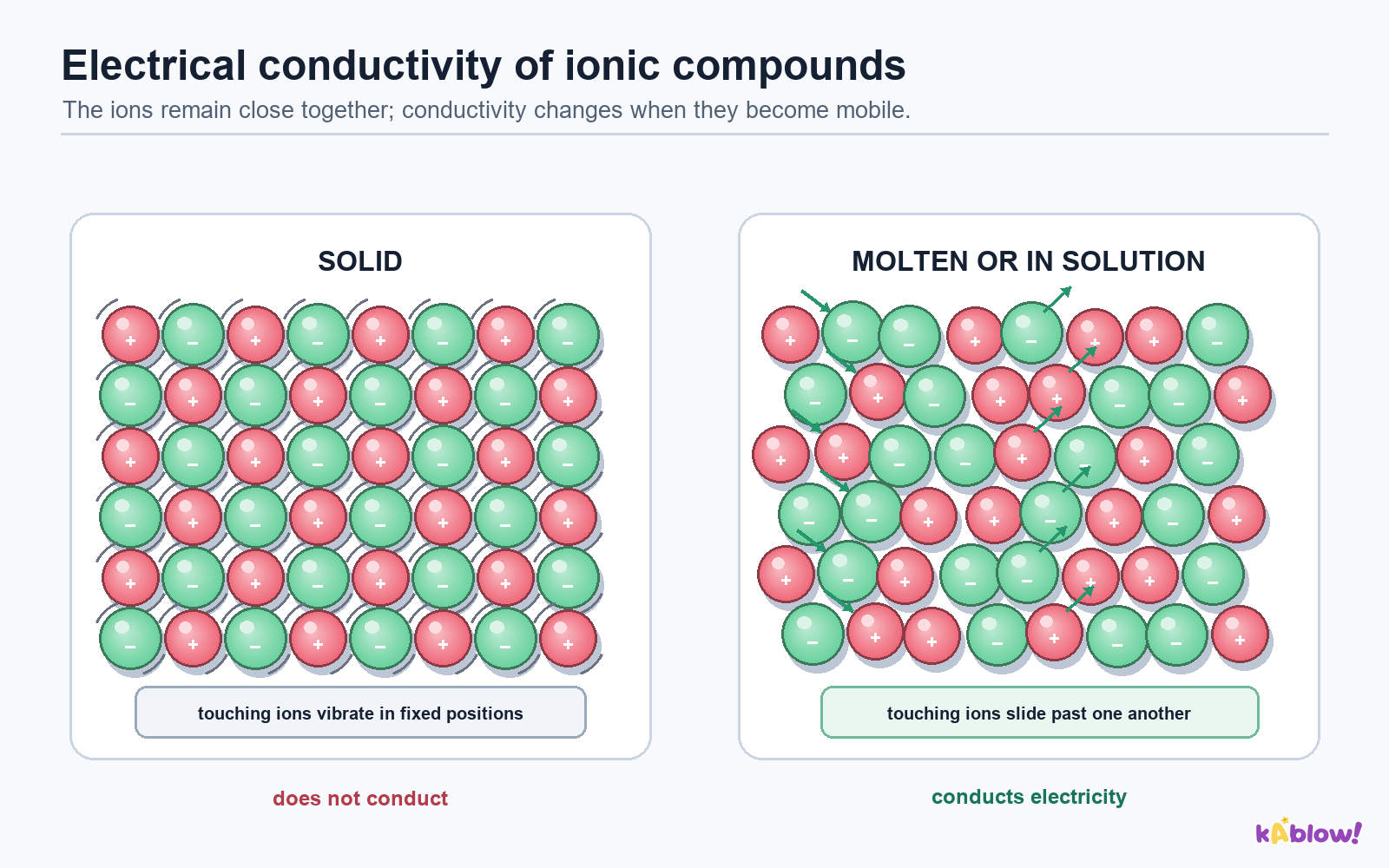
- Solid state: poor electrical conductors because ions are fixed in the lattice and cannot move.
- Molten or aqueous state: good conductors because ions are free to move and carry charge.
- Greater ion charges (e.g., Mg²⁺ and O²⁻) lead to stronger forces and higher melting points than singly charged ions (e.g., Na⁺ and Cl⁻).
Electrical conductivity of ionic compounds
投影片
練習題
免費預覽——52 題中的 8 題。註冊即可查看全部。
1.What is an ion?
Easy- AAn atom with a full outer shell
- BAn electrically charged atom or group of atoms
- CA neutral atom
- DA molecule
2.What is the name for a positive ion?
Easy3.What is the name for a negative ion?
Easy4.Complete the sentence:
EasyAn atom that loses electrons becomes a ____ ion.
5.All metals lose electrons to become positively charged ions.
EasyTrue or false?
6.What is the charge on an ion formed from a Group 2 element?
Easy- A3
- B4
- C1
- D2
7.Which of the following describes the structure of an ionic compound?
Medium- AA giant lattice of alternating positive and negative ions
- BA simple molecular structure
- CA giant covalent structure
- DA lattice of atoms held by metallic bonds
8.Ionic compounds conduct electricity in the solid state.
EasyTrue or false?
歷屆試題
這個主題的歷屆試題練習即將推出。
即將推出