Reactivity Series And Corrosion Of Metals
邊玩邊學
回答這些題目賺取能量,接著就能釣魚、探索。不需要帳號。
課程筆記
Reactivity Series
- The reactivity series lists metals in order of their reactivity based on reactions with water and acids.
- Non-metals carbon and hydrogen are included for extraction and acid reactions.
- Order (most to least reactive): Potassium > Sodium > Calcium > Magnesium > Aluminium > Carbon > Zinc > Iron > Hydrogen > Copper > Silver > Gold.
- Mnemonic: 'Please send cats, monkeys and cute zebras into hot countries signed Gordon'.
Reactions with Water and Steam
- Potassium, sodium, and calcium react with cold water to produce metal hydroxide and hydrogen gas.
- Example: 2K(s) + 2H₂O(l) → 2KOH(aq) + H₂(g).
- Magnesium reacts with steam to produce magnesium oxide and hydrogen: Mg(s) + H₂O(g) → MgO(s) + H₂(g).
- Reactivity with water decreases down the series: potassium reacts violently, sodium quickly, calcium less strongly.
Reactions with Dilute Hydrochloric Acid
- Metals above hydrogen in the series react with dilute HCl to form a salt and hydrogen gas.
- Example: Mg(s) + 2HCl(aq) → MgCl₂(aq) + H₂(g).
- The more reactive the metal, the more vigorous the reaction.
- Metals below hydrogen (copper, silver, gold) do not react with dilute HCl.
Displacement Reactions
- A more reactive metal can displace a less reactive metal from a solution of its salt.
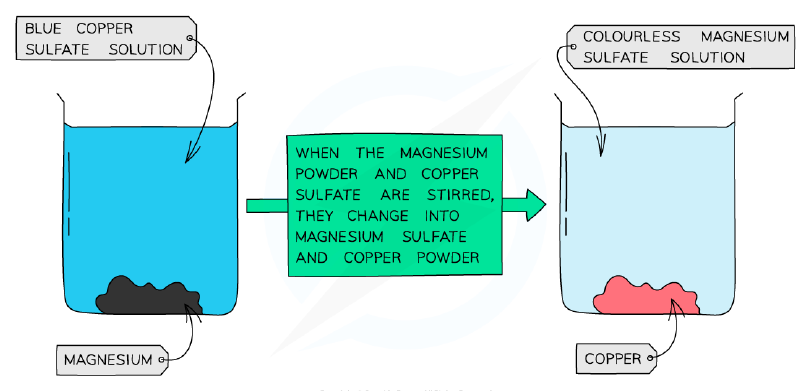
- Example: Mg(s) + CuSO₄(aq) → MgSO₄(aq) + Cu(s); blue colour fades as copper deposits.
- Displacement occurs because more reactive metals lose electrons more readily (are better reducing agents).
- Experimental displacement data can be used to deduce the relative order of reactivity.
Displacement of copper by magnesium
Explaining Reactivity (Extended)
- Reactivity depends on the tendency of a metal atom to lose electrons and form positive ions.
- Metals high in the series lose electrons easily and are strong reducing agents.
- In displacement, the less reactive metal ion gains electrons (is reduced); the more reactive metal loses electrons (is oxidised).
Rusting of Iron
- Rusting is the corrosion of iron requiring both oxygen and water.
- Rust is hydrated iron(III) oxide, a reddish-brown compound.
- Equation: iron + water + oxygen → hydrated iron(III) oxide.
- Only iron or steel rusts; other metals corrode.
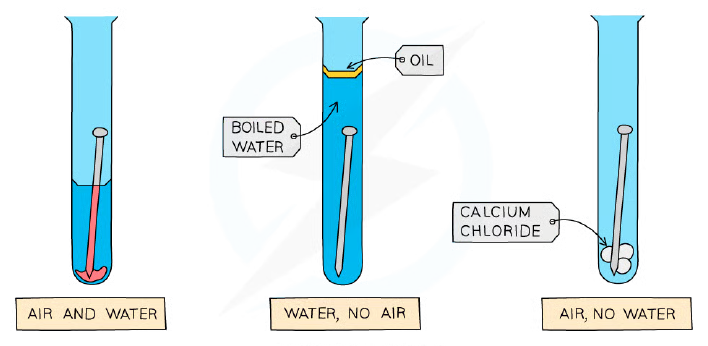
- Investigating rusting: nail in air+water rusts; nail in boiled water with oil (no air) does not; nail with calcium chloride (no water) does not.
Requirements for rusting
Rust Prevention Methods
- Barrier methods (grease, oil, paint, plastic) prevent contact with water and oxygen.
- If the barrier is scratched, iron is exposed and rusting occurs.
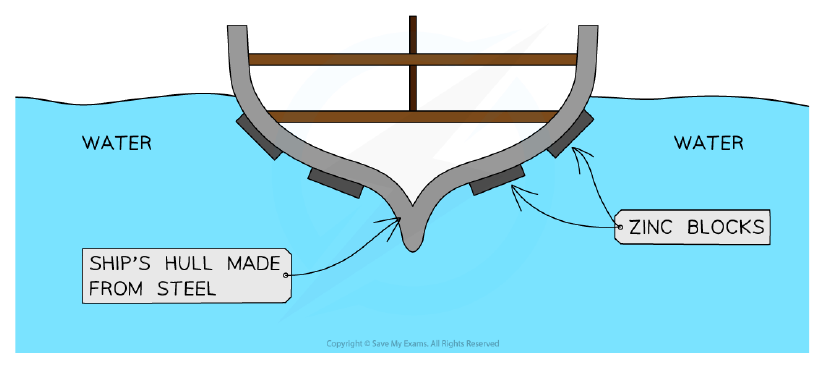
- Sacrificial protection uses a more reactive metal (e.g., zinc) attached to iron; the more reactive metal corrodes instead.
- Zinc bars on steel ships: Zn → Zn²⁺ + 2e⁻; zinc oxidises, iron is protected.
- Galvanising coats iron with zinc; acts as barrier and provides sacrificial protection if scratched.
Zinc bars on steel ship hulls
Choosing a Protective Metal (Extended)
- A metal above iron in the reactivity series is suitable for sacrificial protection (e.g., zinc, magnesium).
- A metal below iron (e.g., copper) is not suitable; iron would corrode instead.
投影片
練習題
免費預覽——51 題中的 8 題。註冊即可查看全部。
1.Which of the following is the correct order of reactivity for the metals potassium, sodium, calcium, magnesium, aluminium, zinc, iron, copper, silver, gold?
Easy- APotassium > Sodium > Calcium > Magnesium > Aluminium > Zinc > Iron > Copper > Silver > Gold
- BGold > Silver > Copper > Iron > Zinc > Aluminium > Magnesium > Calcium > Sodium > Potassium
- CPotassium > Sodium > Magnesium > Calcium > Aluminium > Zinc > Iron > Copper > Silver > Gold
- DSodium > Potassium > Calcium > Magnesium > Aluminium > Zinc > Iron > Copper > Silver > Gold
2.State the two conditions necessary for rusting to occur.
Easy3.Iron can rust in the presence of water alone, without oxygen.
EasyTrue or false?
4.Complete the sentence: In the reactivity series, carbon is placed between aluminium and zinc because it is used to extract metals from their oxides.
MediumIn the reactivity series, carbon is placed between ____ and ____ because it is used to extract metals from their oxides.
5.Match each metal with its reaction with cold water.
Medium- Potassium
- Sodium
- Calcium
- Magnesium
- Reacts violently
- Reacts quickly
- Reacts less strongly
- Does not react with cold water
6.Write the word equation for the reaction of magnesium with steam.
Medium7.In an experiment to determine the reactivity of a metal, a student measures the temperature change when the metal reacts with dilute hydrochloric acid. The temperature rises from 20.0°C to 35.0°C. What is the temperature change in °C?
Easy- A15
- B17
- C14
- D16
8.Which of the following metals will displace copper from copper(II) sulfate solution?
Easy- ASilver
- BGold
- CZinc
- DCopper