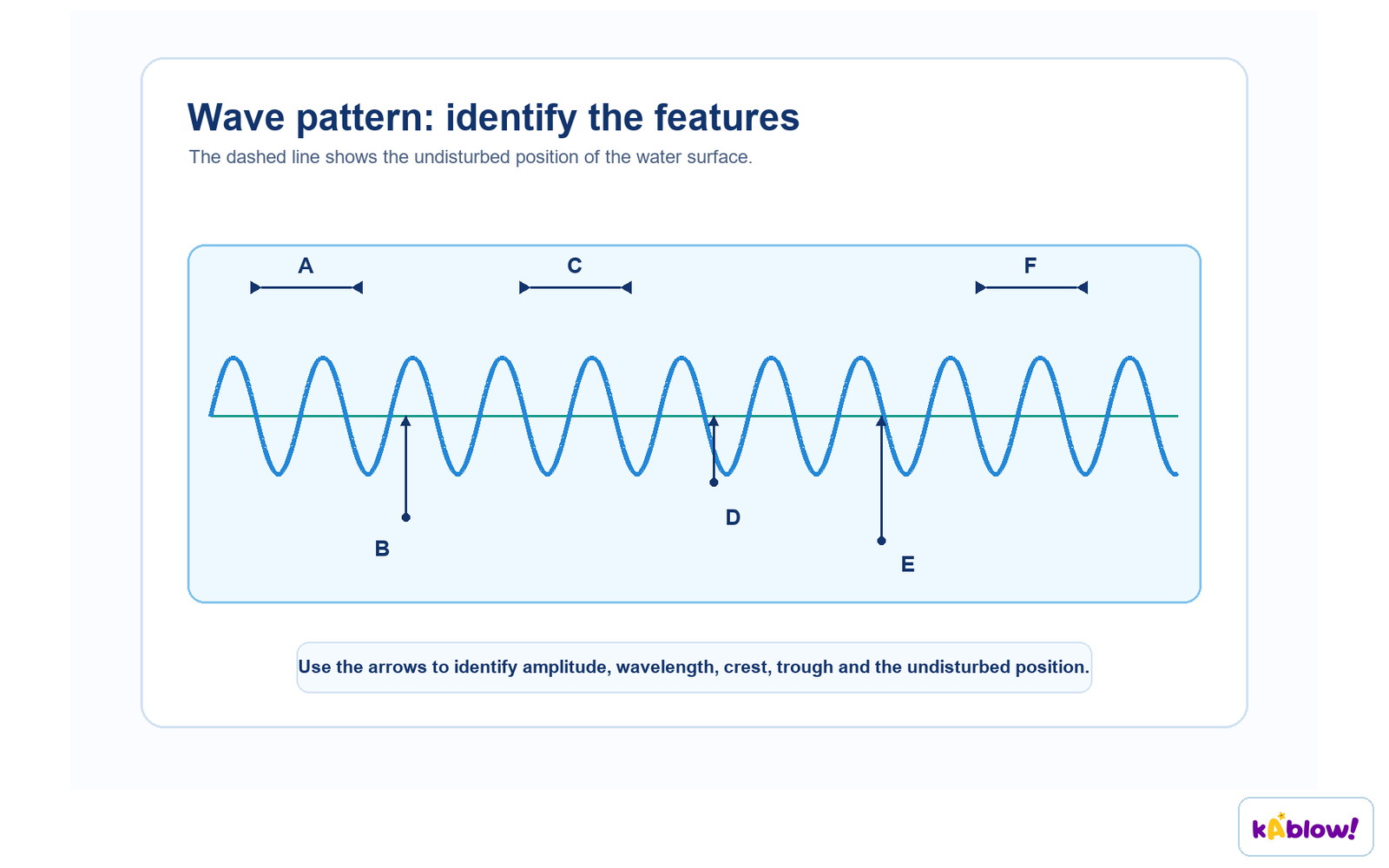
General Properties Of Waves
邊玩邊學
回答這些題目賺取能量,接著就能釣魚、探索。不需要帳號。
課程筆記
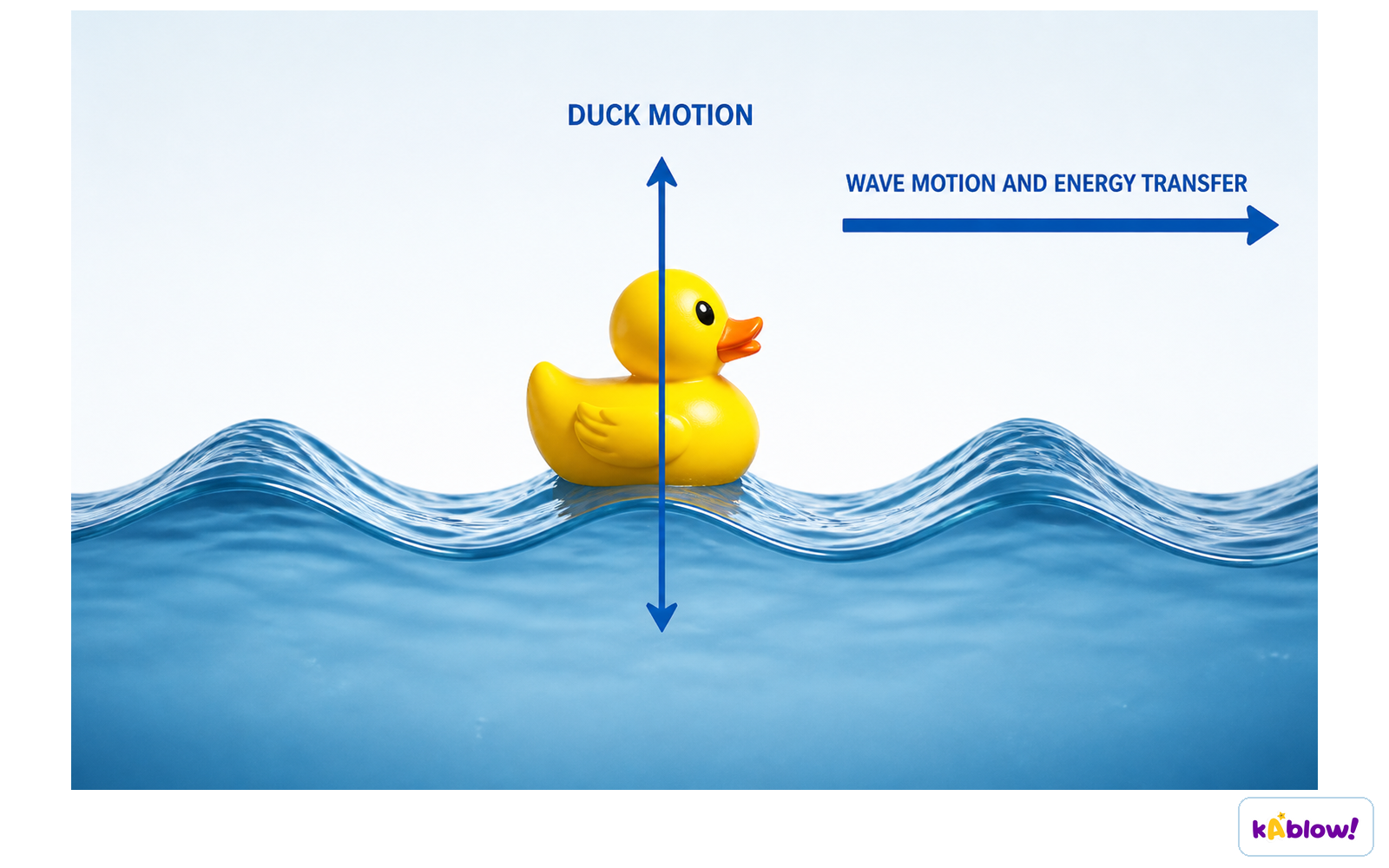
Wave Motion & Energy Transfer
- Waves transfer energy without transferring matter.
- Objects floating on water bob up and down but do not travel with the wave, showing no net movement of matter.
- Waves are described as oscillations or vibrations about a fixed point.
- Wave motion can be demonstrated using vibrations in ropes, springs, or water waves in a ripple tank.
A toy duck bobbing up and down on water waves, illustrating that waves transfer energy but not matter.
Features of Waves
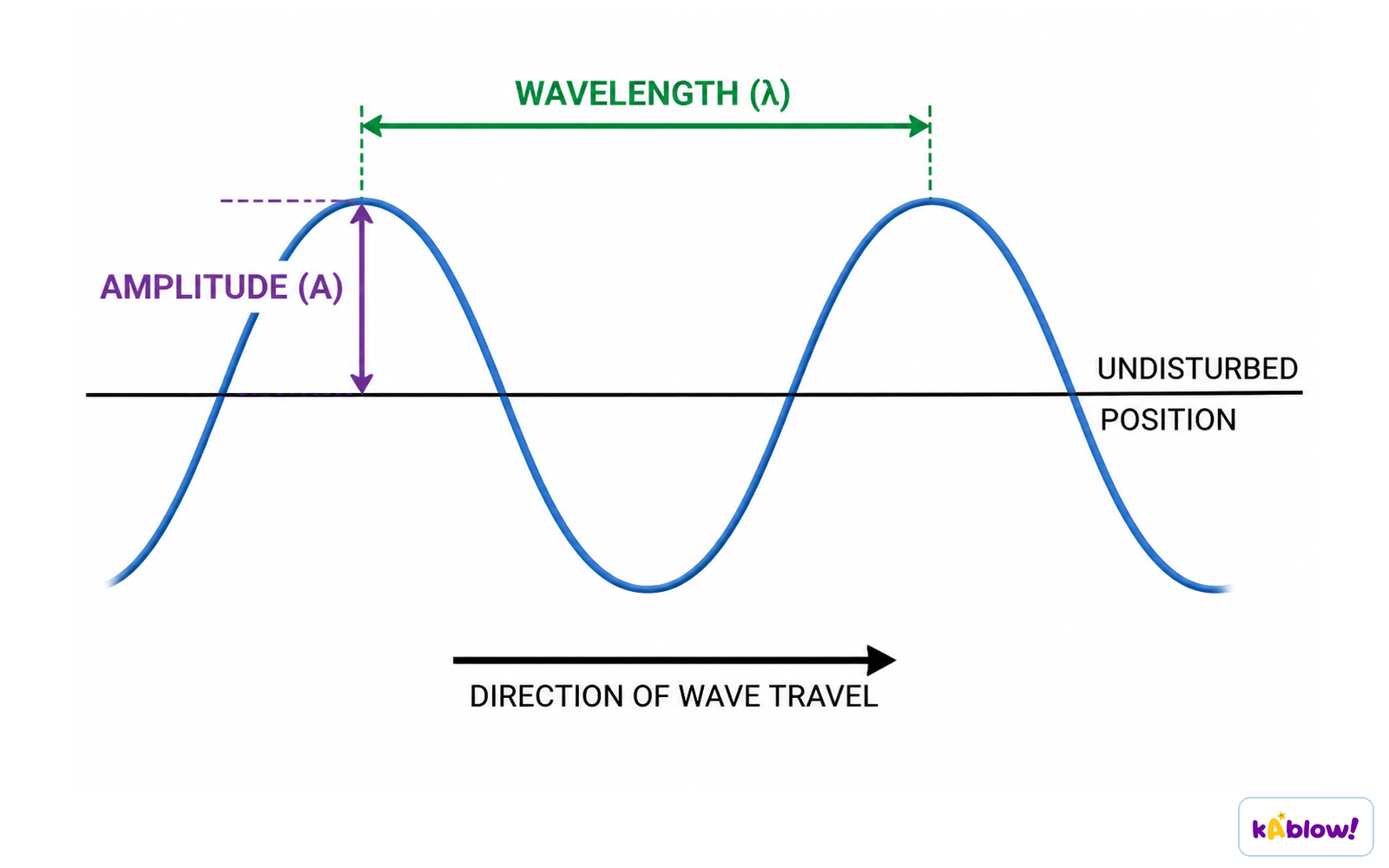
- Wavelength (λ): distance from one point on a wave to the same point on the next wave (e.g., crest to crest). Measured in metres (m).
- Frequency (f): number of waves passing a point per second. Measured in hertz (Hz).
- Amplitude (A): maximum displacement from the undisturbed position to a peak or trough. Measured in metres (m).
- Crest (peak): highest point above the equilibrium; trough: lowest point below equilibrium.
- Wave speed (v): distance travelled by a wave each second. Measured in m/s.
- Wavefronts represent waves from above; spacing between wavefronts indicates wavelength.
Diagram showing the amplitude and wavelength of a transverse wave, measured from the undisturbed position.
The Wave Equation
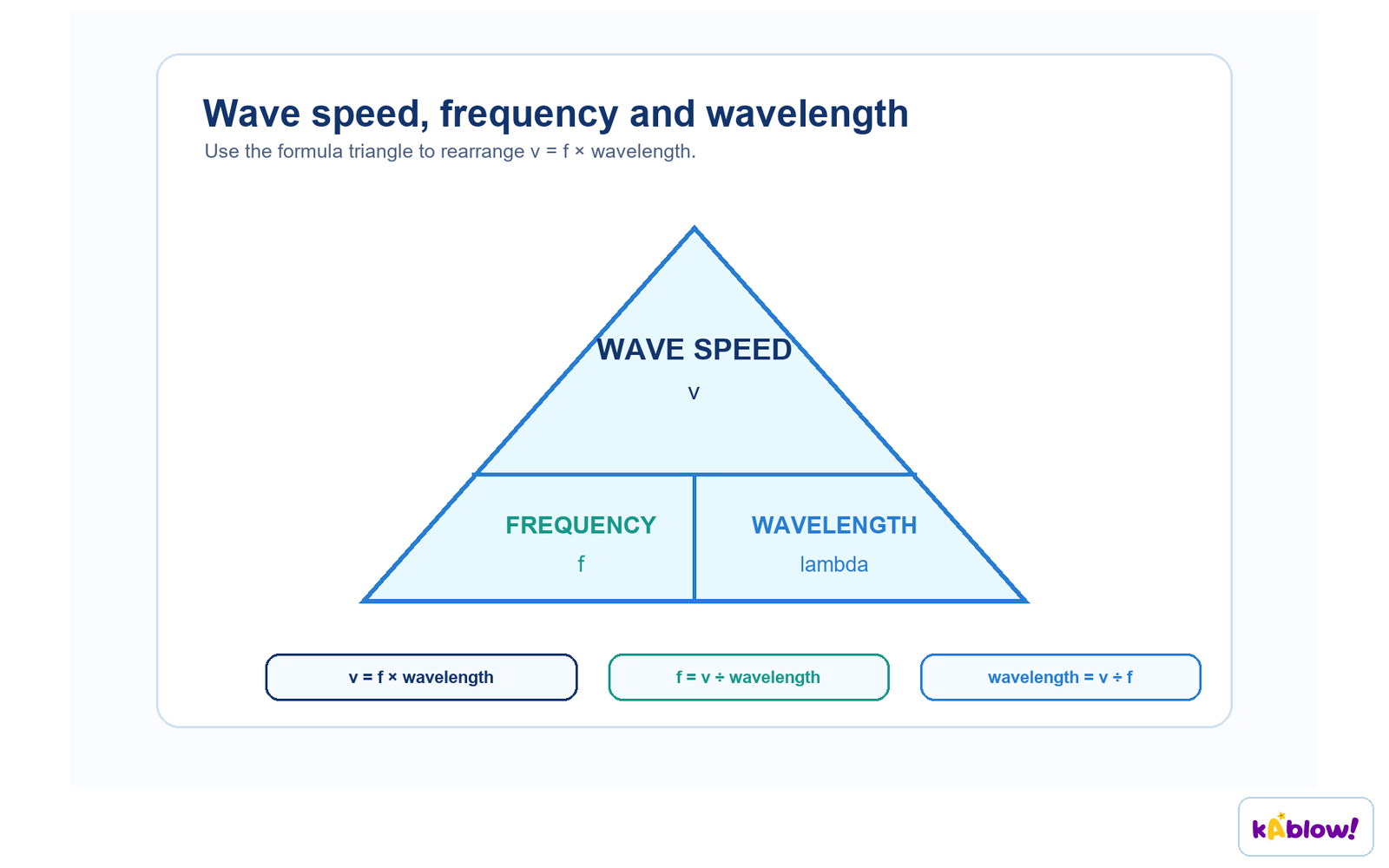
- Wave speed equation: v = f × λ (v = wave speed in m/s, f = frequency in Hz, λ = wavelength in m).
- Both transverse and longitudinal waves obey the wave equation.
- Frequency and time period (T) are related: f = 1/T.
- Example: A wave with speed 0.15 m/s and period 2 s has frequency 0.5 Hz and wavelength 0.30 m.
The wave speed formula triangle: v = f x wavelength.
Transverse Waves
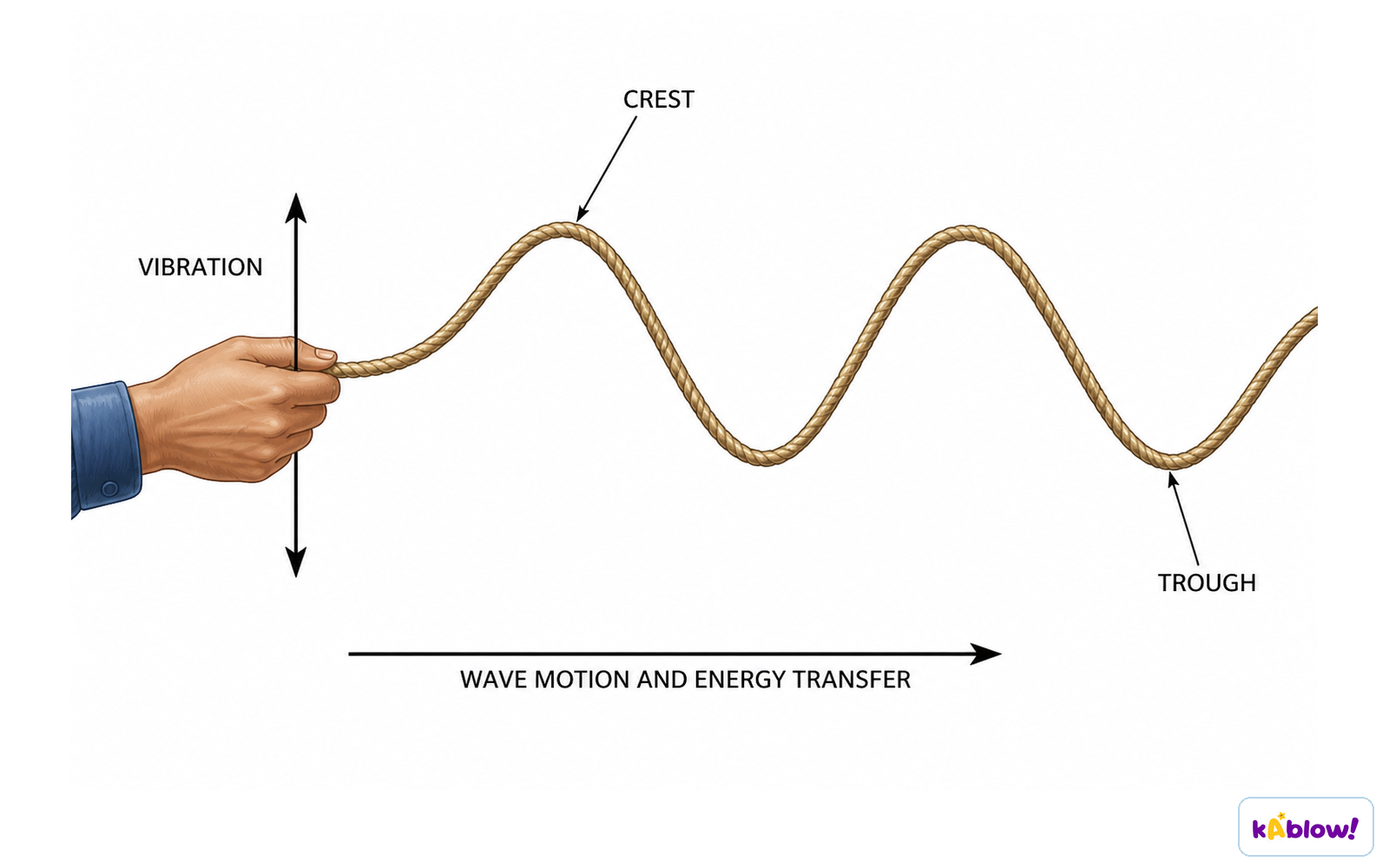
- Transverse waves: vibrations are perpendicular to the direction of energy transfer.
- They have peaks and troughs.
- Can travel through solids and on liquid surfaces, but not through liquids or gases (except electromagnetic waves in vacuum).
- Examples: electromagnetic waves (light, radio), water ripples, seismic S-waves.
Transverse wave motion in a rope: vibration at 90 degrees to the direction of wave motion and energy transfer, with wave peak and wave trough labelled.
Longitudinal Waves
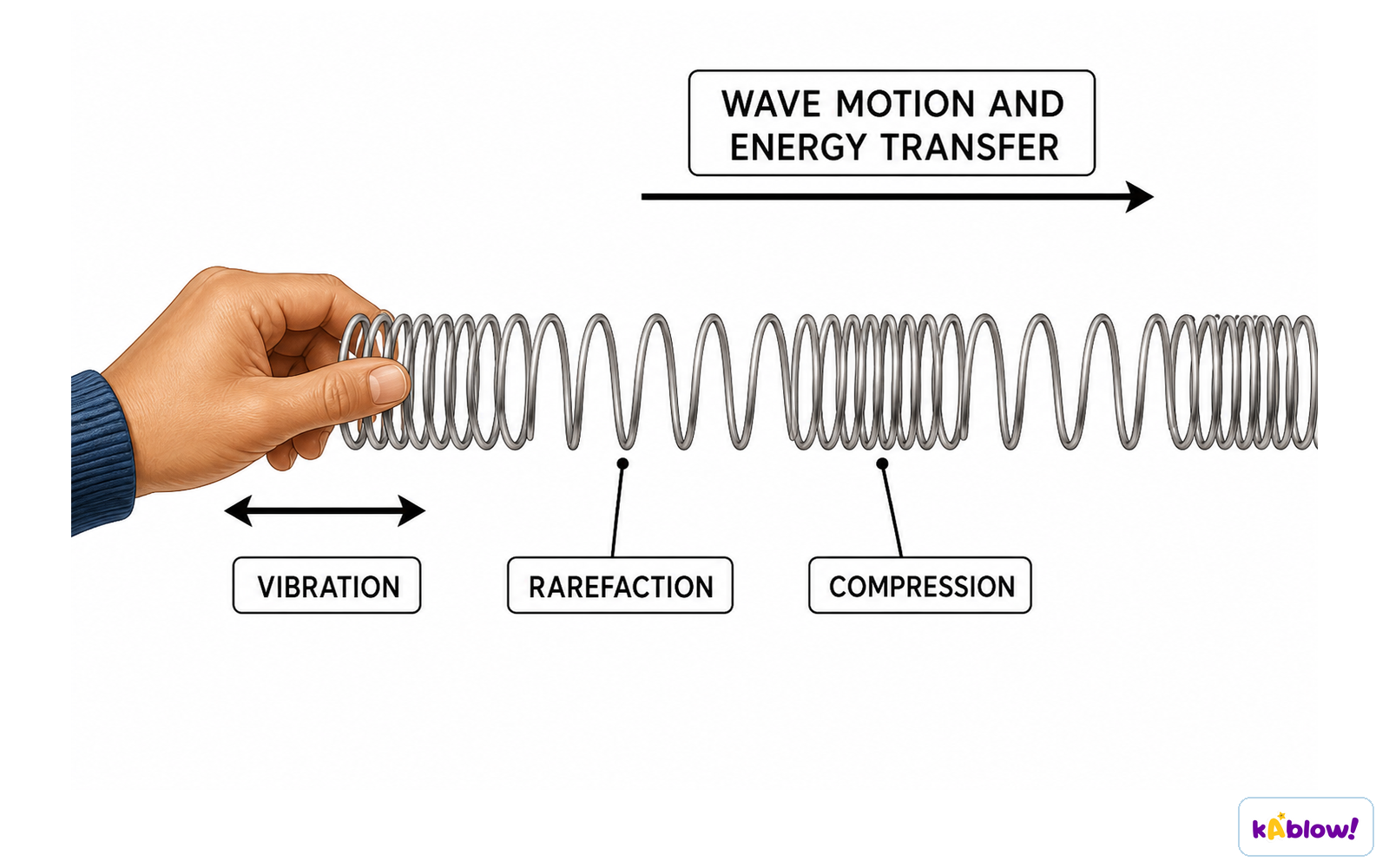
- Longitudinal waves: vibrations are parallel to the direction of energy transfer.
- They consist of compressions (particles close together) and rarefactions (particles spread apart).
- Can travel through solids, liquids, and gases, but not through a vacuum.
- Examples: sound waves, seismic P-waves.
Longitudinal wave motion in a spring, showing compression and rarefaction relative to the direction of wave motion and energy transfer.
Reflection & Refraction
- Reflection: a wave hits a boundary and stays in the original medium; angle of incidence equals angle of reflection.
- Refraction: a wave passes into a different medium, changing speed, wavelength, and direction (frequency remains constant).
- Angles are measured from the normal (line perpendicular to the boundary).
- When waves slow down (enter denser medium), they bend towards the normal; when they speed up, they bend away from the normal.
An identical image of a tree is seen in the water due to reflection.

Diffraction
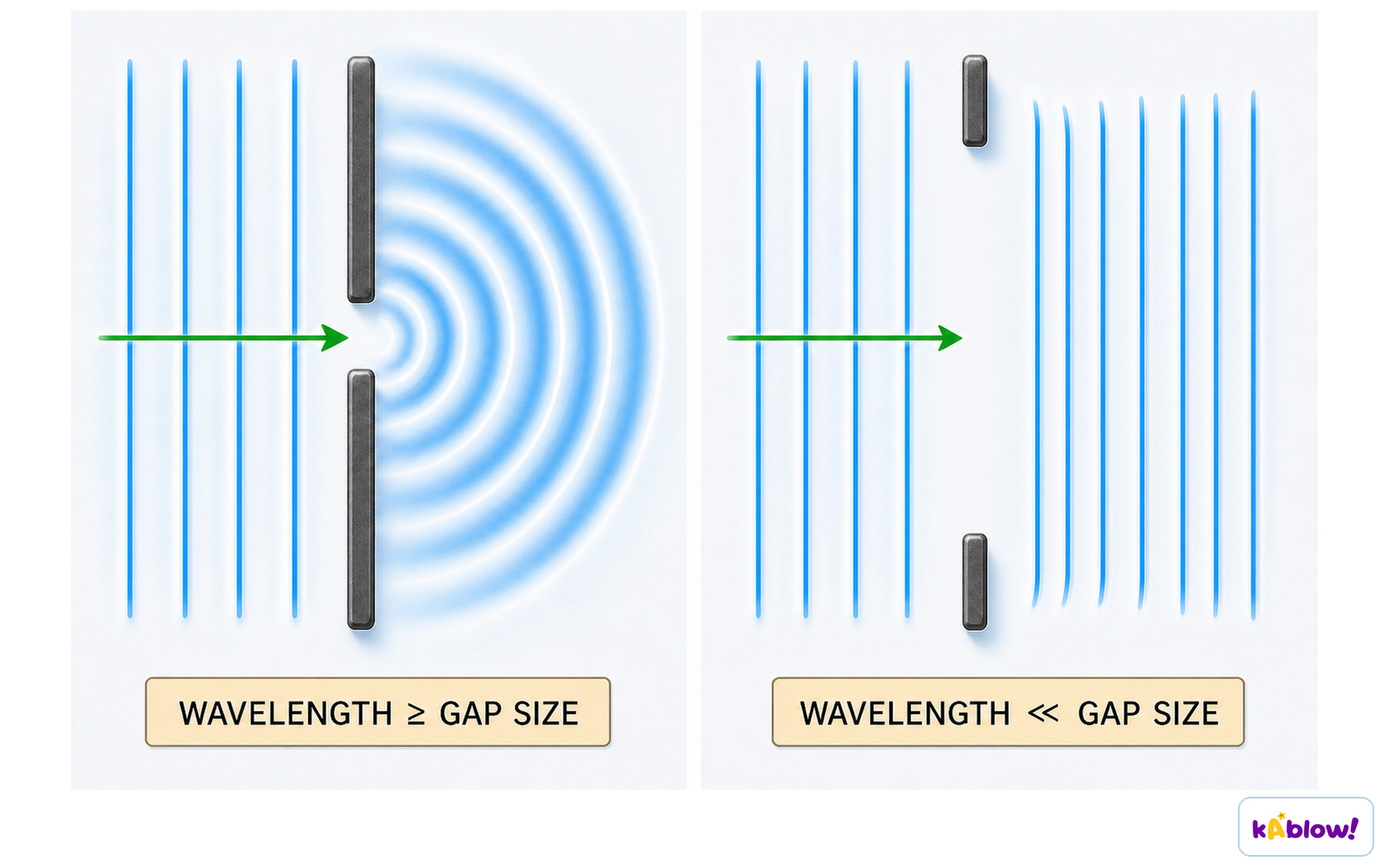
- Diffraction: waves spread out when passing through a narrow gap or around an obstacle.
- The effect is most pronounced when the gap width is approximately equal to the wavelength.
- As gap size increases relative to wavelength, diffraction becomes less noticeable.
- Diffraction does not change the wavelength of the wave.
Diffraction through a gap: when the wavelength is greater than the gap size the waves spread out a lot; when the wavelength is much less than the gap size they spread out very little.
投影片
練習題
免費預覽——56 題中的 8 題。註冊即可查看全部。
1.Which of the following correctly describes what waves transfer?
Easy- AMatter
- BEnergy
- CBoth matter and energy
- DNeither matter nor energy
2.State the term used to describe the distance from one point on a wave to the same point on the next wave.
Easy3.A wave has a frequency of 5 Hz and a wavelength of 2 m. Calculate the wave speed in m/s.
Easy- A12
- B9
- C11
- D10
4.In a transverse wave, the direction of vibration is parallel to the direction of energy transfer.
EasyTrue or false?
5.Complete the sentence about longitudinal waves.
EasyIn a longitudinal wave, the regions where particles are close together are called ____ and the regions where particles are spread apart are called ____.
6.A wave travels from air into glass. Which of the following changes occurs?
Medium- AIts frequency increases
- BIts wavelength decreases
- CIts speed increases
- DIts direction remains unchanged
7.The time period of a wave is 0.02 s. Calculate its frequency in Hz.
Easy- A50
- B55
- C45
- D60
8.Name the wave effect that occurs when a wave passes through a narrow gap and spreads out.
Easy