Light
邊玩邊學
回答這些題目賺取能量,接著就能釣魚、探索。不需要帳號。
課程筆記
Reflection of Light
- The law of reflection states: angle of incidence (i) = angle of reflection (r).
- Angles are measured between the ray and the normal (an imaginary line perpendicular to the boundary).
- In a plane mirror, the image is virtual, same size, same distance behind the mirror as the object is in front, and laterally inverted.
- A virtual image is formed where extended reflected rays appear to meet; it cannot be projected onto a screen.
- When drawing ray diagrams, use arrows to show direction: incident ray points toward the boundary, reflected ray points away.
Reflection at a plane mirror
Investigating Reflection
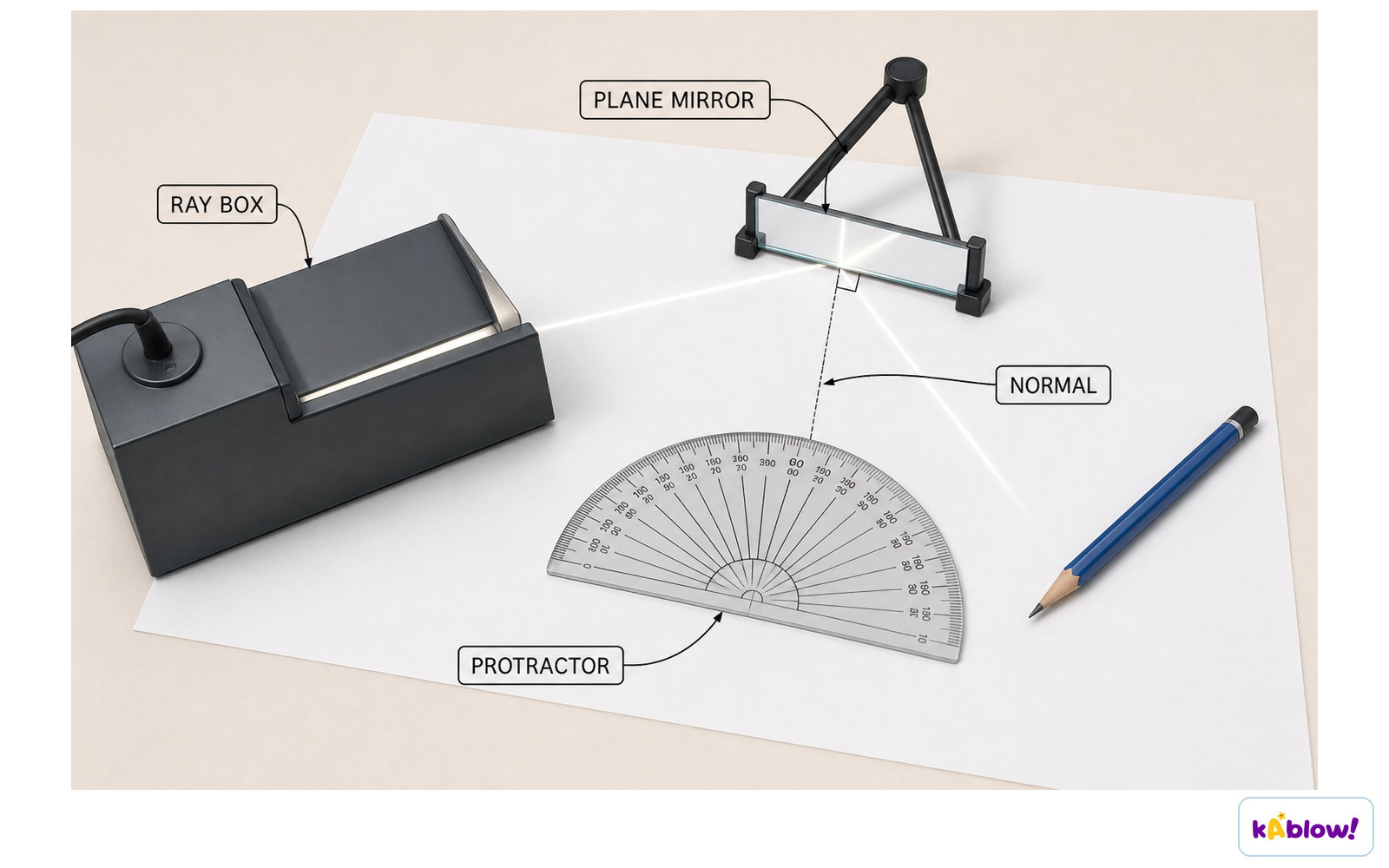
- Aim: To investigate reflection by a plane mirror.
- Independent variable: angle of incidence; dependent variable: angle of reflection.
- Method: Use a ray box, protractor, and plane mirror; mark incident and reflected ray positions on paper.
- Analysis: The law of reflection i = r should be verified; results are recorded in a table.
- Safety: Avoid looking directly at the ray box light; run burns under cold water for at least five minutes.
Apparatus to investigate reflection
Refraction of Light
- Refraction is the change in direction of a light ray when passing from one medium to another.
- From less dense to more dense (e.g., air to glass), light bends towards the normal.
- From more dense to less dense (e.g., glass to air), light bends away from the normal.
- When light enters a rectangular glass block, it bends towards the normal at entry and away at exit.
- Only speed and wavelength change during refraction; frequency remains constant.
Refraction of light
Refractive Index
- Refractive index n = speed of light in vacuum / speed of light in material (n > 1).
- Also given by Snell's law: n = sin i / sin r, where i = angle of incidence, r = angle of refraction.
- Denser materials have higher refractive indices (e.g., diamond ≈ 2.4, glass ≈ 1.5).
- Use the inverse sine function (sin⁻¹) to find an angle from its sine value.
Total Internal Reflection
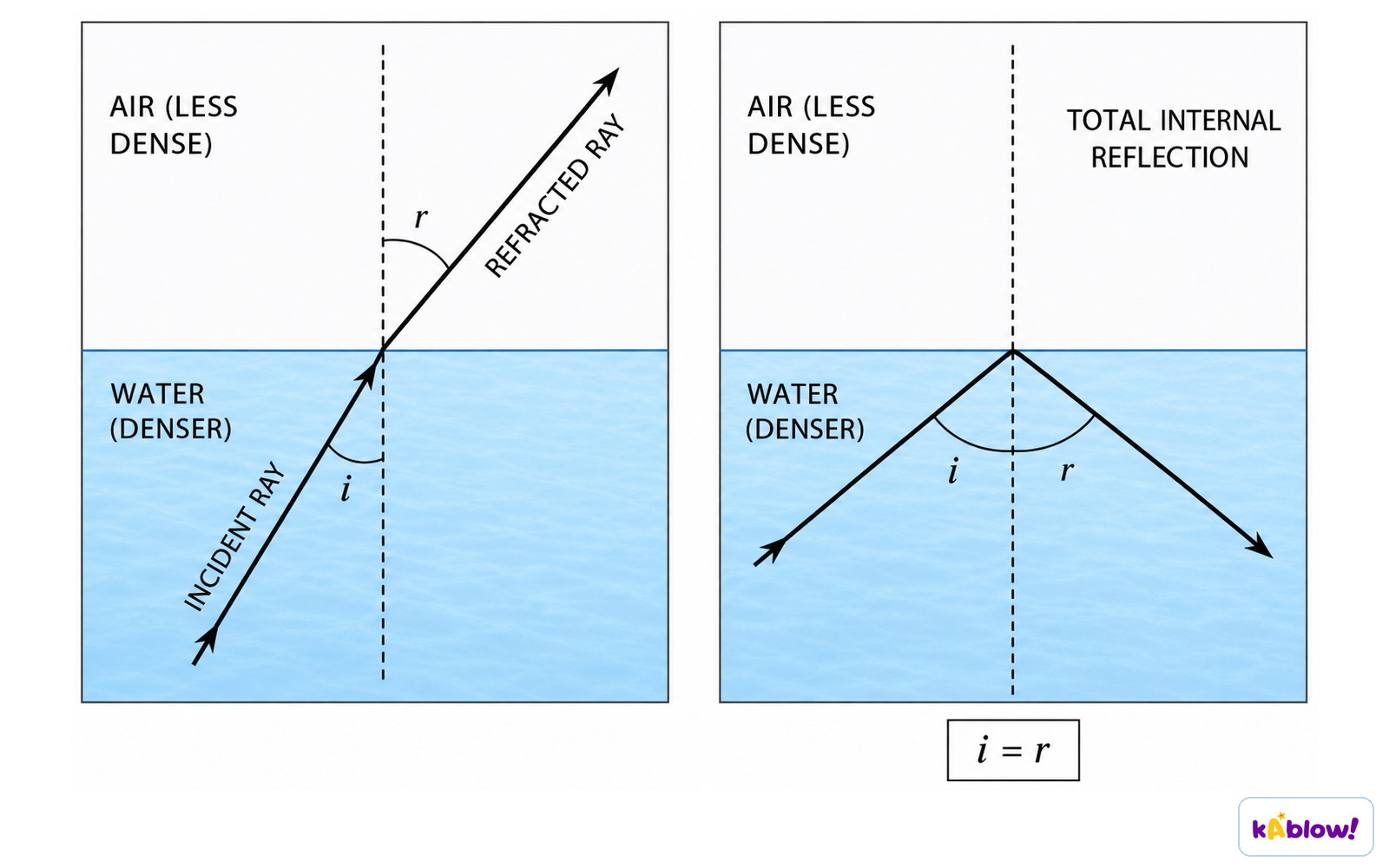
- Total internal reflection (TIR) occurs when light travels from a denser to a less dense medium and the angle of incidence exceeds the critical angle.
- The critical angle is the angle of incidence for which the angle of refraction is 90°.
- When i > critical angle, all light is reflected back into the denser medium.
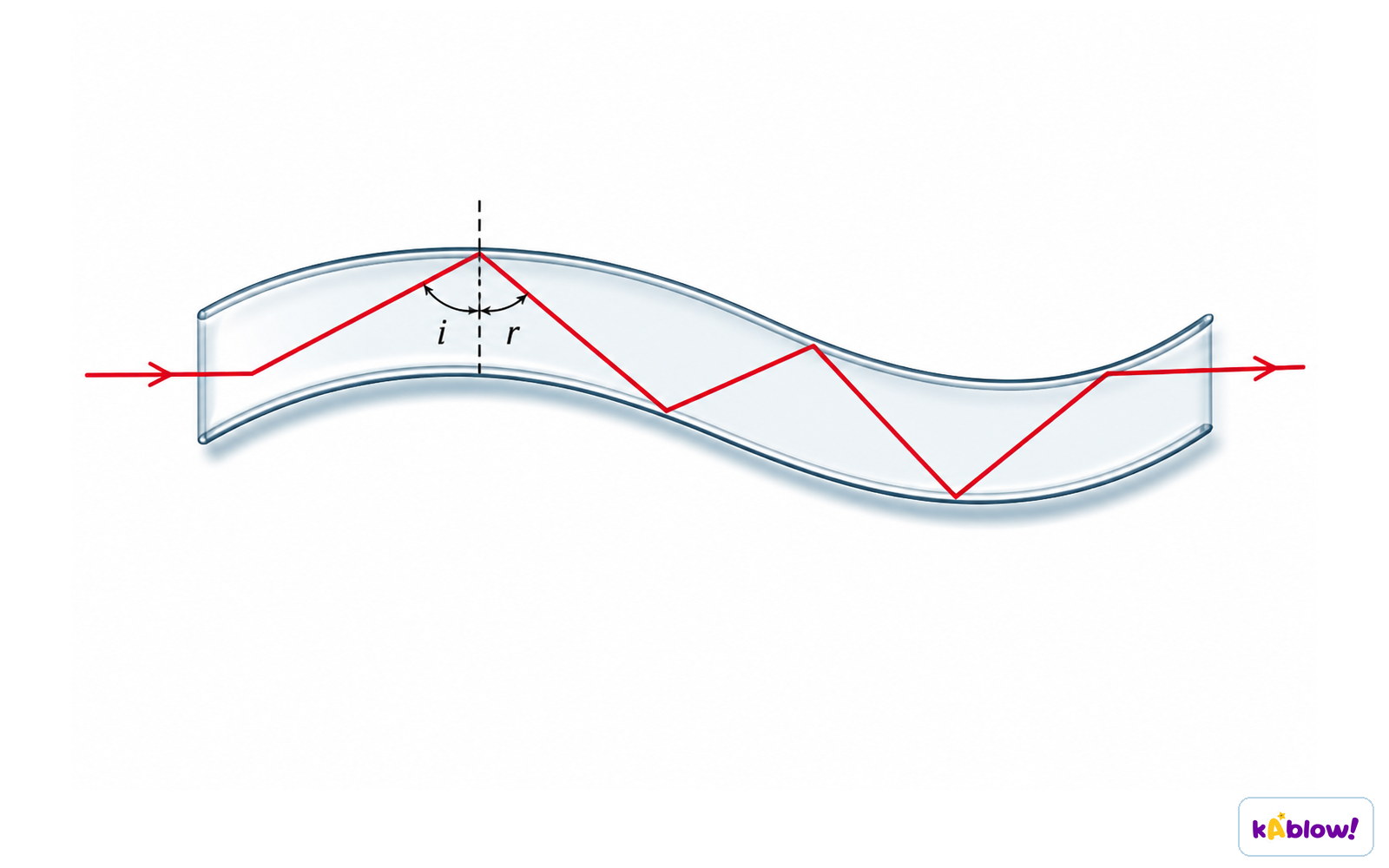
- Optical fibres use TIR to transmit light signals for communications, endoscopes, and decorative lamps.
Refraction and total internal reflection compared
Ray Diagrams and Lenses
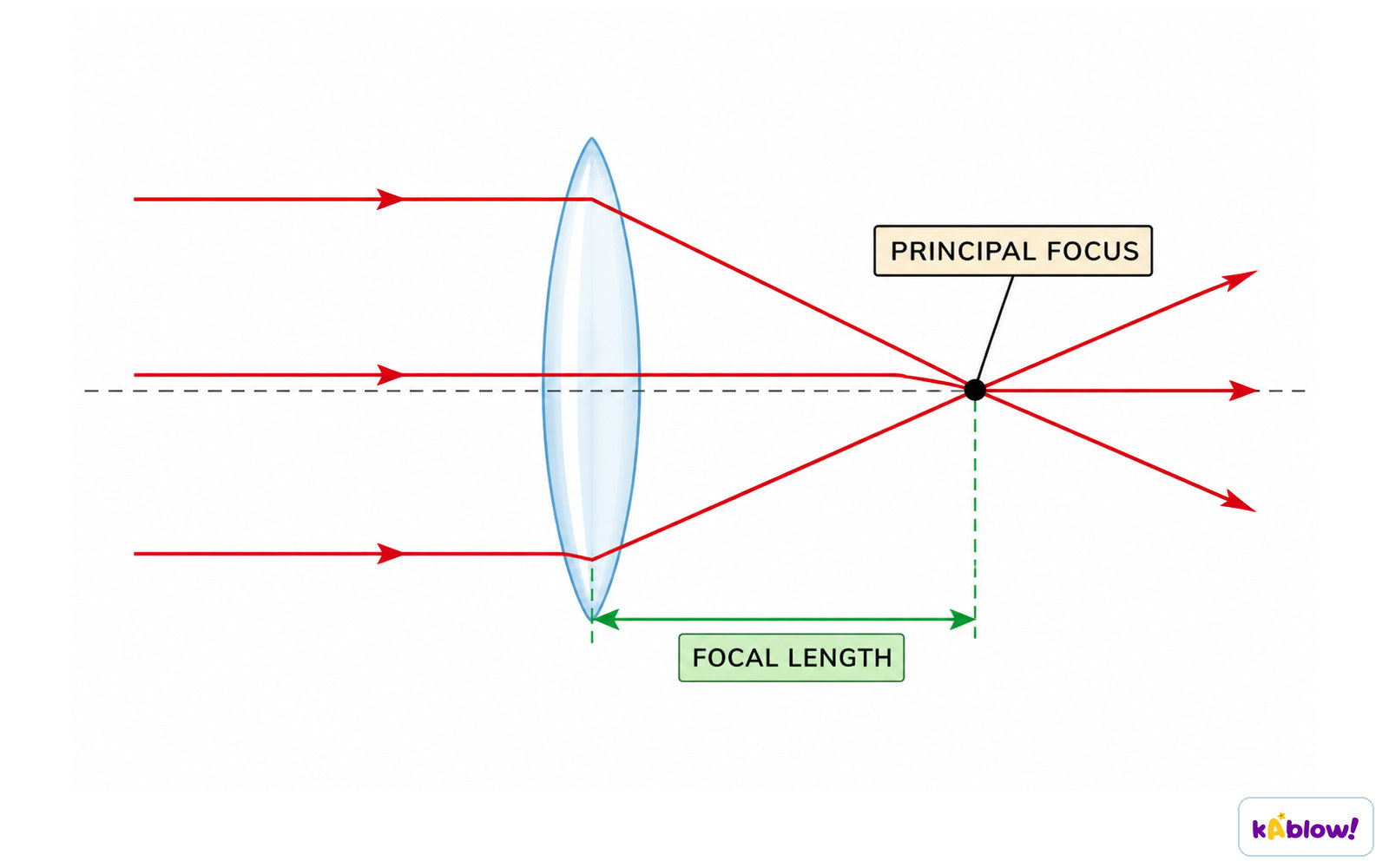
- A converging (convex) lens brings parallel rays to a focus at the principal focus (focal point).
- Focal length is the distance from the lens centre to the principal focus.
- Three key rays: through optical centre (undeviated), parallel to principal axis (refracts through focus), through focus (emerges parallel).
- For an object beyond 2f, the image is real, inverted, and diminished.
- For an object between f and 2f, the image is real, inverted, and magnified.
- For an object at 2f, the image is real, inverted, and same size.
Converging lens: principal focus and focal length
Virtual Images
- A real image is formed where light rays converge; it can be projected onto a screen and is inverted.
- A virtual image is formed where light rays appear to diverge from; it cannot be projected and is upright.
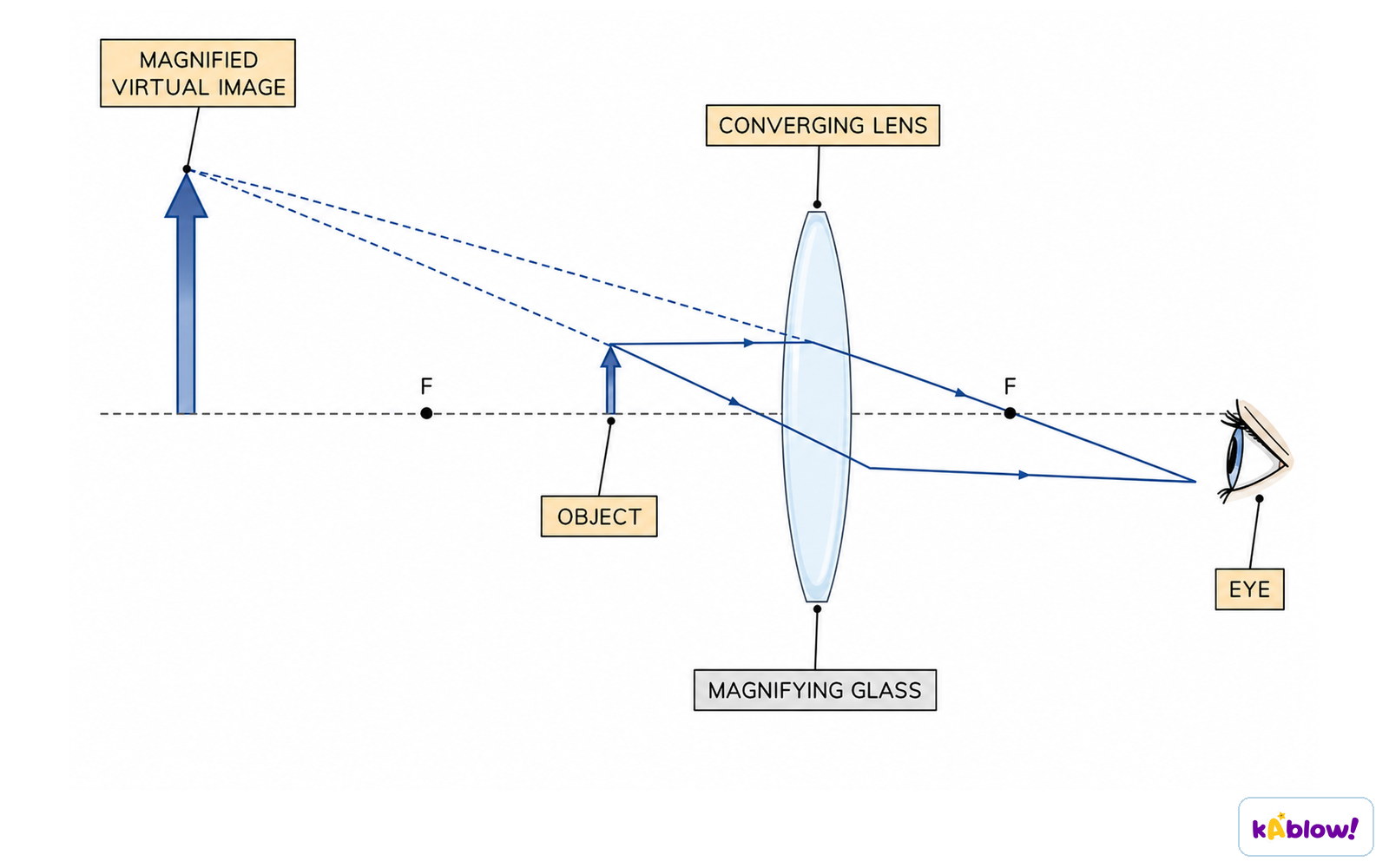
- When an object is placed closer than the focal length to a converging lens, a virtual, upright, magnified image is formed (magnifying glass).
- In ray diagrams for virtual images, use dashed lines to trace back the diverging rays to where they appear to meet.
Virtual image formed by a magnifying glass
Dispersion of Light
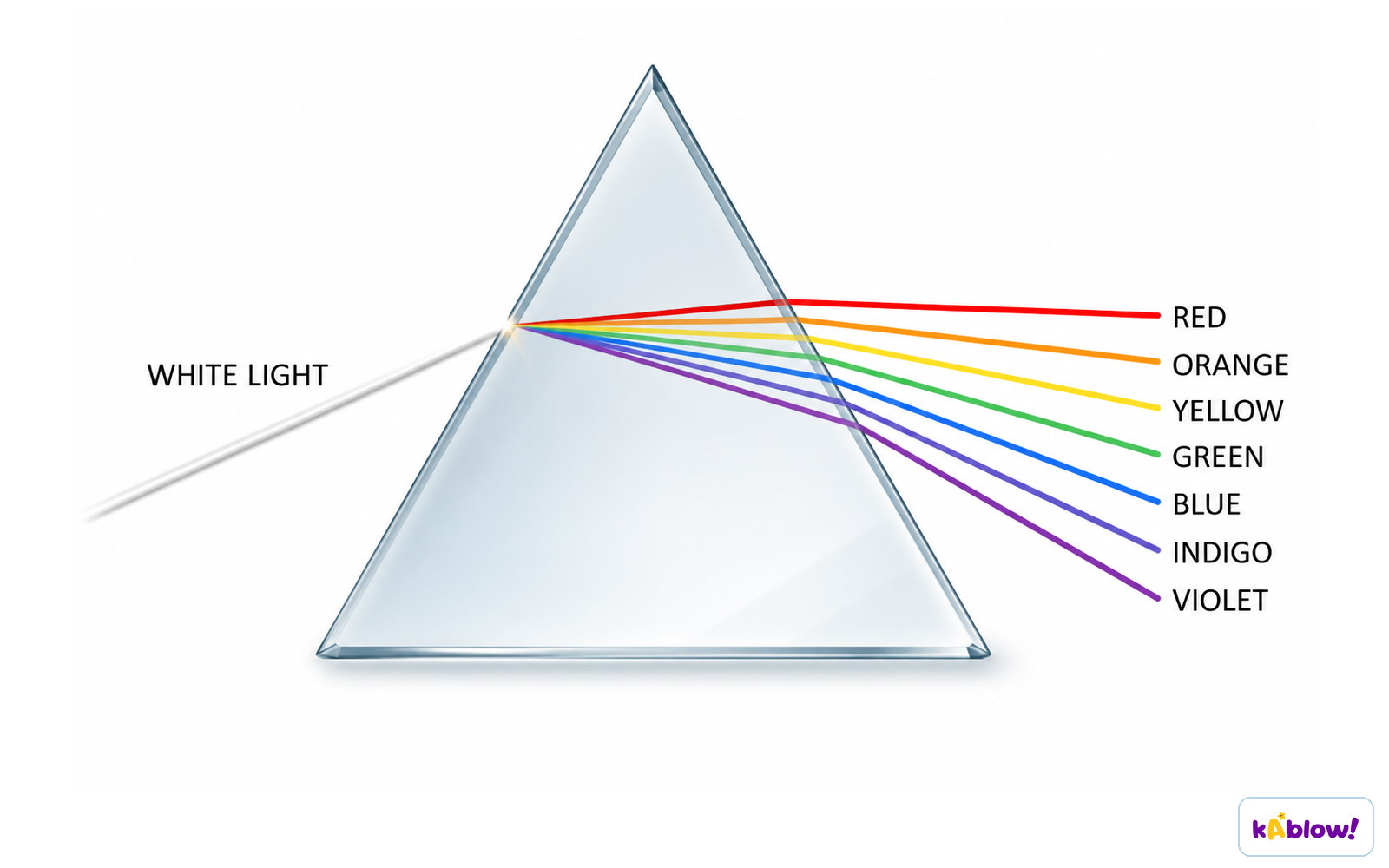
- Dispersion is the separation of white light into its component colours by a prism.
- Violet light is refracted most; red light is refracted least.
- The visible spectrum in order of increasing wavelength: violet, indigo, blue, green, yellow, orange, red.
- Each colour corresponds to a different wavelength and frequency; frequency does not change during refraction.
Dispersion of white light through a prism
投影片
練習題
免費預覽——57 題中的 8 題。註冊即可查看全部。
1.What is the angle between the incident ray and the normal called?
Easy- Aangle of reflection
- Bangle of incidence
- Ccritical angle
- Drefractive angle
2.The angle of incidence is always equal to the angle of reflection.
EasyTrue or false?
3.State the law of reflection.
Easy4.Complete the sentence:
EasyWhen light passes from air into glass, it bends ____ the normal.
5.A ray of light enters a glass block of refractive index 1.53 at an angle of incidence of 15°. Calculate the angle of refraction in degrees. (Give your answer to 1 decimal place.)
Medium- A10.7
- B8.7
- C9.7
- D11.7
6.Which colour of light is refracted the most when white light passes through a prism?
Easy- Ared
- Bgreen
- Cviolet
- Dyellow
7.What is the name of the angle at which the angle of refraction is 90°?
Easy8.Total internal reflection can occur when light travels from a less dense medium to a denser medium.
MediumTrue or false?