Symmetry And Shapes
邊玩邊學
回答這些題目賺取能量,接著就能釣魚、探索。不需要帳號。
給教育者: 為 Symmetry And Shapes(Maths [CIE]、Core)準備好可直接使用的課程投影片, 複習筆記, 圖表——用於你的課程,或把這個主題當成互動班級活動,讓學習者以即時遊戲的方式進行。
課程筆記
Introduction to Lines & Angles
- A line is straight, one-dimensional, and extends forever; a line segment has a start and end point.
- Parallel lines never intersect and are marked with arrows; perpendicular lines intersect at right angles (90°).
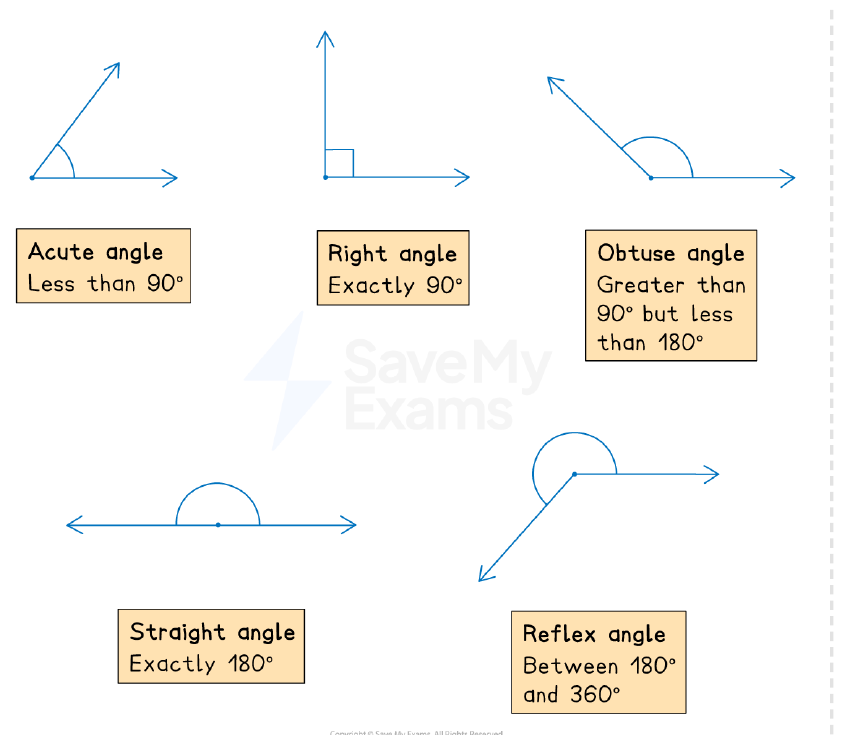
- Acute angle: less than 90°; right angle: exactly 90°; obtuse angle: greater than 90° but less than 180°.
- Straight angle: exactly 180°; reflex angle: greater than 180° but less than 360°.
- Angles at a point sum to 360°; angles on a straight line sum to 180°; angles that sum to 180° are supplementary.
Types of angles
Rotational Symmetry
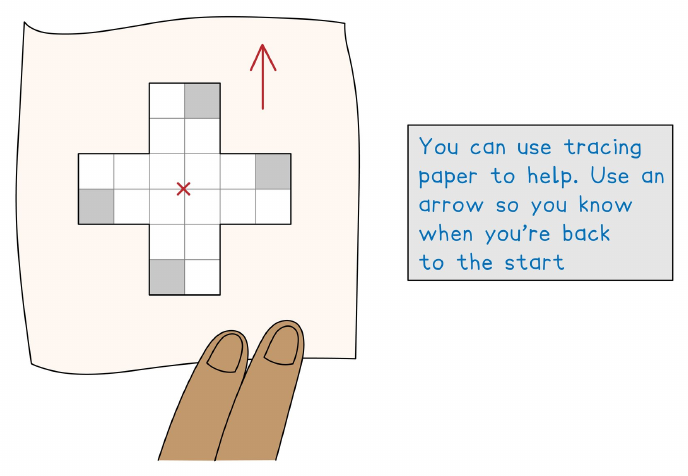
- Rotational symmetry is the number of times a shape looks the same during a full 360° rotation; this number is the order of rotational symmetry.
- Use tracing paper with an arrow to track orientation; returning to the start counts as 1, so order is at least 1.
- A shape with order 1 has no rotational symmetry (only looks the same at the start).
- A regular octagon has rotational symmetry of order 8; a regular pentagon has order 5.
Finding rotational symmetry with tracing paper
Lines of Symmetry
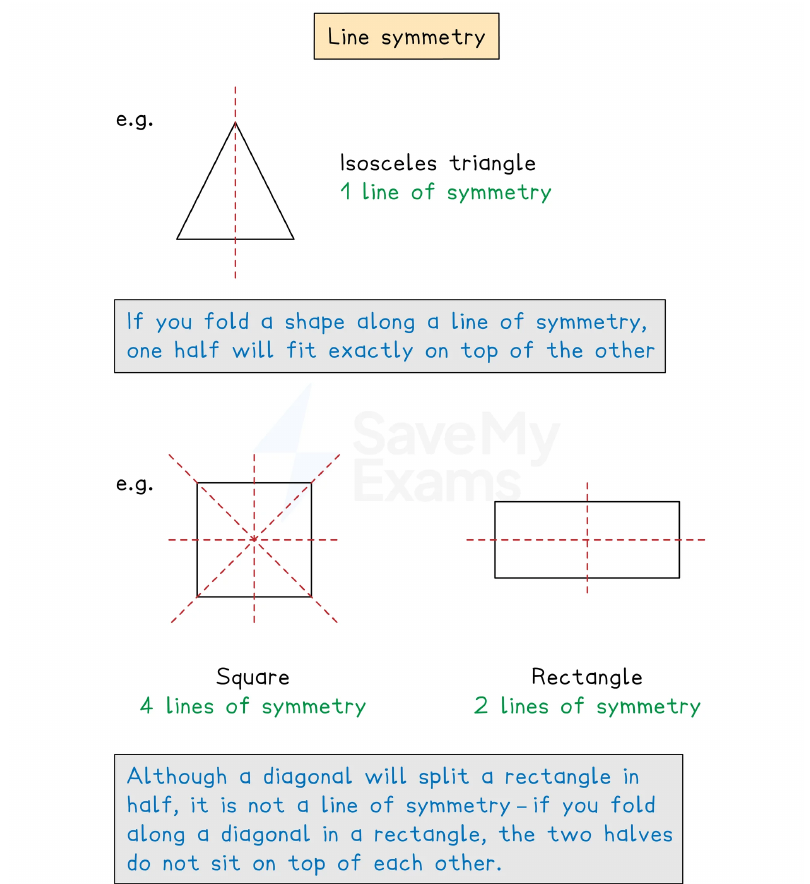
- A line of symmetry divides a shape into two mirror-image halves; folding along it makes the halves coincide.
- Some shapes have multiple lines of symmetry (e.g., square has 4, rectangle has 2).
- To complete a shape given a line of symmetry, reflect the given part across the line.
- Diagonal lines of symmetry require careful reflection; tracing paper can help.
Lines of symmetry
Properties of Polygons
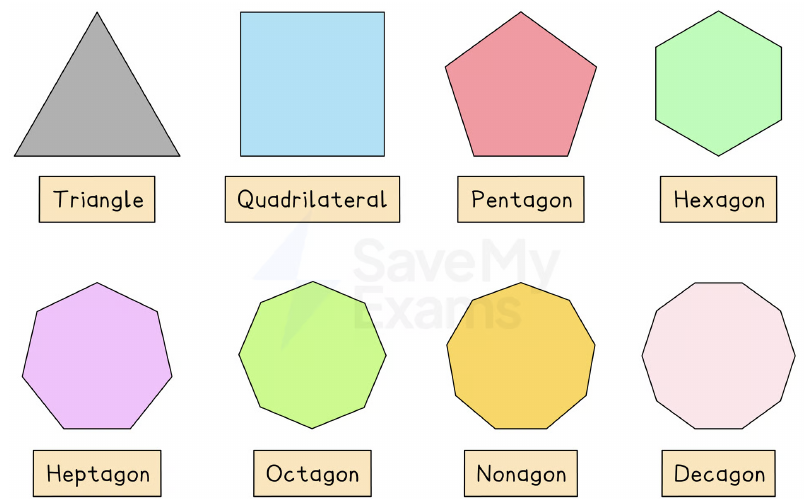
- Polygons are named by number of sides: triangle (3), quadrilateral (4), pentagon (5), hexagon (6), heptagon (7), octagon (8), nonagon (9), decagon (10).
- A regular polygon has all sides equal and all angles equal.
- Triangles: equilateral (3 equal sides/angles), isosceles (2 equal sides/angles), right-angled (one 90° angle), scalene (no equal sides).
- Quadrilaterals: square (4 equal sides, 4 right angles, 4 lines of symmetry, order 4 rotational symmetry).
- Rectangle: opposite sides equal, 4 right angles, 2 lines of symmetry, order 2 rotational symmetry.
- Parallelogram: opposite sides parallel and equal, opposite angles equal, no lines of symmetry, order 2 rotational symmetry.
- Rhombus: all sides equal, opposite sides parallel, opposite angles equal, 2 lines of symmetry, order 2 rotational symmetry.
- Trapezium: one pair of parallel sides; isosceles trapezium: non-parallel sides equal, 1 line of symmetry.
- Kite: two pairs of equal adjacent sides, one pair of equal opposite angles, 1 line of symmetry, order 1 rotational symmetry.
Named polygons
Properties of Circles
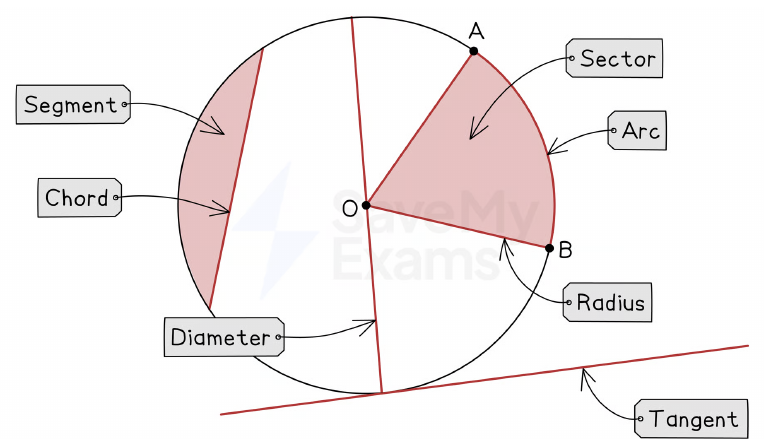
- Key terms: circumference (perimeter), diameter (line through centre, 2× radius), radius (centre to circumference).
- Chord: line joining two points on circumference; arc: part of circumference; sector: region between two radii and an arc.
- Segment: region between a chord and an arc; tangent: line touching circle at one point only.
- Diameter = 2 × radius; ratio circumference/diameter = π.
Parts of a circle
Properties of 3D Shapes
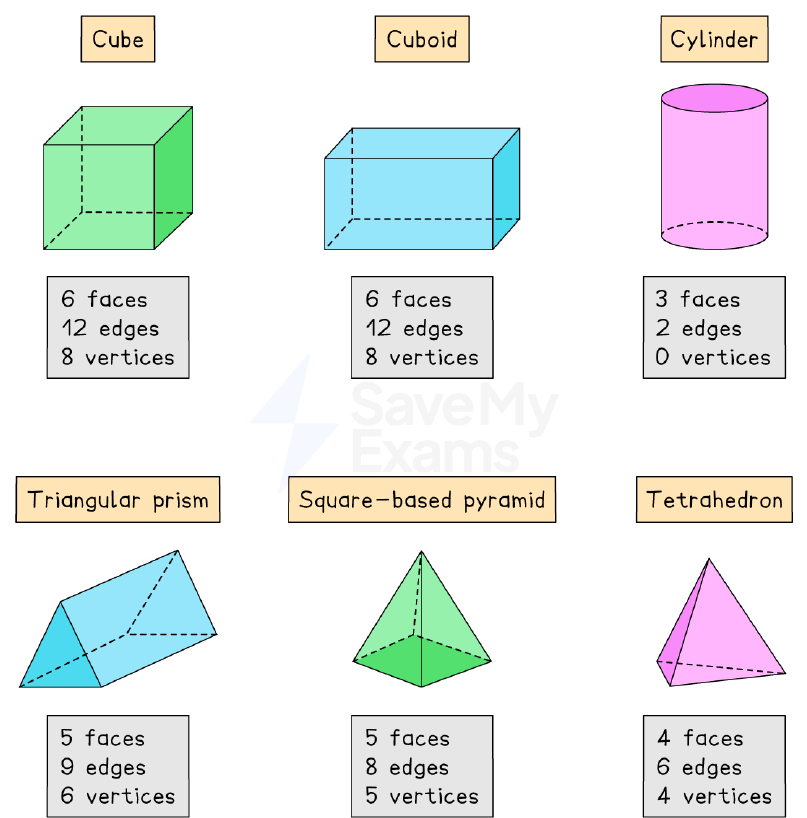
- A prism has the same cross-section throughout; examples: cube (square cross-section), cuboid (rectangle), triangular prism, cylinder (circle).
- A pyramid has a flat base and sloping sides meeting at an apex; square-based pyramid, tetrahedron (triangular-based pyramid), cone (circular base).
- Faces: flat surfaces; vertices: corners; edges: lines where faces meet.
- Cube: 6 square faces, 12 edges, 8 vertices. Cuboid: 6 rectangular faces, 12 edges, 8 vertices.
- Triangular prism: 2 triangular + 3 rectangular faces, 9 edges, 6 vertices. Square-based pyramid: 1 square + 4 triangular faces, 8 edges, 5 vertices.
- Cylinder: 2 circular + 1 curved face, 2 edges, 0 vertices. Sphere: 1 curved face, 0 edges, 0 vertices.
Properties of common 3D shapes
Nets of Solids
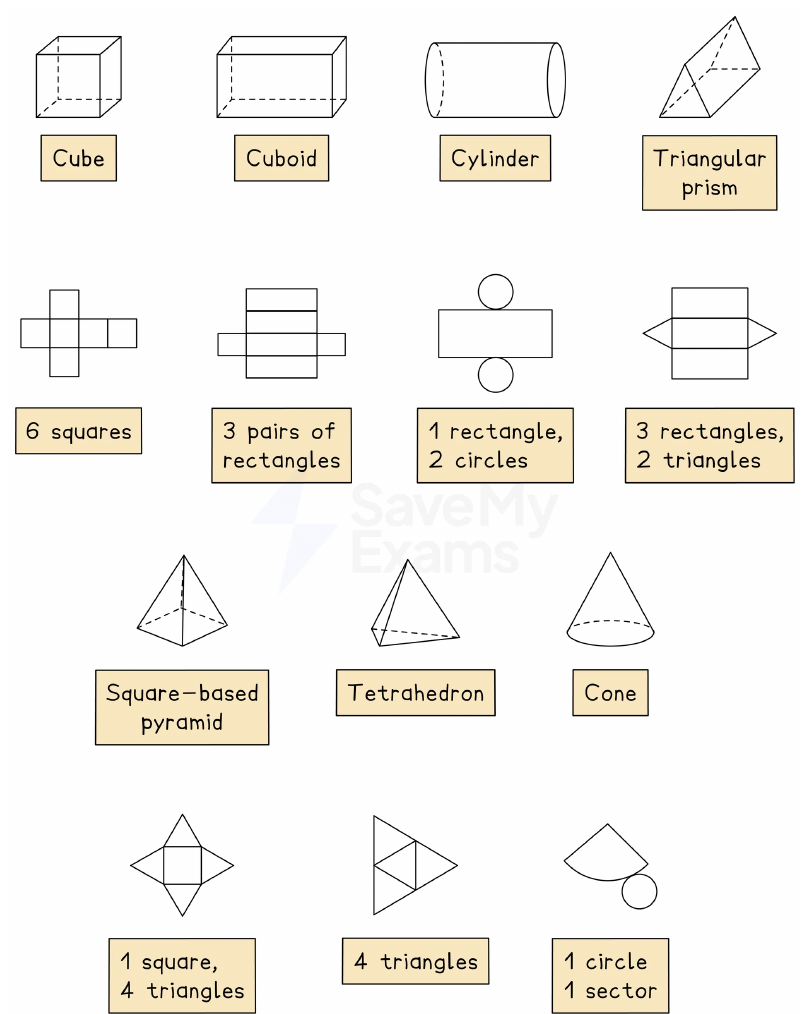
- A net is a 2D shape that can be folded to form a 3D solid; the area of the net equals the surface area of the solid.
- Net of a cube: 6 squares; there are 11 possible nets, the most common is a cross shape.
- Net of a cuboid: 6 rectangles in three pairs (opposite faces equal); 54 possible nets.
- Net of a cylinder: two circles (top and bottom) and a rectangle (curved surface); rectangle length = circumference of circle.
- Net of a square-based pyramid: one square and four congruent triangles.
Nets of common solids
投影片
練習題
免費預覽——38 題中的 8 題。註冊即可查看全部。
1.What is the order of rotational symmetry of a regular octagon?
Easy- A8
- B4
- C6
- D2
2.What is the mathematical name for a quadrilateral with exactly one pair of parallel sides?
Easy- ATrapezium
- BParallelogram
- CRhombus
- DKite
3.Write down the mathematical name for an angle which is less than 90°.
Easy- AAcute angle
- BObtuse angle
- CRight angle
- DReflex angle
4.How many lines of symmetry does a regular pentagon have?
Easy- A5
- B4
- C3
- D2
5.What is the order of rotational symmetry of a regular pentagon?
Easy- A5
- B4
- C3
- D2
6.Write down the mathematical name for a polygon with 5 sides.
Easy- APentagon
- BHexagon
- CHeptagon
- DOctagon
7.A quadrilateral has rotational symmetry of order 2 and exactly two lines of symmetry. What is its mathematical name?
Medium- ARectangle
- BKite
- CSquare
- DParallelogram
8.The diagram shows a circle with centre O and a chord AB. What is the mathematical name for line AB?
Medium- AChord
- BDiameter
- CRadius
- DTangent
歷屆試題
這個主題的歷屆試題練習即將推出。
即將推出