Sequences
邊玩邊學
回答這些題目賺取能量,接著就能釣魚、探索。不需要帳號。
給教育者: 為 Sequences(Maths [CIE]、Extended)準備好可直接使用的課程投影片, 複習筆記——用於你的課程,或把這個主題當成互動班級活動,讓學習者以即時遊戲的方式進行。
課程筆記
Introduction to Sequences
- A sequence is an ordered set of numbers that follow a rule (e.g., 3, 6, 9, 12… add 3 each time).
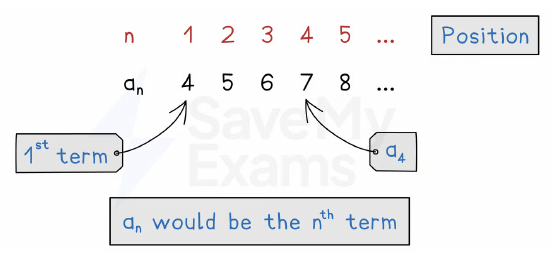
- Each number in a sequence is called a term; its position is denoted by n (n=1 for first term).
- A term-to-term rule tells how to get the next term from the current one (e.g., add 4, multiply by 3).
- A position-to-term rule (nth term formula) lets you find any term directly: substitute n=1,2,3…
- To check if a value belongs to a sequence, set the nth term equal to the value and solve for n; if n is a whole number, it is in the sequence.
Sequence position notation
nth Terms of Linear Sequences
- A linear (arithmetic) sequence has a constant common difference (d) between consecutive terms.
- The nth term formula is dn + b, where d is the common difference and b is the term before the first term (zero term).
- To find b, continue the sequence backwards by one term (subtract d from the first term).
- Example: For 5, 7, 9, 11… d=2, b=3 → nth term = 2n+3.
- For decreasing sequences, d is negative (e.g., 15,10,5… d=-5, b=20 → nth term = -5n+20).
Quadratic Sequences
- A quadratic sequence has an nth term involving n²; its second differences are constant.
- To find the nth term: Step 1 – find first and second differences. Step 2 – halve the second difference to get a (coefficient of n²).
- Step 3 – write out an² and subtract from the original sequence to get a linear sequence. Step 4 – find the nth term of that linear sequence (bn+c).
- Step 5 – add an² + bn + c to get the nth term formula.
- Example: For 6,9,14,21,30… second difference=2 → a=1; an²=1,4,9,16,25; difference=5,5,5,5,5 → linear nth term=5; so nth term = n²+5.
- Common simple quadratics: n²+1, 2n², (n+1)²-2, etc.
Other Sequences
- Cubic sequences have constant third differences; nth term involves n³. The coefficient a = (third difference)/6.
- Exponential (geometric) sequences multiply by a constant common ratio (r) each time; nth term = a × rⁿ (or a × rⁿ⁻¹).
- Common sequences: prime numbers (2,3,5,7…), triangular numbers (1,3,6,10…), cube numbers (1,8,27,64…).
- Sequences can be combined: e.g., fractions with linear numerator and cubic denominator, or sums of two sequences.
- Harder problems may involve setting up and solving equations (e.g., simultaneous equations) to find unknown terms or ratios.
Fibonacci and Special Sequences
- In a Fibonacci sequence, each term is the sum of the two previous terms (e.g., 1,1,2,3,5,8…).
- Given first two terms a and b, the 3rd term is a+b, 4th is a+2b, 5th is 2a+3b, 6th is 3a+5b.
- To find unknown terms in a Fibonacci sequence, set up equations using given terms and solve.
- Some sequences follow a pattern like adding a decreasing amount or using a specific rule (e.g., term-to-term rules).
Finding Terms and Checking Membership
- To find a specific term, substitute n into the nth term formula (e.g., 20th term of n²+5 = 20²+5 = 405).
- To check if a number is in a sequence, set the nth term equal to the number and solve for n; if n is a positive integer, it is a term.
- Example: Is 98 in the sequence 8n+2? 8n+2=98 → n=12, yes. Is 124? 8n+2=124 → n=15.25, no.
- Always write the position number above each term in the exam to help spot patterns.
投影片
練習題
免費預覽——55 題中的 8 題。註冊即可查看全部。
1.What is the next term in the sequence 8, 11, 14, 17, 20?
Easy- A21
- B22
- C23
- D24
2.The nth term of a sequence is n2 + 1. What are the first three terms?
Easy- A2, 5, 10
- B1, 4, 9
- C2, 4, 8
- D1, 5, 10
3.Write an expression for the nth term of the sequence 15, 12, 9, 6.
Medium- A18 - 3n
- B3n + 12
- C15 - 3n
- D3n + 15
4.A sequence has nth term 2n2 + 5n - 15. Find the difference between the 4th term and the 5th term.
Medium- A23
- B27
- C19
- D31
5.In a sequence, T1 = 17, T2 = 12, T3 = 7, T4 = 2. Find T5.
Easy- A-3
- B-8
- C3
- D0
6.The nth term of a sequence is 60 - 8n. Find the largest number in this sequence.
Medium- A52
- B60
- C56
- D48
7.Find an expression for the nth term of the sequence 12, 19, 26, 33, 40.
Medium- A7n + 5
- B5n + 7
- C7n + 12
- D12n + 7
8.Find an expression for the nth term of the sequence 7, 5, 3, 1, -1, ...
Medium- A9 - 2n
- B2n + 5
- C7 - 2n
- D2n + 7
歷屆試題
這個主題的歷屆試題練習即將推出。
即將推出