Computer networks: LANs, WANs and the internet
邊玩邊學
回答這些題目賺取能量,接著就能釣魚、探索。不需要帳號。
課程筆記
Why Network Computers?
- Networks let computers and peripherals (hosts) communicate and share data.
- They support services like the World Wide Web, email, instant messaging, digital video/audio, and shared printers.
- Many applications have limited functionality without a network connection.
- Networks allow resource sharing (e.g., storage servers, applications).
- They enable remote access to computers and data.
LANs and WANs
- A Local Area Network (LAN) covers a small area, like a home, school, or office.
- A Wide Area Network (WAN) spans a large geographical area, often connecting multiple LANs.
- The internet is the largest WAN, connecting networks worldwide.
- LANs are usually owned and managed by a single organisation, while WANs may be owned by multiple providers.
- WANs often use leased telecommunication lines or satellite links.
Wired and Wireless Connections
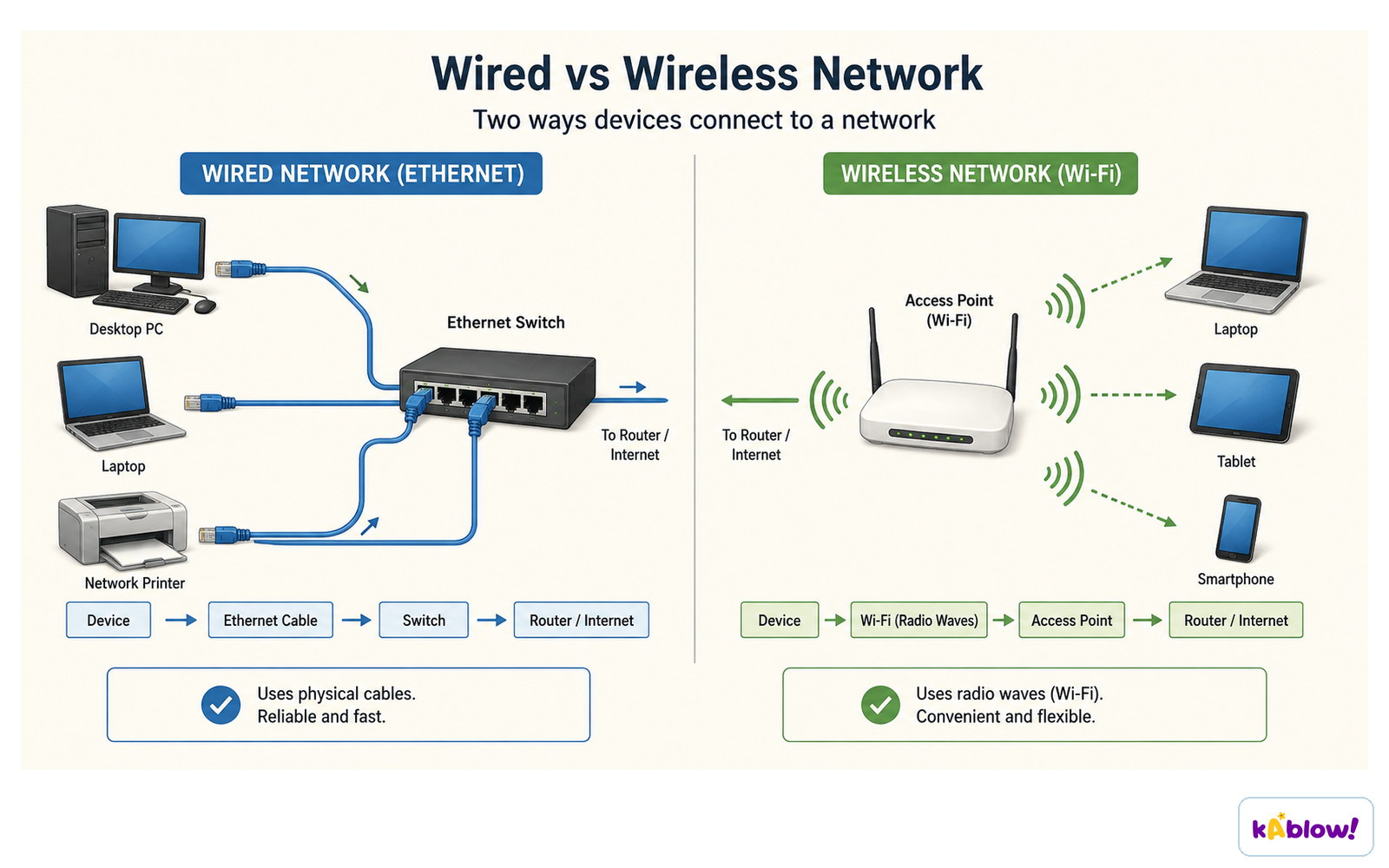
- Wired connections use physical media like copper cables (e.g., Ethernet) or optical fibres.
- Wireless connections use radio-frequency signals, such as Wi-Fi and Bluetooth.
- Wired connections generally offer faster and more stable speeds.
- Wireless connections provide mobility and easier setup.
- The choice depends on factors like speed, reliability, and convenience.
Wired networks use cables and are fast and reliable; wireless uses radio waves and is convenient and flexible.
Network Hardware
- Routers forward data packets between different networks, e.g., a home LAN to the internet.
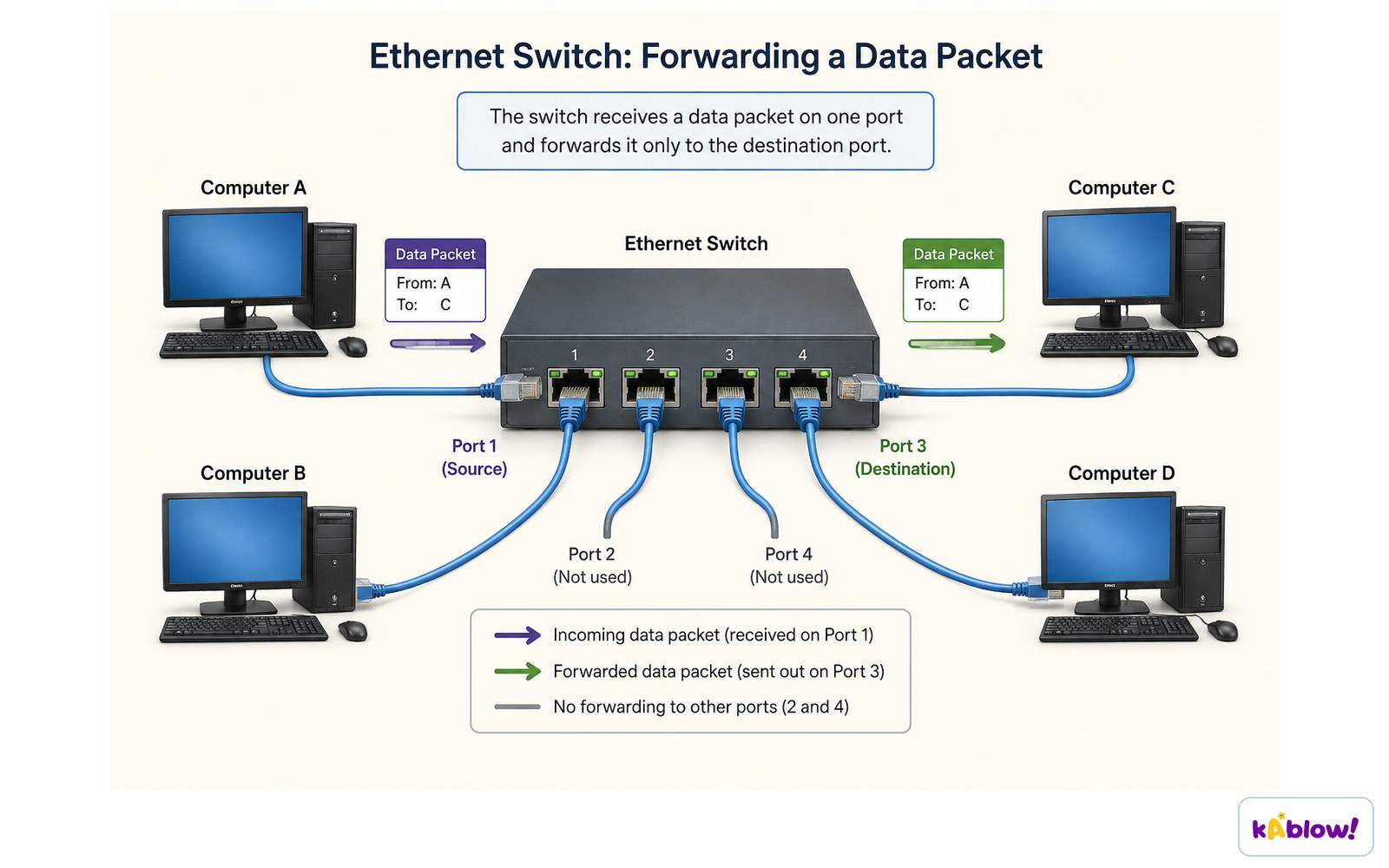
- Switches connect devices within a LAN, directing data to the correct device.
- Servers provide resources or services to other computers (clients) on the network.
- Hosts are any devices that send or receive data, such as computers, printers, or smartphones.
- Modems (like the Bell 101) modulate/demodulate signals for transmission over telephone lines.
A switch receives a data packet on one port and forwards it only to the destination port.
The Internet as a Global Network
- The internet is a global network of networks that connects millions of devices.
- It evolved from the ARPANET, which began in 1969 with four nodes.
- The internet uses packet switching to send data in small chunks.
- It relies on communication protocols (like TCP/IP) to ensure data is sent and received correctly.
- The internet enables services like the World Wide Web, email, and streaming.
How Systems Communicate
- Each host on a network has a network address (e.g., IP address) that identifies it.
- Hosts may also have hostnames (like www.example.com) that are easier to remember.
- A name server (e.g., Domain Name System) maps hostnames to network addresses.
- Data is transmitted using communication protocols that define rules for exchange.
- Packet switching breaks data into packets that travel independently and are reassembled at the destination.
Network Topologies
- Network topology is the arrangement of hosts and hardware in a network.
- Common topologies include bus, star, ring, and mesh.
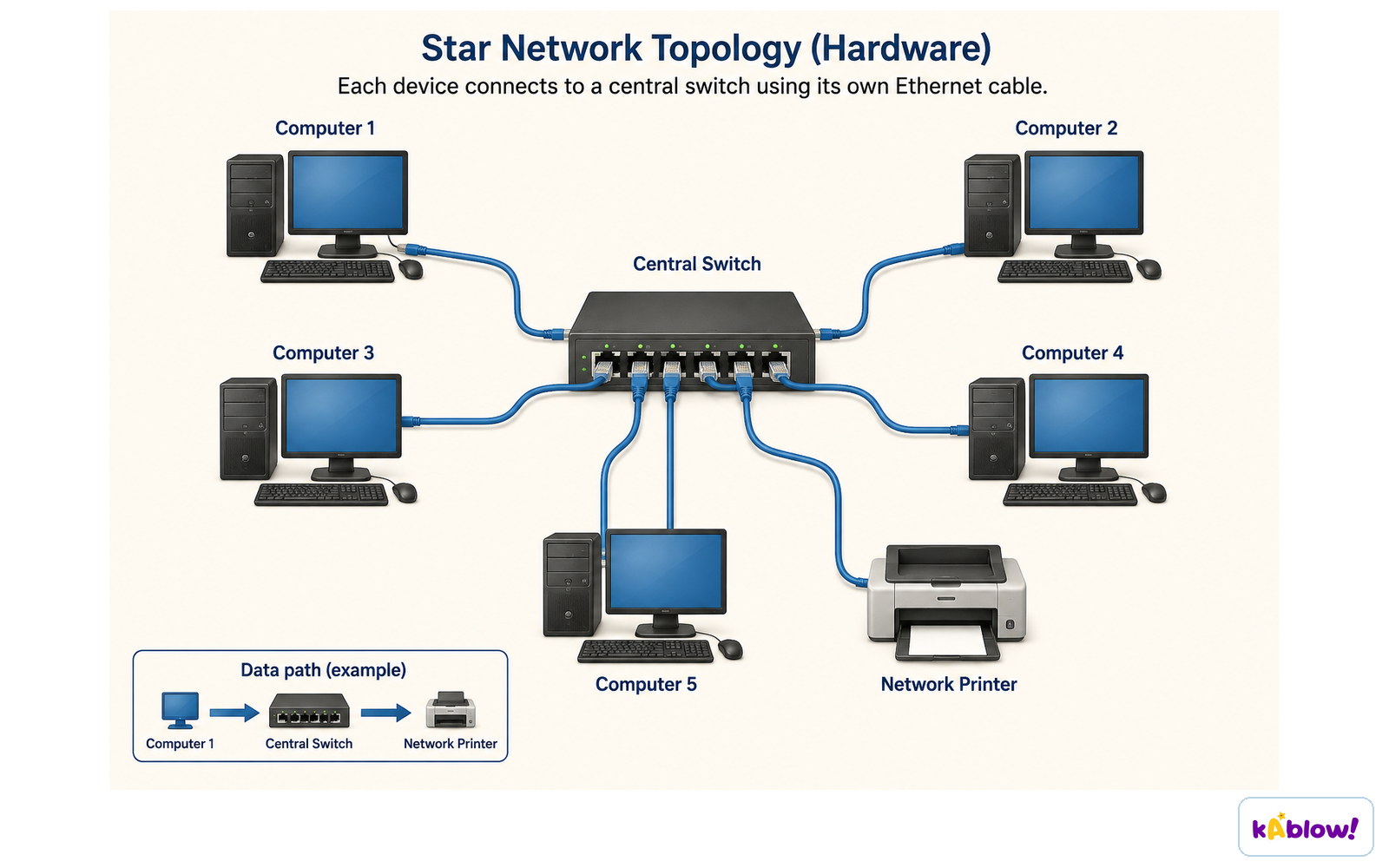
- In a star topology, all devices connect to a central switch or hub.
- In a mesh topology, devices connect to many others, providing redundancy.
- Topology affects performance, cost, and reliability.
In a star topology every device connects to a central switch using its own cable.
History of Networks
- The first computer network was created in 1940 when George Stibitz connected a terminal to a computer at Bell Labs.
- The SAGE radar system in the late 1950s used the first commercial modem (Bell 101) at 110 bit/s.
- Packet switching was invented independently by Paul Baran and Donald Davies in the 1960s.
- The ARPANET (1969) was the first network to use packet switching and became the basis for the internet.
- Ethernet was developed by Robert Metcalfe at Xerox PARC in 1973.
A home network: the broadband line reaches a modem, then a router, a switch and a wireless access point serve the devices.
A message is split into numbered packets that may take different routes and are reassembled in order at the destination.
投影片
練習題
免費預覽——60 題中的 8 題。註冊即可查看全部。
1.A computer network is a group of communicating computers and peripherals known as hosts.
EasyTrue or false?
2.What is the name for the memorable labels that can be mapped to a network address using a hosts file or a name server?
Easy- AHostnames
- BIP addresses
- CProtocols
- DTopologies
3.Which of the following are examples of physical media that support information exchange in a computer network? (Select all that apply)
Easy- ACopper cables
- BOptical fibres
- CRadio-frequency media
- DRouters
- EHostnames
4.A WAN (Wide Area Network) typically covers a smaller geographical area than a LAN (Local Area Network).
EasyTrue or false?
5.Which device is used to connect a local network to the internet and route data between networks?
Easy- ARouter
- BSwitch
- CServer
- DModem
6.Match each network term to its correct definition.
Medium- LAN
- WAN
- Router
- Connects devices over a large geographical area
- Connects devices within a limited area like a school
- Device that forwards data between networks
7.Packet switching was independently invented by Paul Baran and Donald Davies.
MediumTrue or false?
8.Match each network component to its primary function.
Easy- Router
- Switch
- Server
- Connects different networks and routes data
- Connects devices within a single network
- Provides resources or services to clients