Representing sound digitally
邊玩邊學
回答這些題目賺取能量,接著就能釣魚、探索。不需要帳號。
給教育者: 為 Representing sound digitally(KS3 Computing、Computer Systems)準備好可直接使用的課程投影片, 複習筆記——用於你的課程,或把這個主題當成互動班級活動,讓學習者以即時遊戲的方式進行。
課程筆記
Sound as a Wave
- Sound is a wave of pressure variations that travels through a medium (like air).
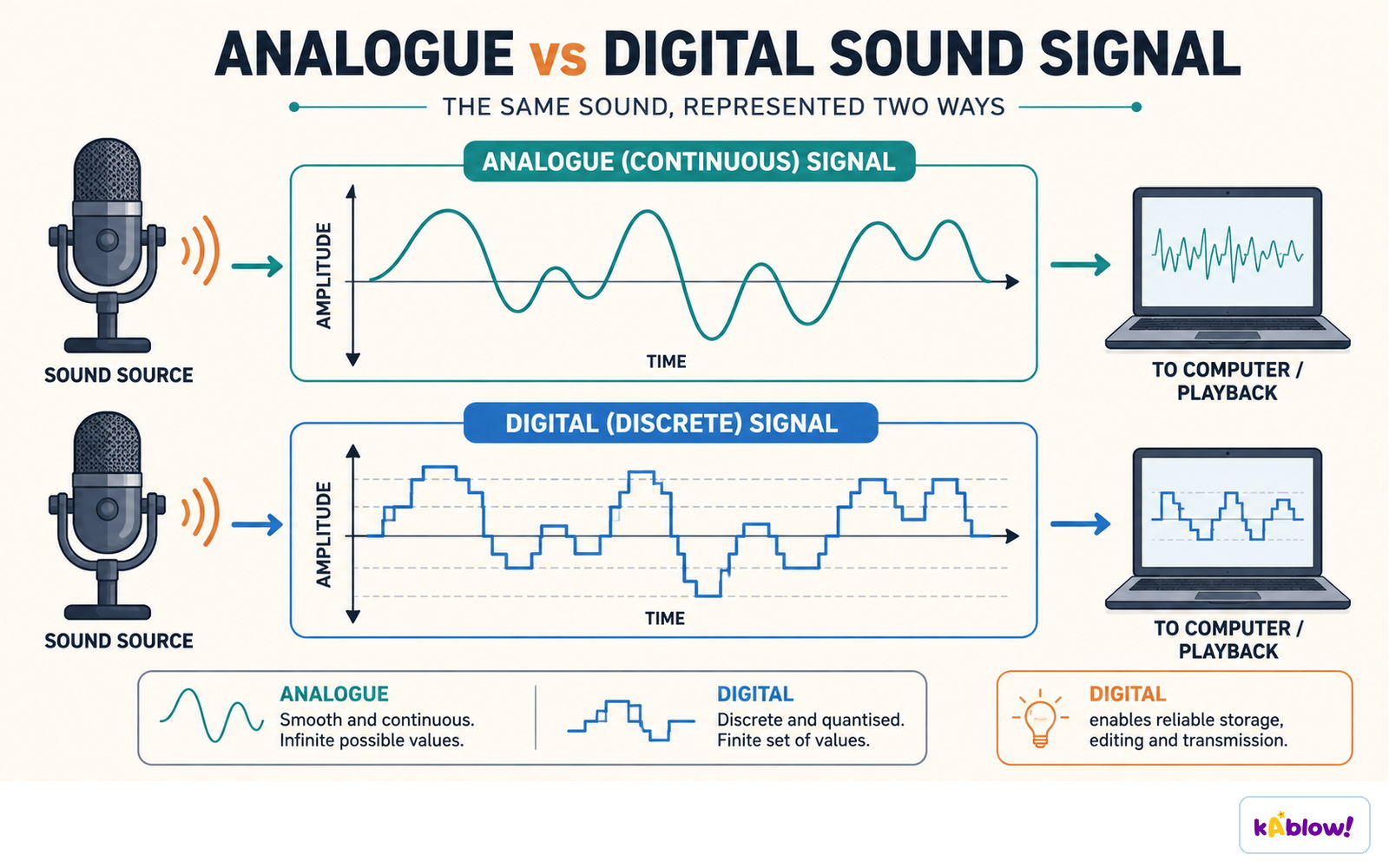
- A microphone (a transducer) converts sound waves into an analog electrical signal that mirrors the wave's shape.
- Analog audio retains its wave-like characteristics throughout storage and playback, but it is susceptible to noise and distortion.
- In contrast, digital audio represents sound as numerical samples, which can be stored and processed without degradation.
An analogue signal varies continuously; a digital one stores a finite set of discrete values.
Digital Representation of Sound
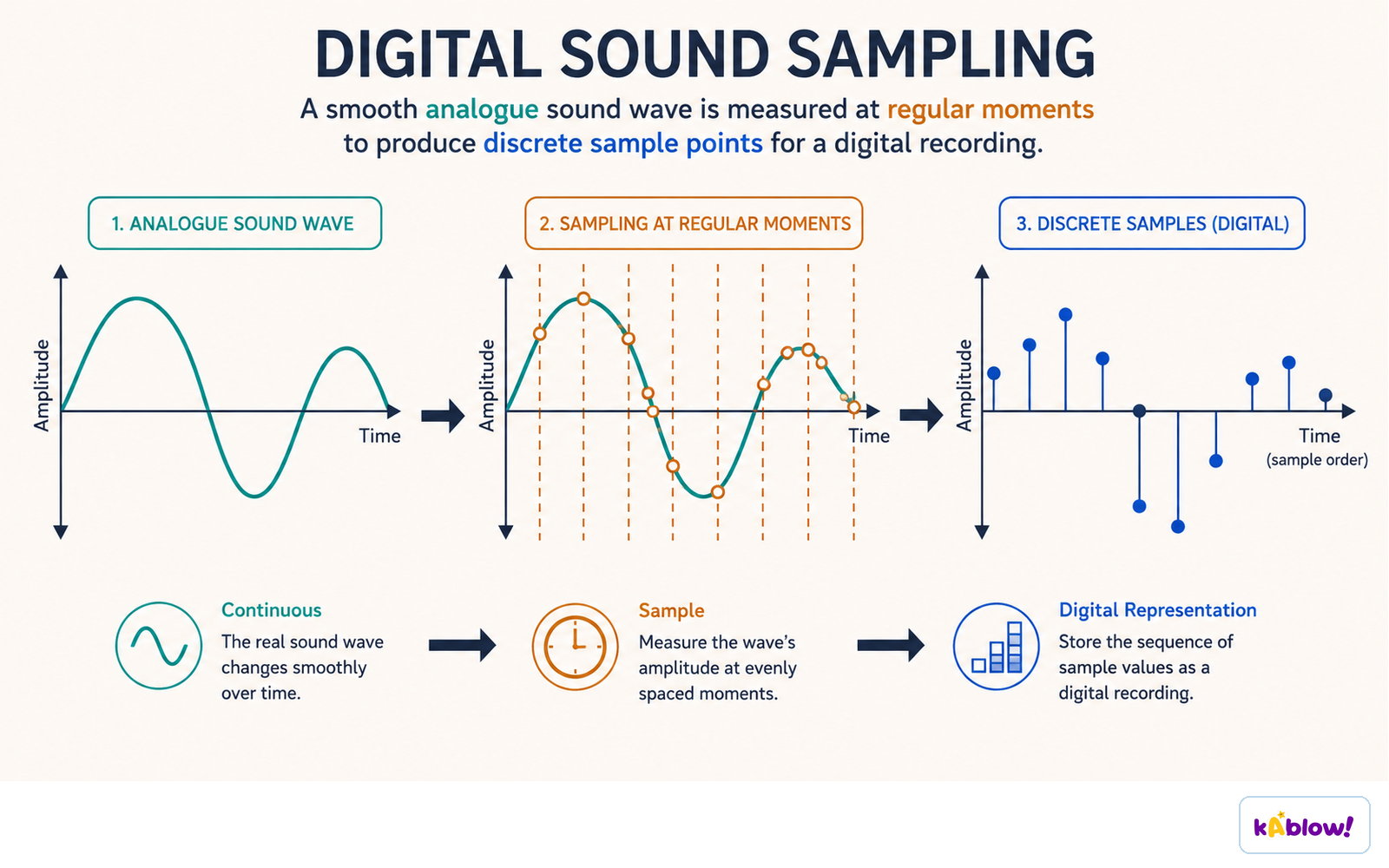
- Digital audio encodes the sound wave as a continuous sequence of numerical samples.
- Each sample measures the amplitude (loudness) of the wave at a specific moment in time.
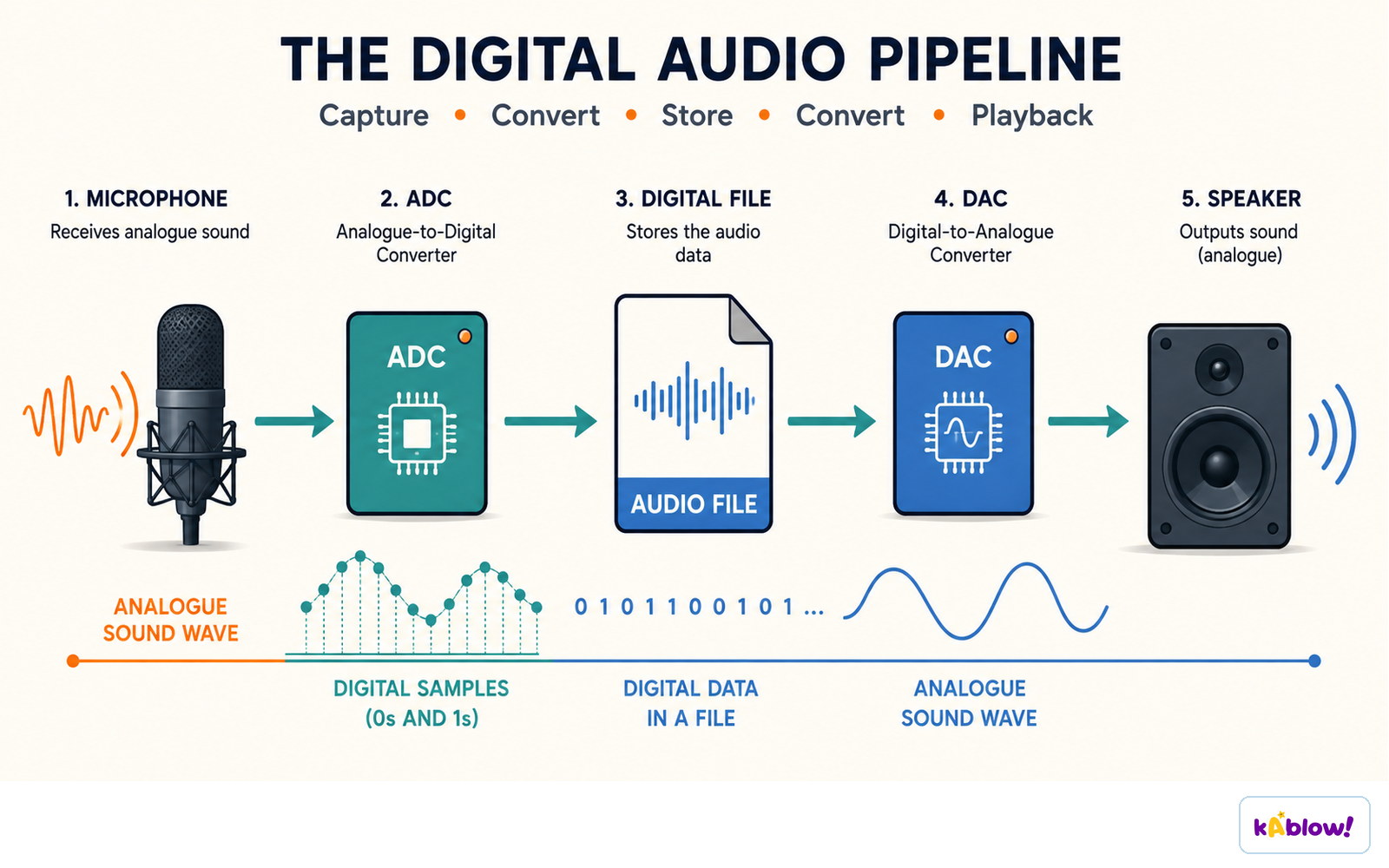
- The process of converting an analog signal to digital is done by an analog-to-digital converter (ADC).
- The most common method is pulse-code modulation (PCM), which records the amplitude as a binary number.
Sampling measures the amplitude of a sound wave at regular moments to produce discrete sample points.
Sampling Rate
- The sampling rate is the number of samples taken per second, measured in hertz (Hz).
- For example, CD audio uses a sampling rate of 44.1 kHz, meaning 44,100 samples per second.
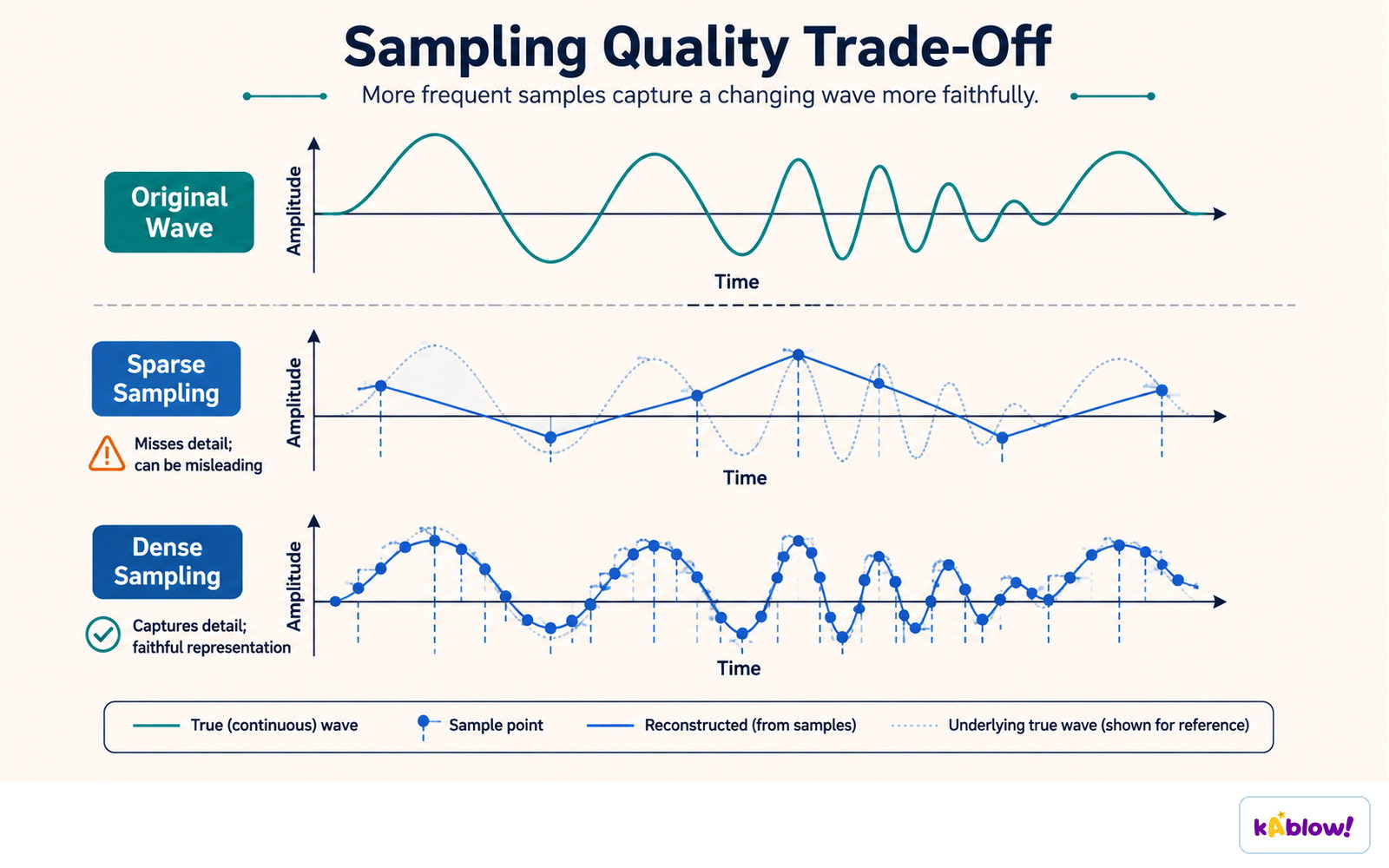
- A higher sampling rate captures more detail of the wave, especially high frequencies, but results in larger file sizes.
- According to the Nyquist–Shannon sampling theorem, the sampling rate must be at least twice the highest frequency to accurately reconstruct the sound.
Sampling more often reconstructs a changing wave more faithfully; sparse sampling can mislead.
Bit Depth
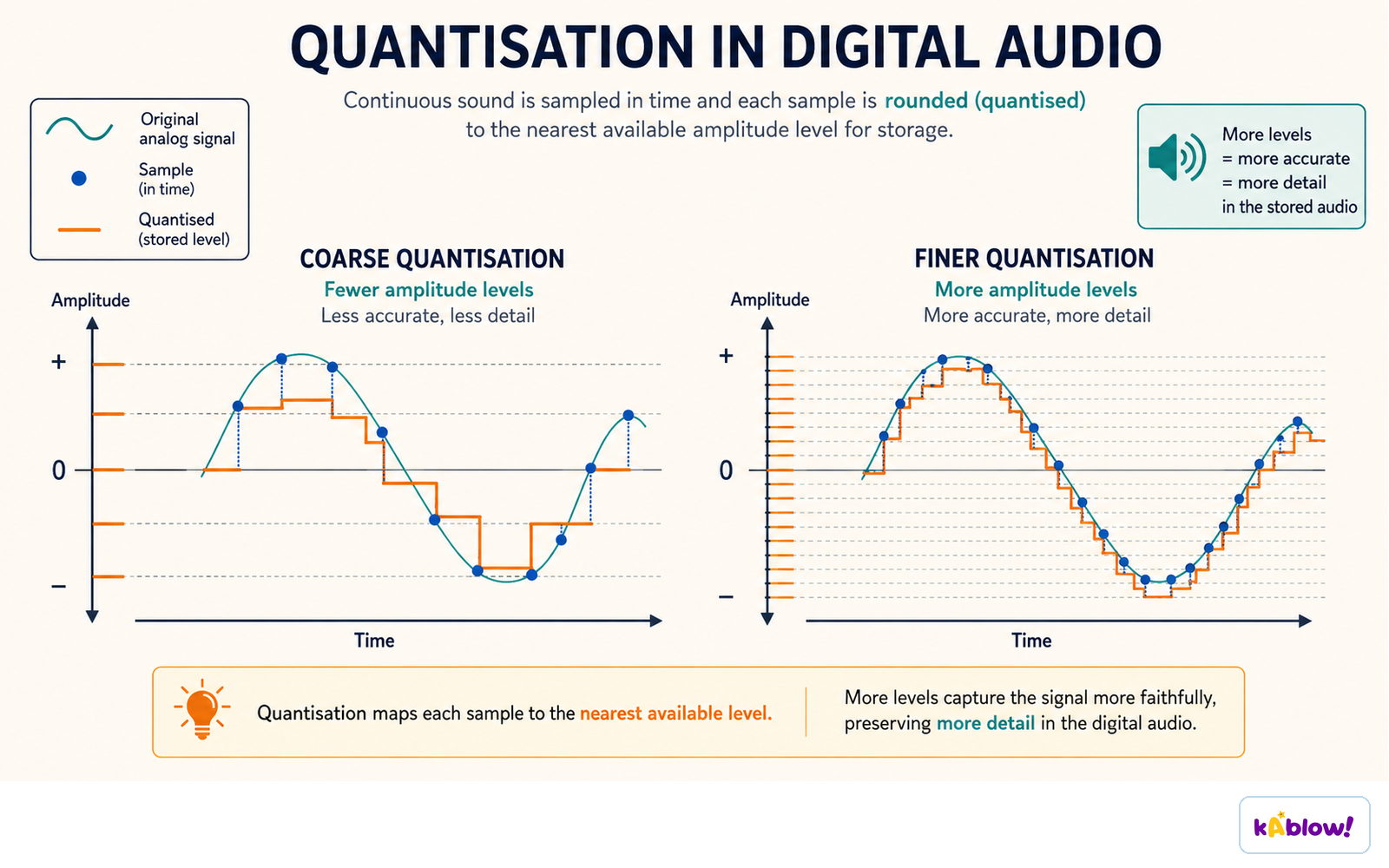
- Bit depth (or resolution) is the number of bits used to represent each sample's amplitude.
- CD audio uses 16-bit resolution, allowing 65,536 possible amplitude levels.
- A higher bit depth gives a more accurate representation of amplitude, reducing quantization noise.
- Higher bit depth also increases file size because each sample stores more data.
Quantisation rounds each sample to the nearest available level; more levels keep more detail.
Trade-offs: Quality vs. File Size
- Increasing sampling rate and bit depth improves sound quality but increases file size.
- Lower sampling rates and bit depths reduce file size but can lose detail and introduce distortion.
- For example, a low sampling rate may miss high-frequency sounds, and a low bit depth can make quiet sounds less distinct.
- Choosing settings depends on the purpose: high quality for music production, lower for voice recordings or streaming.
Playback and Reconstruction
- To play back digital audio, a digital-to-analog converter (DAC) converts the digital samples back into an analog signal.
- The DAC reconstructs a continuous wave by 'joining the dots' between samples, following the Nyquist–Shannon theorem.
- The analog signal is then amplified and sent to a loudspeaker, which converts it back into sound waves.
- Digital audio allows infinite copies without quality loss, unlike analog copies which degrade.
Sound is captured, converted to digital, stored, converted back, and played.
Advantages of Digital Audio
- Digital audio can be stored, edited, and transmitted easily using computers and digital devices.
- It is immune to noise and distortion during storage and transmission, as long as errors are corrected.
- Error correction (channel coding) ensures bit accuracy, e.g., Eight-to-fourteen modulation on CDs.
- Digital formats enable compression (like MP3) to reduce file sizes for streaming and storage.
Real-World Applications
- Modern music distribution relies on digital audio, with services like iTunes selling digital files.
- Streaming services (Apple Music, Spotify, YouTube) provide temporary access to digital audio over the internet.
- Digital audio is used in podcasts, sound effects, and all forms of recorded music.
- Before digital, music was sold as physical records and tapes, which degraded with copying.
投影片
練習題
免費預覽——63 題中的 8 題。註冊即可查看全部。
1.Digital audio represents sound as a continuous analog waveform.
EasyTrue or false?
2.What does an analog-to-digital converter (ADC) do?
Easy- AConverts a digital signal to an analog signal
- BConverts an analog signal to a digital signal
- CAmplifies an analog signal
- DCompresses a digital audio file
3.Which of the following are used in digital audio systems to reduce file size? (Select all that apply)
Medium- AMP3
- BAAC
- CFLAC
- DPCM
- EDAC
4.Analog audio signals are immune to noise and distortion.
EasyTrue or false?
5.What is the Nyquist frequency for a system with a sampling rate of 40 kHz?
Medium- A10 kHz
- B20 kHz
- C40 kHz
- D80 kHz
6.Match each term with its correct description.
Medium- Sample rate
- Bit depth
- ADC
- DAC
- Number of samples taken per second
- Number of bits used per sample
- Converts analog signal to digital
- Converts digital signal to analog
7.Put the steps in the digital audio playback process in the correct order.
Medium- Digital signal is stored or transmitted
- DAC converts digital to analog
- Analog signal is amplified
- Loudspeaker produces sound
8.What is the sampling rate in samples per second?
Medium- A44,100
- B441
- C4,410
- D441,000
歷屆試題
這個主題的歷屆試題練習即將推出。
即將推出