Crude oil
邊玩邊學
回答這些題目賺取能量,接著就能釣魚、探索。不需要帳號。
給教育者: 為 Crude oil(KS3 Science、Chemistry)準備好可直接使用的課程投影片, 複習筆記, 圖表——用於你的課程,或把這個主題當成互動班級活動,讓學習者以即時遊戲的方式進行。
課程筆記
Formation of Crude Oil
- Crude oil is a liquid found deep under the Earth's surface.
- It is made from the remains of organisms like algae and plankton.
- These remains were deposited on the sea floor and covered by sediments.
- Over millions of years, heat and pressure turned the remains into crude oil.
Composition of Crude Oil
- Crude oil is a mixture of many different substances.
- Most of these substances are hydrocarbons – compounds made of hydrogen and carbon.
Fractional Distillation Process
- Crude oil is separated into different parts by fractional distillation.
- In a refinery, crude oil is heated until it turns into a gas.
- The gas enters a tall tower called a fractionating column.
- The column is hotter at the bottom and cooler at the top.
- As the gas rises, different substances cool and condense at different temperatures (different boiling points).
- Liquids are collected at various levels, each collecting a different fraction.
The process separates the fractions according to their boiling point
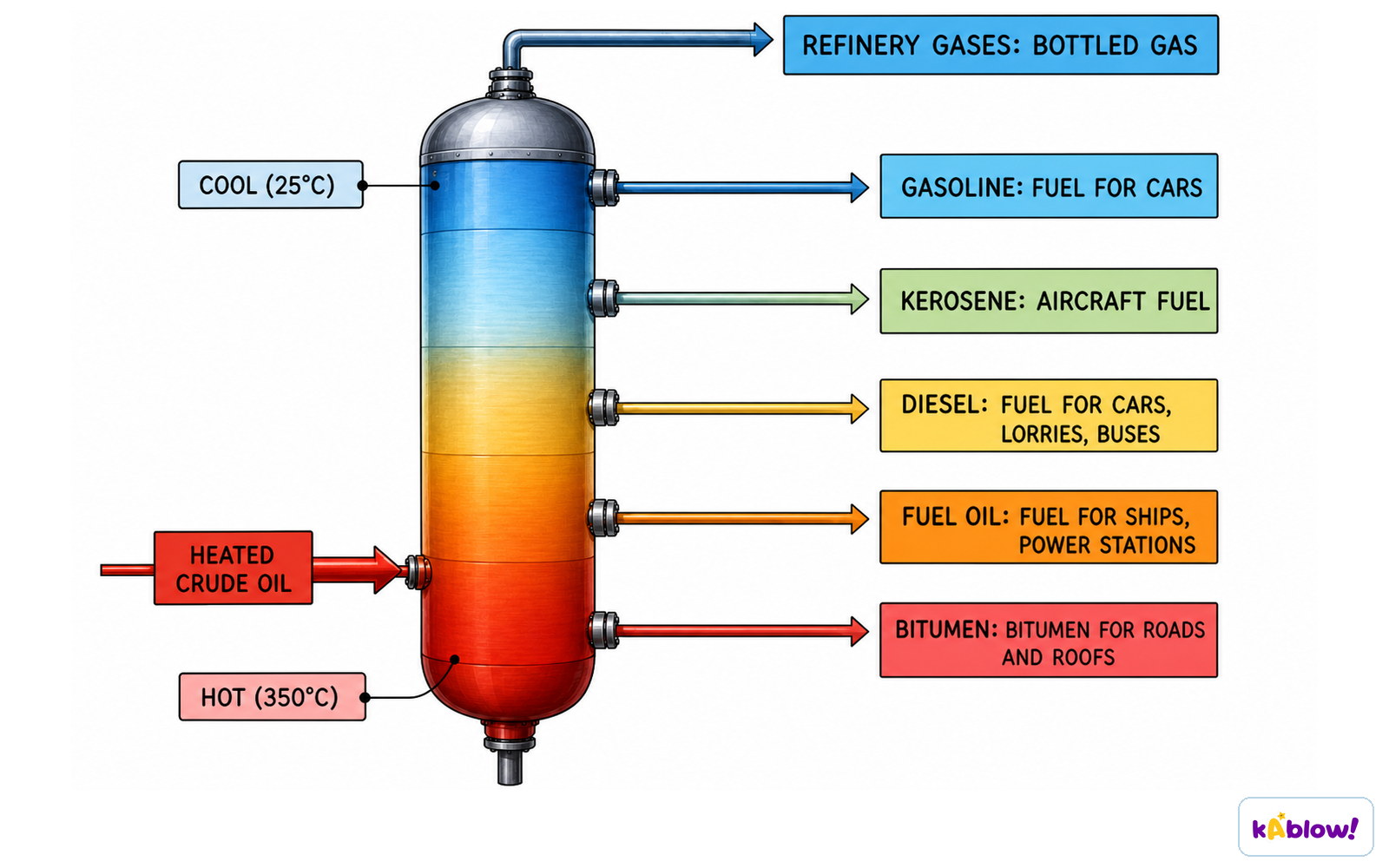
Products and Their Uses
- Petrol: Fuel for cars.
- Diesel: Fuel for trucks, buses, and some cars.
- Kerosene: Fuel for jet engines and heaters.
- Fuel Oil: Used in ships and large industrial plants.
- Butane and Propane: Fuel for cooking, heating, and lighters.
- Lubricating oils: Reduce friction in engines and machines.
Environmental Impact
- Burning fuels from crude oil releases carbon dioxide (CO₂).
- CO₂ is a greenhouse gas that contributes to global warming.
States of matter: solid, liquid, gas. Crude oil is a liquid; fractional distillation involves heating to gas and cooling to liquid.
投影片
練習題
免費預覽——39 題中的 8 題。註冊即可查看全部。
1.What is crude oil mostly made of?
Easy- AHydrocarbons
- BCarbohydrates
- CProteins
- DFats
2.Which of the following is NOT a product obtained from fractional distillation of crude oil?
Easy- APetrol
- BDiesel
- CKerosene
- DEthanol
3.In a fractionating column, where is the temperature highest?
Medium- AAt the top
- BAt the bottom
- CIn the middle
- DIt is the same everywhere
4.Why does fractional distillation separate crude oil into fractions?
Medium- ADifferent substances have different boiling points
- BDifferent substances have different densities
- CDifferent substances have different colors
- DDifferent substances have different viscosities
5.Which of the following correctly lists the fractions in order of increasing boiling point?
Hard- APetrol, kerosene, diesel, fuel oil
- BFuel oil, diesel, kerosene, petrol
- CPetrol, diesel, kerosene, fuel oil
- DKerosene, petrol, diesel, fuel oil
6.What is a hydrocarbon?
Medium- AA compound made of hydrogen and carbon only
- BA compound made of hydrogen and oxygen only
- CA compound made of carbon and oxygen only
- DA compound made of hydrogen, carbon, and oxygen
7.Which gas is released when fuels from crude oil are burned?
Easy- ACarbon dioxide
- BOxygen
- CNitrogen
- DHydrogen
8.Why is crude oil described as a non-renewable resource?
Medium- AIt is made from remains of organisms that lived millions of years ago and takes millions of years to form
- BIt can be made quickly in a laboratory
- CIt is found in unlimited quantities
- DIt is not used up when burned
歷屆試題
這個主題的歷屆試題練習即將推出。
即將推出