The atom
邊玩邊學
回答這些題目賺取能量,接著就能釣魚、探索。不需要帳號。
給教育者: 為 The atom(KS3 Science、Chemistry)準備好可直接使用的課程投影片, 複習筆記, 圖表——用於你的課程,或把這個主題當成互動班級活動,讓學習者以即時遊戲的方式進行。
課程筆記
Scientific Models
- A scientific model is a simplified version of an object or phenomenon, making it easier to understand while still representing key features.
- The particle model is one example; it explains and predicts the behaviour of solids, liquids and gases.
- Models are changed and updated over time as new evidence emerges.
Dalton Model of the Atom
- The Dalton model described atoms as indivisible – they could not be broken down into anything smaller.
- This was the earlier model before sub-atomic particles were discovered.
Current Model of the Atom
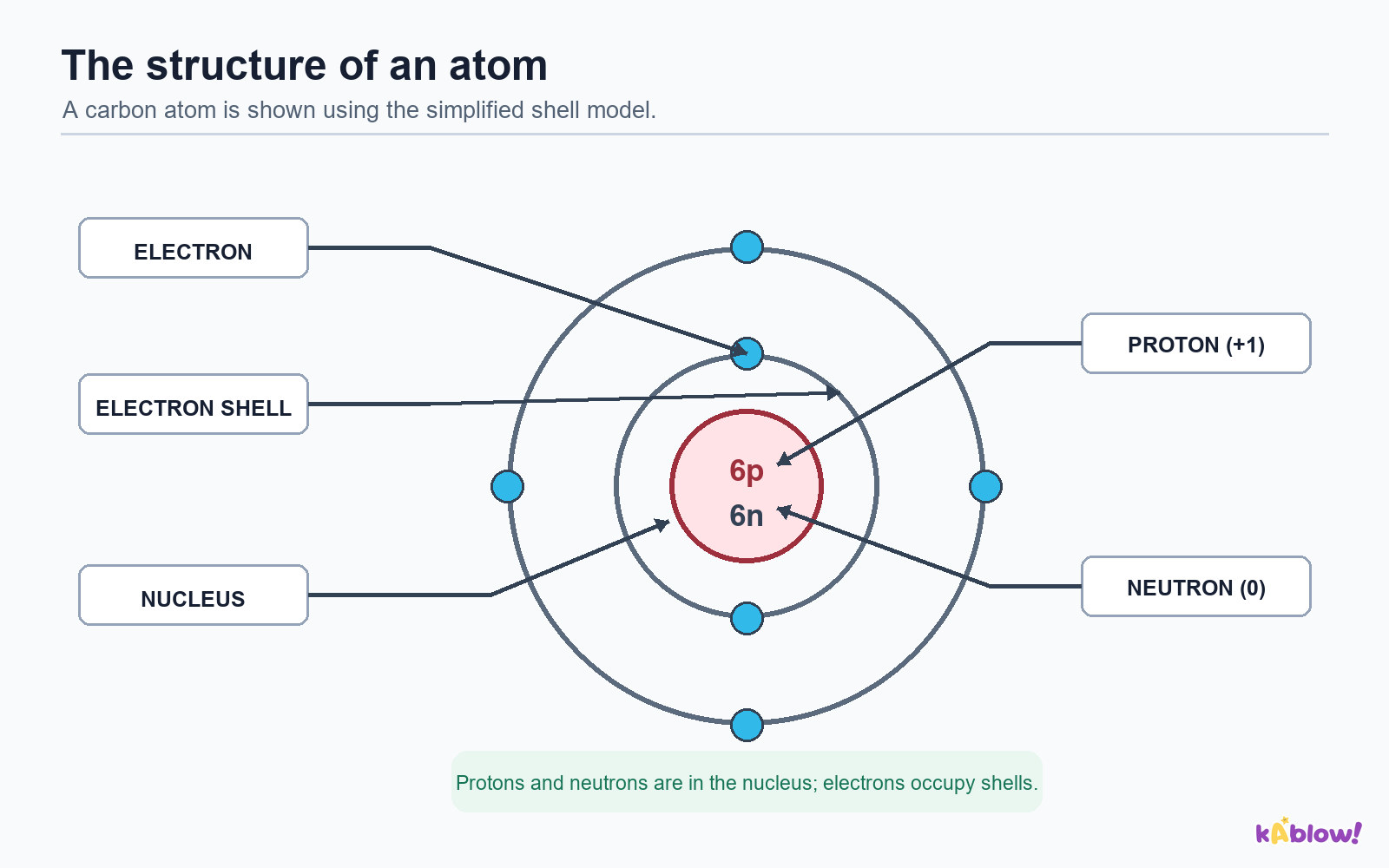
- The atom is made of three sub-atomic particles: protons, neutrons and electrons.
- Protons have a positive charge and are found in the nucleus.
- Neutrons are neutral (no charge) and also in the nucleus.
- Electrons have a negative charge and orbit around the nucleus.
- Most of the atom's mass is in the nucleus; protons and neutrons have about 2000 times more mass than an electron.
- Overall, an atom is neutral because it has equal numbers of protons and electrons.
Protons and neutrons in the nucleus; electrons orbiting in shells.
Peer Review
- Peer review is when other scientists examine new evidence to decide if it is valid.
- It prevents incorrect models and theories from being spread.
- After peer review, research can be published and other scientists may try to reproduce the results to check repeatability.
Bohr model of a sodium atom showing the nucleus (11 protons, 12 neutrons) and electron shells (2,8,1).
Particle arrangement in solids, liquids and gases.
投影片
練習題
免費預覽——40 題中的 8 題。註冊即可查看全部。
1.What is the Dalton model of the atom?
Easy- AAtoms are indivisible and cannot be broken down into anything smaller.
- BAtoms are made of protons, neutrons and electrons.
- CAtoms have a nucleus with electrons orbiting.
- DAtoms are mostly empty space.
2.Where is the nucleus of an atom located?
Easy- AIn the centre of the atom.
- BOrbiting the atom.
- COutside the electron shells.
- DScattered throughout the atom.
3.Which two sub-atomic particles are found in the nucleus?
Easy- AProtons and neutrons.
- BProtons and electrons.
- CNeutrons and electrons.
- DProtons, neutrons and electrons.
4.Which sub-atomic particle orbits around the nucleus?
Easy- AElectron
- BProton
- CNeutron
- DPositron
5.What is the charge on a proton?
Easy- APositive
- BNegative
- CNeutral
- DNo charge
6.What is the charge on an electron?
Easy- ANegative
- BPositive
- CNeutral
- DNo charge
7.What is the charge on a neutron?
Easy- ANeutral
- BPositive
- CNegative
- DNo charge
8.Which sub-atomic particle has the least mass?
Easy- AElectron
- BProton
- CNeutron
- DNucleus
歷屆試題
這個主題的歷屆試題練習即將推出。
即將推出