The periodic table
邊玩邊學
回答這些題目賺取能量,接著就能釣魚、探索。不需要帳號。
給教育者: 為 The periodic table(KS3 Science、Chemistry)準備好可直接使用的課程投影片, 複習筆記, 圖表——用於你的課程,或把這個主題當成互動班級活動,讓學習者以即時遊戲的方式進行。
課程筆記
History of the Periodic Table
- Early tables arranged elements by atomic weight, but this didn't always match properties.
- In 1869, Dmitri Mendeleev rearranged elements so that similar properties were in the same group.
- Mendeleev left gaps for undiscovered elements and predicted their properties.
- When new elements were found, they matched Mendeleev's predictions.
Modern Periodic Table
- Elements are arranged by increasing atomic number (number of protons).
- Each element has a chemical symbol (e.g., Na for sodium).
- The atomic number is written above the symbol.
Groups and Periods
- Columns are called groups; elements in the same group have similar properties.
- Group 1 elements are alkali metals; they react vigorously with water.
- Rows are called periods.
- Metals are on the left of the bold line; non-metals on the right.
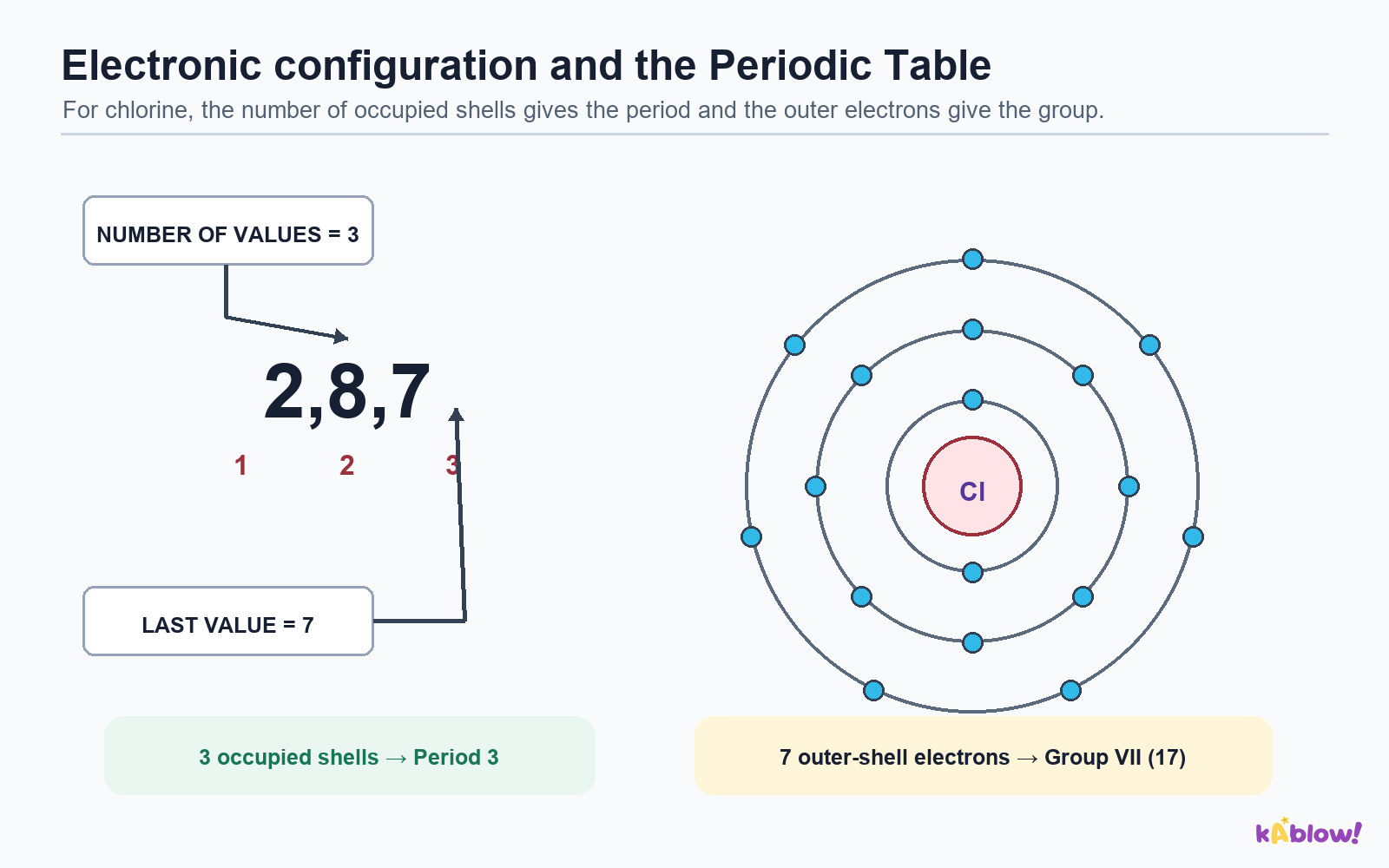
Chlorine's electron configuration (2,8,7): the number of notations gives the period, the last notation gives the group.
Metals and Non-Metals
- Aluminium (Al) is a metal (left of bold line).
- Carbon (C) is a non-metal (right of bold line).
- Metals are good conductors of electricity; non-metals are poor conductors.
Advantages of Grouping
- Similar properties in a group make it easy to predict properties of unknown elements.
- For example, all alkali metals react similarly with water.
Bohr model of sodium atom (atomic number 11) showing electron configuration 2,8,1.
投影片
練習題
免費預覽——56 題中的 8 題。註冊即可查看全部。
1.In the periodic table, elements are arranged in order of increasing:
Easy- Aatomic number
- Batomic weight
- Catomic radius
- Dnumber of neutrons
2.Which of the following statements about the periodic table is true?
Medium- AElements in the same period have similar properties.
- BElements are ordered by atomic mass.
- CColumns are called groups and contain elements with similar properties.
- DMetals are found on the right of the bold line.
3.What is the atomic number of iron (Fe)?
Easy- A26
- B56
- C55
- D30
4.Which of the following elements is a non-metal?
Easy- AAluminium (Al)
- BCarbon (C)
- CIron (Fe)
- DCopper (Cu)
5.Why did Mendeleev leave gaps in his periodic table?
Easy- ATo make the table look balanced
- BFor elements that had not yet been discovered
- CBecause the atomic weights did not match
- DTo separate metals from non-metals
6.Which of the following is a property of alkali metals (Group 1)?
Easy- AThey are unreactive
- BThey react vigorously with water
- CThey are non-metals
- DThey are gases at room temperature
7.Aluminium (Al) is a metal. Which of the following best explains why aluminium is a good conductor of electricity?
Easy- AIt is a non-metal
- BIt is a metal and metals are good conductors
- CIt is in Group 1
- DIt has a low atomic number
8.In the periodic table, what do the rows (periods) indicate?
Easy- ASimilar chemical properties
- BNumber of electron shells
- CAtomic mass increasing
- DNumber of neutrons
歷屆試題
這個主題的歷屆試題練習即將推出。
即將推出