Cameras
邊玩邊學
回答這些題目賺取能量,接著就能釣魚、探索。不需要帳號。
給教育者: 為 Cameras(KS3 Science、Physics)準備好可直接使用的課程投影片, 複習筆記, 圖表——用於你的課程,或把這個主題當成互動班級活動,讓學習者以即時遊戲的方式進行。
課程筆記
Pinhole Camera
- A pinhole camera is a simple device that forms an image using a small hole.
- It consists of a box with a small hole at one end and a translucent screen (e.g., tracing paper) at the other.
- Translucent means allows some light to pass through, but not clear.
- Light rays from the object travel in straight lines through the pinhole.
- The image formed is inverted (upside down) because rays from the top and bottom cross at the pinhole.
- The image is formed on the screen and can be seen from outside.
Modern Camera
- A modern camera uses a convex lens instead of a pinhole.
- The convex lens refracts (bends) light rays to bring them to a focus.
- The camera has a light-sensitive sensor (like the retina in the human eye).
- The sensor captures the focused image and converts it into an electronic signal.
- Even small phone cameras contain a lens and a sensor.
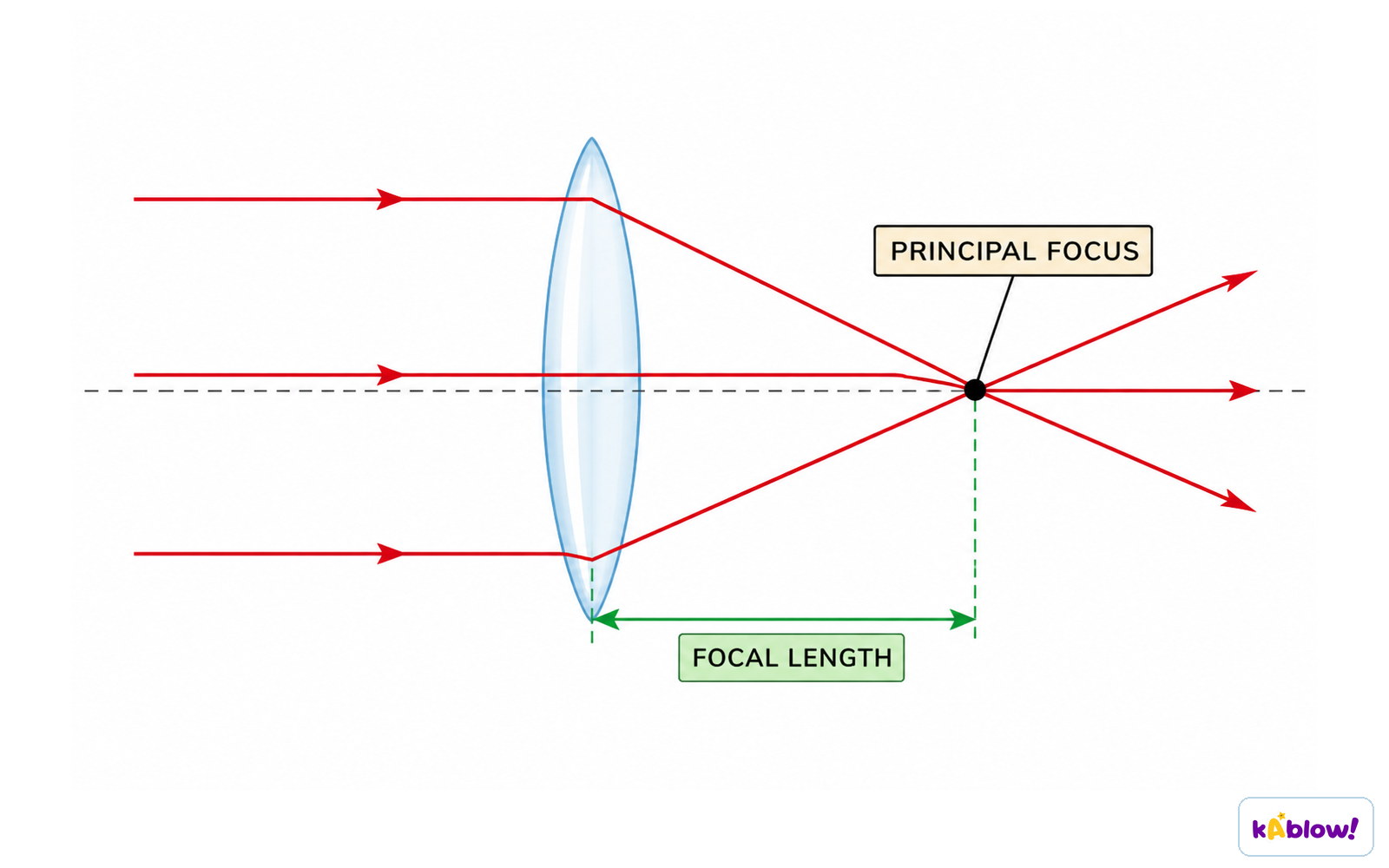
A converging lens brings parallel rays to the principal focus; focal length is measured from the lens to that point.
Comparison with the Human Eye
- Both the human eye and a camera contain a convex lens to focus light.
- The eye's retina is equivalent to the camera's sensor.
- Both produce an inverted image on the retina/sensor, but the brain corrects it for the eye.
Key Terms
- Inverted: upside down relative to the object.
- Translucent: allows light to pass through diffusely.
- Refraction: bending of light when it passes from one medium to another.
- Convex lens: a lens that bulges outward and converges light rays to a point.
Refraction of light through a convex lens (simplified).
投影片
練習題
免費預覽——57 題中的 8 題。註冊即可查看全部。
1.What does it mean if a material is translucent?
Easy- AIt allows all light to pass through.
- BIt allows some light to pass through.
- CIt allows no light to pass through.
- DIt reflects all light.
2.What does 'inverted' mean when describing an image in a pinhole camera?
Easy- AThe image is smaller than the object.
- BThe image is upside down.
- CThe image is the same size as the object.
- DThe image is larger than the object.
3.Which part of a modern camera is equivalent to the retina in the human eye?
Easy- ALens
- BSensor
- CScreen
- DAperture
4.Which of the following statements is true?
Medium- AA pinhole camera contains a convex lens.
- BThe human eye contains a convex lens, but a camera does not.
- CBoth the human eye and a camera contain a convex lens.
- DNeither the human eye nor a camera contains a convex lens.
5.What is the screen of a pinhole camera typically made of?
Easy- ACardboard
- BTracing paper
- CGlass
- DMetal
6.A student makes a pinhole camera with a larger hole. What effect does this have on the image?
Medium- AThe image becomes sharper.
- BThe image becomes brighter but blurrier.
- CThe image becomes dimmer but sharper.
- DThe image becomes inverted.
7.In a pinhole camera, why is the image inverted?
Medium- ABecause the screen is curved.
- BBecause light rays travel in straight lines and cross at the pinhole.
- CBecause the box is light-tight.
- DBecause the pinhole is too small.
8.Which of the following is NOT a component of a modern camera?
Easy- AConvex lens
- BSensor
- CRetina
- DAperture
歷屆試題
這個主題的歷屆試題練習即將推出。
即將推出