Density
邊玩邊學
回答這些題目賺取能量,接著就能釣魚、探索。不需要帳號。
給教育者: 為 Density(KS3 Science、Physics)準備好可直接使用的課程投影片, 複習筆記, 圖表——用於你的課程,或把這個主題當成互動班級活動,讓學習者以即時遊戲的方式進行。
課程筆記
What is Density?
- Density is a measure of how much mass is contained in a given volume.
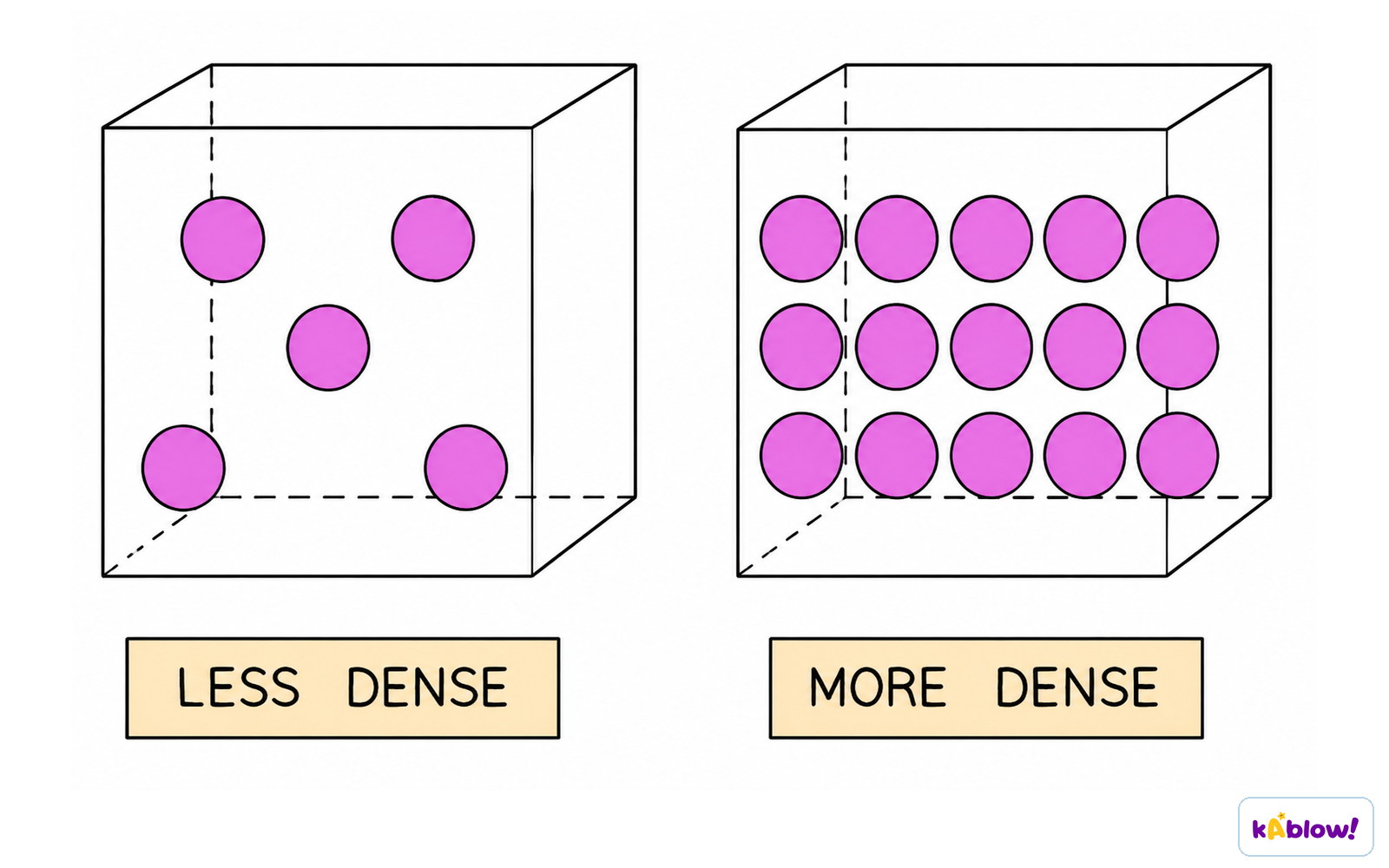
- If particles have the same mass, more particles in the same volume means higher density.
- Density determines whether an object floats or sinks in a fluid.
Particles packed less densely and more densely in equal volumes: a less-dense material compared with a more-dense material.
The Density Equation
- Density = Mass ÷ Volume
- Mass is the amount of matter in an object, measured in kilograms (kg).
- Volume is the space an object occupies, measured in cubic metres (m³).
- Density has units of kg/m³.
Calculating Density
- Example: Wood with mass 210 kg and volume 0.3 m³ has density = 210 ÷ 0.3 = 700 kg/m³.
- Always write the equation, substitute values, then calculate with units.
Rearranging the Equation
- To find volume: Volume = Mass ÷ Density.
- To find mass: Mass = Density × Volume.
- Example: Granite density 2700 kg/m³, mass 5400 kg → volume = 5400 ÷ 2700 = 2 m³.
Floating and Sinking
- Water density = 1000 kg/m³.
- Objects with density less than water float; objects with density greater than water sink.
- Wood (700 kg/m³) floats on water.
- Oil (800 kg/m³) floats on water because it is less dense.
Example Calculations
- Book: mass 1 kg, volume 0.002 m³ → density = 1 ÷ 0.002 = 500 kg/m³.
- Gold bar: mass 3.8 kg, volume 0.0002 m³ → density = 3.8 ÷ 0.0002 = 19,000 kg/m³.
- Rock: mass 300 kg, volume 0.1 m³ → density = 300 ÷ 0.1 = 3000 kg/m³.
Finding Volume from Density and Mass
- Steel density 7800 kg/m³, mass 3900 kg → volume = 3900 ÷ 7800 = 0.5 m³.
- Human body density 995 kg/m³, mass 70 kg → volume = 70 ÷ 995 ≈ 0.0704 m³.
- Crate: mass 250 kg, density 50 kg/m³ → volume = 250 ÷ 50 = 5 m³.
Finding Mass from Density and Volume
- Car: density 280 kg/m³, volume 4.2 m³ → mass = 280 × 4.2 = 1176 kg.
Particle arrangement in solids, liquids, and gases. Density is higher when particles are more closely packed.
投影片
練習題
免費預覽——60 題中的 8 題。註冊即可查看全部。
1.Which equation correctly relates density, mass and volume?
Easy- ADensity = Mass × Volume
- BDensity = Mass ÷ Volume
- CDensity = Volume ÷ Mass
- DDensity = Mass + Volume
2.What are the standard SI units for density, mass and volume respectively?
Easy- Akg/m³, kg, m³
- Bkg, m³, kg/m³
- Cm³, kg, kg/m³
- Dkg/m³, m³, kg
3.Water has a density of 1000 kg/m³ and oil has a density of 800 kg/m³. What will happen when oil is poured into water?
Easy- AThe oil will sink because it is denser.
- BThe oil will float because it is less dense.
- CThe oil will mix completely.
- DThe oil will float because it has a higher density.
4.A book has a mass of 1 kg and a volume of 0.002 m³. What is its density?
Medium- A500 kg/m³
- B2000 kg/m³
- C0.002 kg/m³
- D5000 kg/m³
5.A gold bar has a mass of 3.8 kg and a volume of 0.0002 m³. Calculate its density.
Medium- A19000 kg/m³
- B1900 kg/m³
- C190 kg/m³
- D0.0000526 kg/m³
6.A rock has a mass of 300 kg and a volume of 0.1 m³. What is its density?
Medium- A30 kg/m³
- B3000 kg/m³
- C300 kg/m³
- D0.000333 kg/m³
7.Steel has a density of 7800 kg/m³. What is the volume of a steel object with a mass of 3900 kg?
Medium- A0.5 m³
- B2 m³
- C30,420,000 m³
- D0.5 kg/m³
8.The average human body density is 995 kg/m³. Why can humans float in water (density 1000 kg/m³)?
Medium- ABecause the human body is less dense than water.
- BBecause the human body is more dense than water.
- CBecause humans have air in their lungs.
- DBecause humans can swim.
歷屆試題
這個主題的歷屆試題練習即將推出。
即將推出