Moments
邊玩邊學
回答這些題目賺取能量,接著就能釣魚、探索。不需要帳號。
給教育者: 為 Moments(KS3 Science、Physics)準備好可直接使用的課程投影片, 複習筆記, 圖表——用於你的課程,或把這個主題當成互動班級活動,讓學習者以即時遊戲的方式進行。
課程筆記
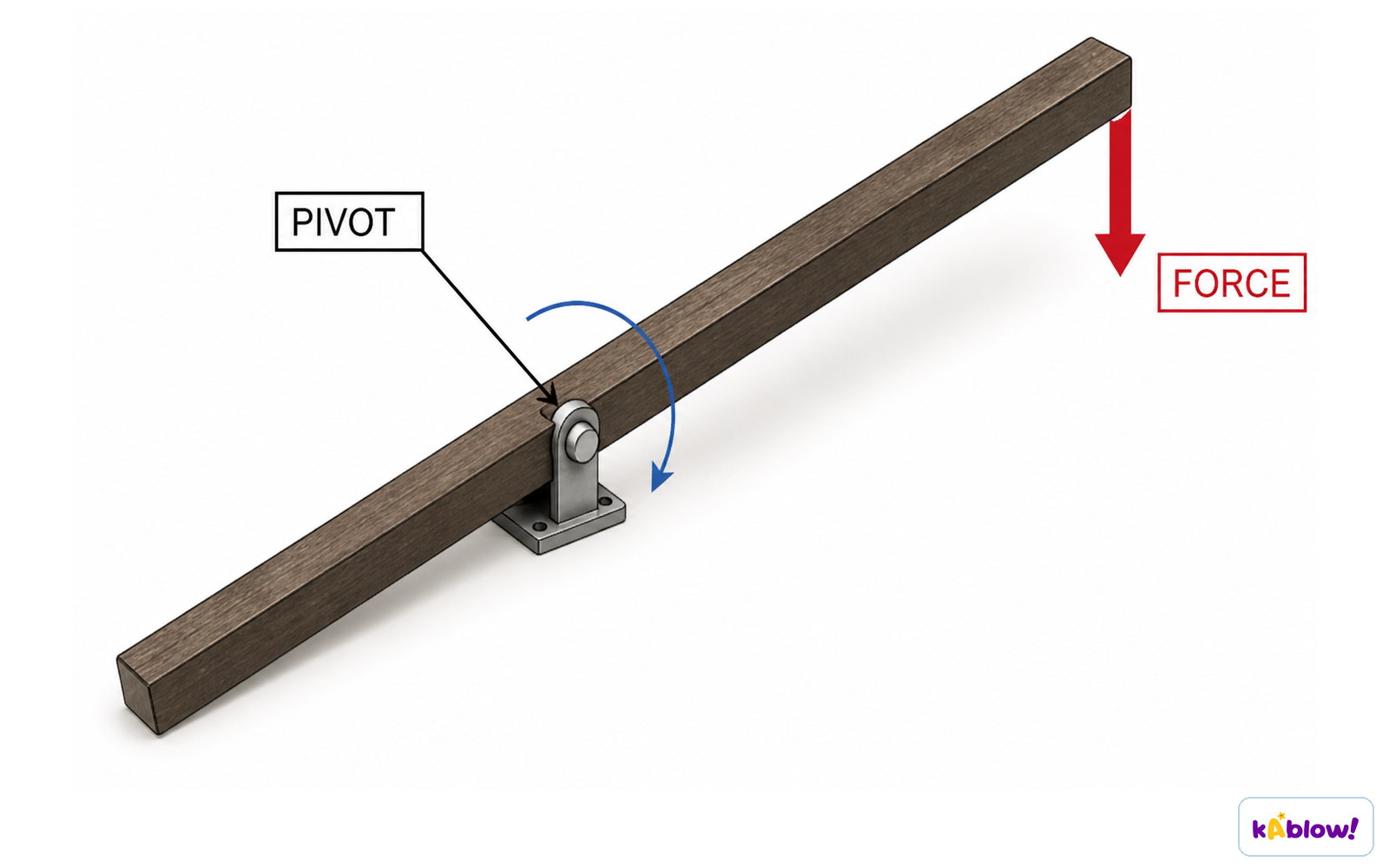
What is a Moment?
- A moment is a turning force.
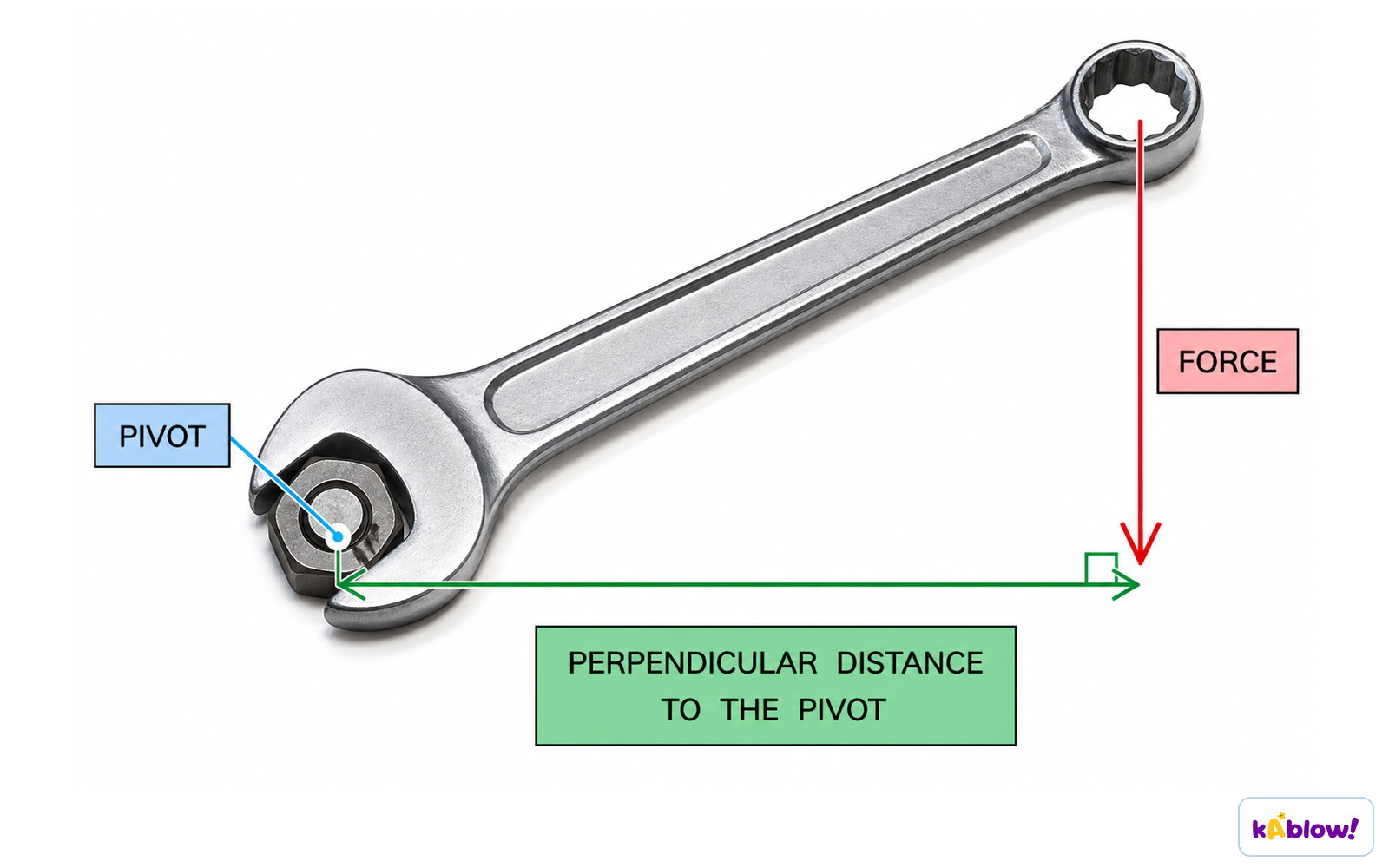
- Moment = Force × Perpendicular distance to the pivot.
- Force is measured in Newtons (N), distance in metres (m), so moment is in Newton-metres (Nm).
- A spanner is a force-multiplier: applying a force at a greater distance reduces the force needed to turn a bolt.
A force applied on one side of the pivot causes the object to rotate about that pivot.
Principle of Moments
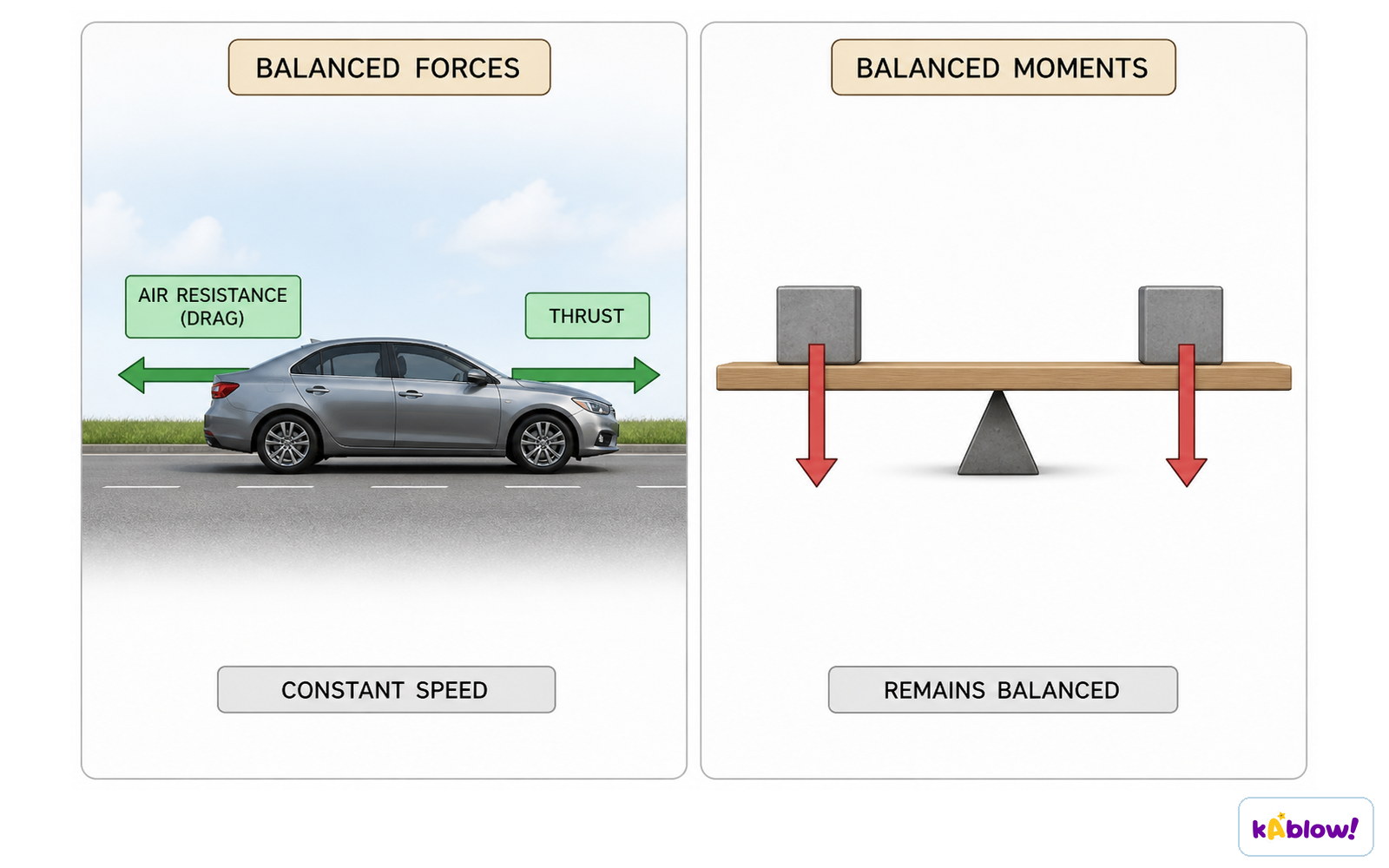
- An object is balanced when the sum of clockwise moments equals the sum of anticlockwise moments about a pivot.
- If moments are unequal, the object will rotate in the direction of the larger moment.
- This principle applies to seesaws, levers, and any object that can turn about a pivot.
When the forces and moments on an object are balanced, the object remains in equilibrium.
Calculating Moments
- Use the equation: Moment = Force × Distance.
- Distance must be the perpendicular distance from the line of action of the force to the pivot.
- For a seesaw, calculate clockwise and anticlockwise moments separately.
- If clockwise moment = anticlockwise moment, the seesaw is balanced.
The moment of a force depends on the force and its perpendicular distance from the pivot.
Example: Balanced Seesaw
- Clockwise moment: 10 N × 0.6 m = 6 Nm.
- Anticlockwise moment: 12 N × 0.5 m = 6 Nm.
- Since both moments are equal, the seesaw is balanced.
Example: Unbalanced Seesaw
- If clockwise moment ≠ anticlockwise moment, the seesaw is unbalanced.
- The side with the larger moment will move downwards.
- For example, 8 N × 0.4 m = 3.2 Nm clockwise, 6 N × 0.5 m = 3.0 Nm anticlockwise → unbalanced, clockwise side drops.
Key Points
- Moments are turning effects; they depend on force size and distance from pivot.
- Increasing distance from pivot increases the moment for the same force.
- The principle of moments is used to solve problems about balance and rotation.
A simple series circuit (for reference, not directly related to moments).
投影片
練習題
免費預覽——54 題中的 8 題。註冊即可查看全部。
1.What is the correct equation for calculating a moment?
Easy- AMoment = Force × Distance
- BMoment = Force ÷ Distance
- CMoment = Distance ÷ Force
- DMoment = Force + Distance
2.What are the correct units for a moment?
Easy- ANewton metres (Nm)
- BNewtons (N)
- CMetres (m)
- DJoules (J)
3.What is the principle of moments?
Easy- AAn object is balanced when the sum of clockwise moments equals the sum of anticlockwise moments about a point.
- BAn object is balanced when the sum of clockwise moments is greater than anticlockwise moments.
- CAn object is balanced when the sum of clockwise moments is less than anticlockwise moments.
- DAn object is balanced when the force equals the distance.
4.A force of 20 N is applied at a perpendicular distance of 0.5 m from a pivot. What is the moment?
Medium- A10 Nm
- B40 Nm
- C20.5 Nm
- D0.025 Nm
5.A seesaw has a 10 N weight 0.6 m from the pivot on the left (anticlockwise) and a 12 N weight 0.5 m from the pivot on the right (clockwise). Is the seesaw balanced?
Medium- AYes, because clockwise moment = anticlockwise moment = 6 Nm
- BNo, because clockwise moment = 6 Nm and anticlockwise moment = 6 Nm, but forces are different
- CNo, because clockwise moment = 5 Nm and anticlockwise moment = 6 Nm
- DYes, because the forces are different so it must be balanced
6.A spanner is used to turn a bolt. A force of 30 N is applied at a distance of 0.2 m from the pivot. What force would be needed if the distance is increased to 0.6 m to produce the same moment?
Medium- A10 N
- B90 N
- C15 N
- D60 N
7.What is a turning force called?
Easy- AA moment
- BA newton
- CA lever
- DA pivot
8.In the equation Moment = Force × Distance, what does 'distance' refer to?
Easy- AThe perpendicular distance from the force to the pivot
- BThe length of the lever
- CThe distance from the force to the ground
- DThe total distance moved by the force
歷屆試題
這個主題的歷屆試題練習即將推出。
即將推出