Properties of substances
邊玩邊學
回答這些題目賺取能量,接著就能釣魚、探索。不需要帳號。
給老師: 為 Properties of substances(NGSS Middle School Science、Chemistry)準備好可直接使用的課程投影片, 複習筆記——用於你的課程,或把這個主題當成互動班級活動,讓學生以即時遊戲的方式進行。
課程筆記
Physical vs. Chemical Changes
- Physical changes do not change the chemical properties of a substance; examples include cutting, boiling, melting, dissolving, and whipping.
- Chemical changes (chemical reactions) transform one or more substances into new substances with different properties.
- Examples of chemical changes: burning gas, milk turning sour, iron rusting, frying eggs.
- Physical changes are often reversible, while chemical changes are usually not (e.g., you can't unbake a cake).
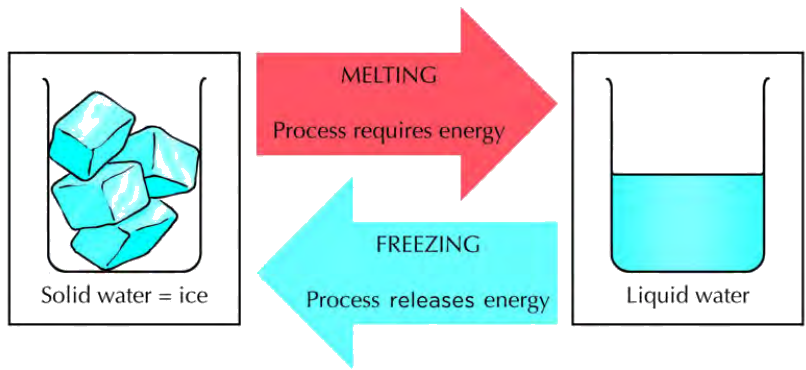
Melting and freezing of water
Signs of a Chemical Reaction
- Color change occurs (not just mixing colors).
- Gas formation – often seen as bubbles (not boiling).
- Formation of a solid – a precipitate or crystals appear in a liquid.
- Odor change – a new smell is produced.
- Energy change – heat, light, sound, or cold is produced or absorbed.
- Extreme property changes – e.g., changes in density, flammability, or state.
- The only definitive sign is the formation of a new substance.
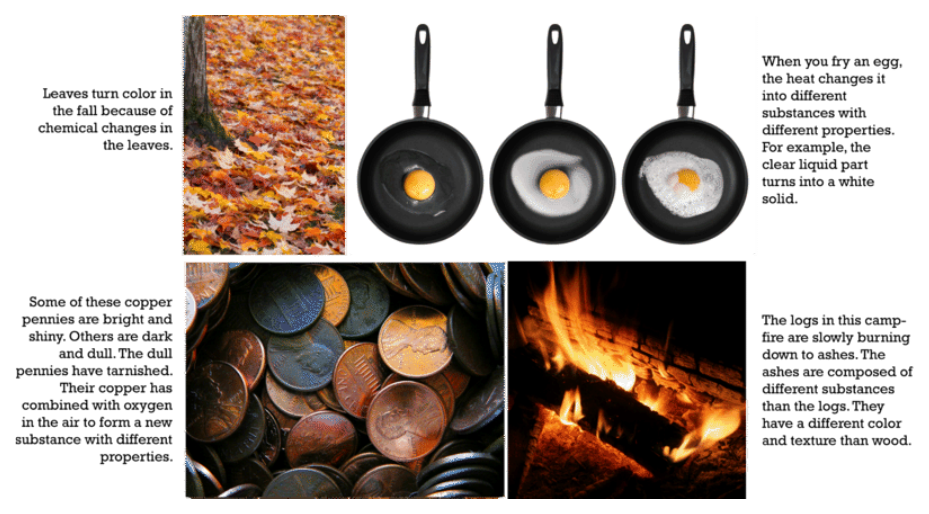
Everyday chemical reactions show new substances with different properties
Reactants and Products
- Reactants are the starting substances in a chemical reaction.
- Products are the new substances formed by the reaction.
- Comparing the properties of the reactants and products (colour, state, odor, and so on) is how we tell that a reaction has taken place.
Properties of Materials
- Properties are distinctive characteristics that describe a material.
- Important properties include: strength, durability, flexibility, malleability, ductility, electrical conductivity, heat conductivity, hardness, solubility, density, color, odor, state, melting point, boiling point, and flammability.
- Materials are chosen for specific uses based on their properties.
- Advantages are desirable properties; disadvantages are unfavorable features (e.g., plastic bags are strong but cause pollution).
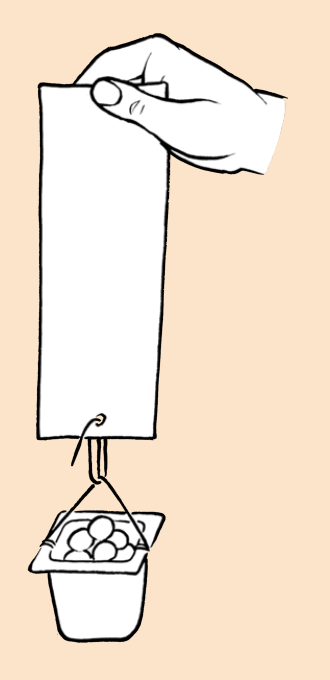
- Strength can be measured by testing how much force is needed to break a material (e.g., tearing paper with marbles).
Testing paper strength with marbles in a yoghurt tub
Heat and Temperature
- Heat is the transfer of energy between objects due to a temperature difference.
- Temperature measures how hot or cold something is; it is measured with a thermometer.
- Adding heat usually raises temperature, but during a phase change, temperature stays constant.
- Heat and temperature are related but not the same.
Melting and Boiling Points
- Melting point is the temperature at which a solid changes to a liquid.
- Boiling point is the temperature at which a liquid changes to a gas (bubbles form).
- For pure water, melting point is 0°C and boiling point is 100°C at sea level.
- Boiling point depends on atmospheric pressure (lower at high altitudes) and purity (impurities raise it).
- Different substances have different melting and boiling points (e.g., nitrogen boils at -200°C, ethanol at 78°C).
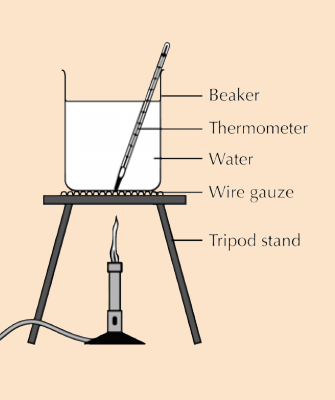
Apparatus for determining the boiling point of water
Matter and Classification
- Matter is anything that has mass and volume.
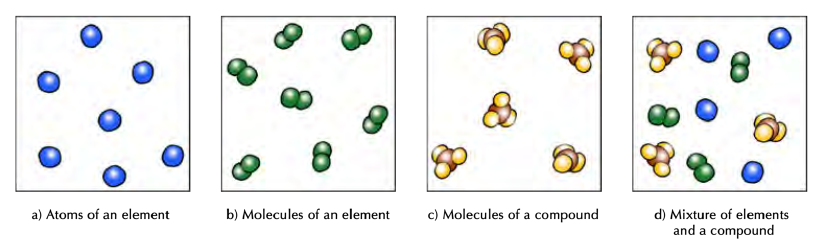
- Matter can be classified as pure substances (elements or compounds) or mixtures.
- Elements consist of one kind of atom; compounds consist of two or more kinds of atoms chemically bonded in a fixed ratio.
- Mixtures contain more than one kind of particle and can be separated by physical methods.
- Physical separation methods (e.g., filtering, evaporation) cannot break chemical bonds.
Diagrams to show the difference between elements, compounds and mixtures
Chemical Reactions in Everyday Life
- Cooking involves chemical reactions (e.g., baking bread changes ingredients into a new substance).
- Burning (combustion) is a chemical reaction (e.g., burning gas, logs).
- Rusting is a chemical reaction between iron and oxygen.
- Digestion and photosynthesis are examples of chemical reactions in living organisms.
- Indigenous practices often use chemical reactions, such as making dyes or preserving food.
投影片
練習題
免費預覽——44 題中的 8 題。註冊即可查看全部。
1.Which of the following is a physical property of a material?
Easy- AFlammability
- BReactivity with acid
- CMalleability
- DAbility to rust
2.Which of the following is a chemical property of a substance?
Easy- ADensity
- BMelting point
- CFlammability
- DElectrical conductivity
3.A pure substance is best defined as:
Easy- AA material that is composed of only one type of matter throughout
- BA material that is natural and not man-made
- CA material that is a solid at room temperature
- DA material that cannot be separated by physical means
4.Which of the following are signs that a chemical reaction may have taken place? (Select all that apply)
Medium- AA color change occurs
- BThe substance changes state from solid to liquid
- CBubbles of gas are produced
- DA solid precipitate forms from a solution
- EThe substance dissolves in water
5.Arrange the following steps in the correct order to determine the boiling point of water experimentally.
Medium- Heat the water with a Bunsen burner
- Record the temperature when it becomes constant
- Set up the apparatus with a thermometer in the beaker
- Measure the initial temperature of the water
6.Match each property of a material with its correct description.
Medium- Malleability
- Ductility
- Flexibility
- Solubility
- Ability to be hammered into sheets
- Ability to be drawn into wires
- Ability to bend without breaking
- Ability to dissolve in a solvent
7.The boiling point of water is always exactly 100°C.
EasyTrue or false?
8.A student mixes baking soda and vinegar in a beaker and observes bubbles forming. The beaker feels colder. What is the most likely conclusion?
Medium- AA physical change occurred because bubbles are always a sign of a physical change.
- BA chemical reaction occurred, producing a new gas and absorbing energy.
- CThe substances simply mixed without any new substance forming.
- DThe beaker became colder because the vinegar was cold.
歷屆試題
這個主題的歷屆試題練習即將推出。
即將推出