Forces and motion (Newton's laws)
邊玩邊學
回答這些題目賺取能量,接著就能釣魚、探索。不需要帳號。
給教育者: 為 Forces and motion (Newton's laws)(NGSS Middle School Science、Physics)準備好可直接使用的課程投影片, 複習筆記, 圖表——用於你的課程,或把這個主題當成互動班級活動,讓學習者以即時遊戲的方式進行。
課程筆記
Forces and Their Effects
- A force is a push or pull on an object; measured in newtons (N).
- Forces can change the shape of an object (deformation), change motion (start, stop, speed up, slow down), and change direction.
- Velocity is speed with direction; acceleration is the rate of change of velocity.
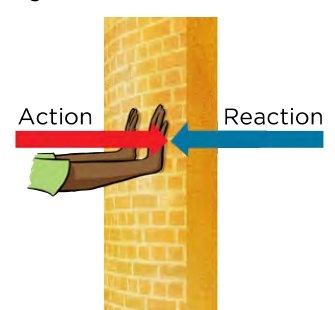
- Forces act in pairs (action and reaction) on different objects, equal in strength and opposite in direction (Newton's Third Law).
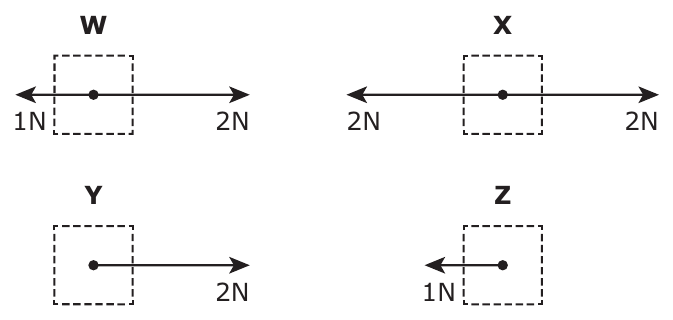
- When multiple forces act, they combine to produce a net force; if balanced, net force is 0 N; if unbalanced, there is a resultant force.
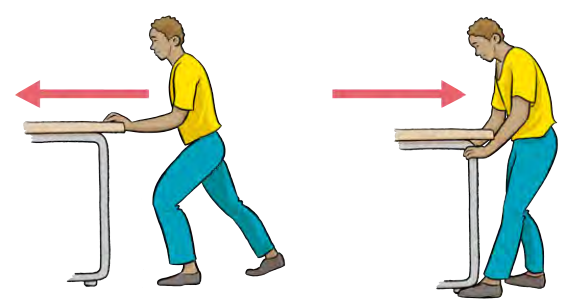
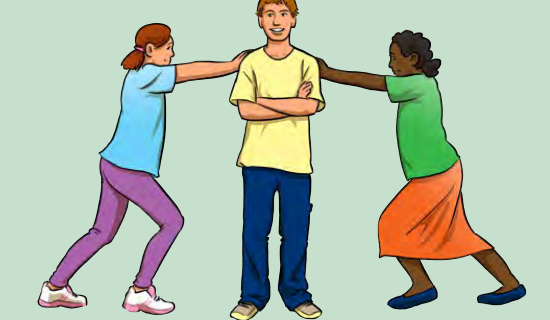
A person pushing and pulling a desk, illustrating how forces can change motion.
Types of Forces
- Contact forces require objects to be touching (e.g., friction, normal force, tension, compression).
- Non-contact (field) forces act over a distance (e.g., gravitational, magnetic, electrostatic).
- Friction opposes motion and acts in the opposite direction to motion.
- Normal force acts perpendicular to a surface, often balancing weight on a level surface.
- Tension is a pulling force transmitted through a rope or string.
- Compression is a force that squashes or deforms an object.
Newton's Laws of Motion
- Newton's First Law: An object at rest stays at rest, and an object in motion stays in motion with constant velocity, unless acted on by an unbalanced force (inertia).
- Newton's Second Law: The acceleration of an object depends on the net force and its mass; greater mass requires greater force for the same change in motion.
- Newton's Third Law: For every action, there is an equal and opposite reaction; forces act on different objects.
- Examples: kicking a ball (ball moves, you feel force), rocket launch (gas pushes down, rocket goes up).
Mass and Weight
- Mass is the amount of matter in an object; measured in kilograms (kg); constant everywhere.
- Weight is the gravitational force on an object; measured in newtons (N); varies with gravity.
- Formula: W = m × g, where W is weight (N), m is mass (kg), g is gravitational acceleration (9.8 m/s² on Earth).
- On the Moon, mass stays the same but weight is less because gravity is weaker.
- Mass is a fundamental property; weight is a force.
Gravitational Force
- Gravity is a non-contact force that attracts objects with mass.
- The gravitational force between two objects depends on their masses and the distance between them.
- Greater mass increases gravitational force; greater distance decreases it.
- Weight is the gravitational force exerted on an object by a planet or moon.
Magnetic and Electrostatic Forces
- Magnetic force is a non-contact force between magnets and magnetic materials (e.g., iron, cobalt, nickel).
- Magnets have north and south poles; like poles repel, opposite poles attract.
- Electrostatic force is between charged objects; like charges repel, opposite charges attract.
- The electrostatic force decreases as distance between charges increases.
- Lightning is an example of electrostatic discharge.
Representing Forces
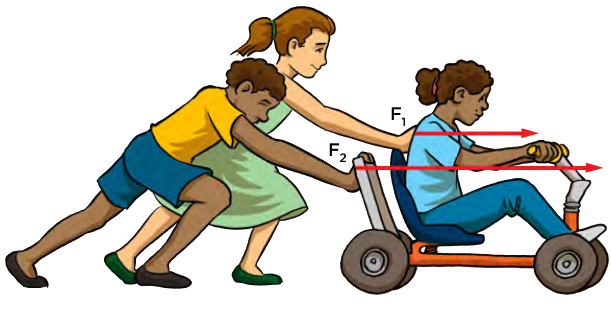
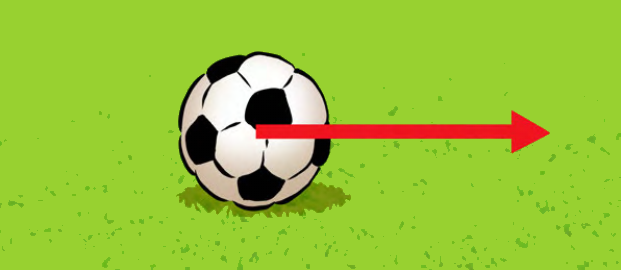
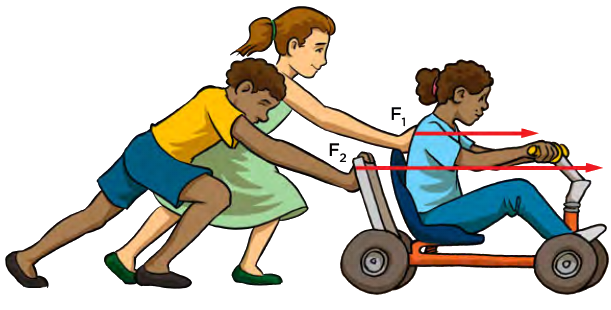
- Forces are represented by arrows in diagrams; length indicates size, direction shows direction.
- Free-body diagrams show all forces acting on an object, drawn from the center.
- Net force is calculated by adding forces in the same direction and subtracting opposite ones.
- Example: 10 N left and 6 N right gives net force 4 N left.
Two people pushing a child on a tricycle, with arrows representing the forces F1 and F2.
Friction and Normal Force Relationship
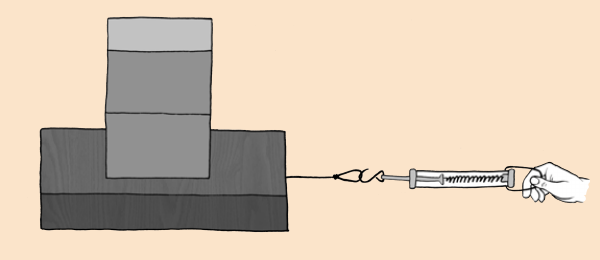
- Friction depends on the type of surface and the normal force.
- The normal force is the support force perpendicular to a surface; on a level surface, it equals the object's weight.
- To move an object, the applied force must exceed the static friction.
- Friction can be beneficial (e.g., walking, car tires) and causes heating.
A wooden block loaded with masses, pulled sideways by a spring balance to measure the force needed to overcome friction.
Engineering Design and Newton's Third Law
- Newton's Third Law explains collisions: when two objects collide, they exert equal and opposite forces on each other.
- Damage in collisions depends on factors like mass, speed, and material strength.
- Design solutions (e.g., car bumpers) aim to reduce damage by absorbing or distributing forces.
- Engineering tasks involve identifying subsystems, interactions, and applying Newton's laws to solve problems.
A hand pushing on a brick wall: the push (action) and the wall's equal, opposite push back (reaction) are shown as labelled arrows.
投影片
練習題
免費預覽——47 題中的 8 題。註冊即可查看全部。
1.Which of the following is the correct definition of a force?
Easy- AA push or a pull on an object
- BA measure of the amount of matter in an object
- CThe rate of change of an object's velocity
- DThe force that opposes motion between two surfaces
2.Which of the following is the unit of force?
Easy- Anewton
- Bkilogram
- Cjoule
- Dwatt
3.A force can change the shape of an object.
EasyTrue or false?
4.A force cannot make a motionless object move.
EasyTrue or false?
5.Which of the following is NOT a field force?
Easy- AFrictional force
- BGravitational force
- CElectrostatic force
- DMagnetic force
6.Which of the following substances is magnetic?
Easy- ACobalt
- BAluminium
- CCopper
- DTin
7.According to Newton's First Law, an object in motion will continue moving at constant velocity unless acted on by an unbalanced force.
EasyTrue or false?
8.If the forces acting on an object are balanced, the object must be at rest.
EasyTrue or false?
歷屆試題
這個主題的歷屆試題練習即將推出。
即將推出