Kinetic energy
邊玩邊學
回答這些題目賺取能量,接著就能釣魚、探索。不需要帳號。
給教育者: 為 Kinetic energy(NGSS Middle School Science、Physics)準備好可直接使用的課程投影片, 複習筆記——用於你的課程,或把這個主題當成互動班級活動,讓學習者以即時遊戲的方式進行。
課程筆記
Definition of Kinetic Energy
- Kinetic energy is the energy an object or system has because it is moving.
- It is often called the energy of motion.
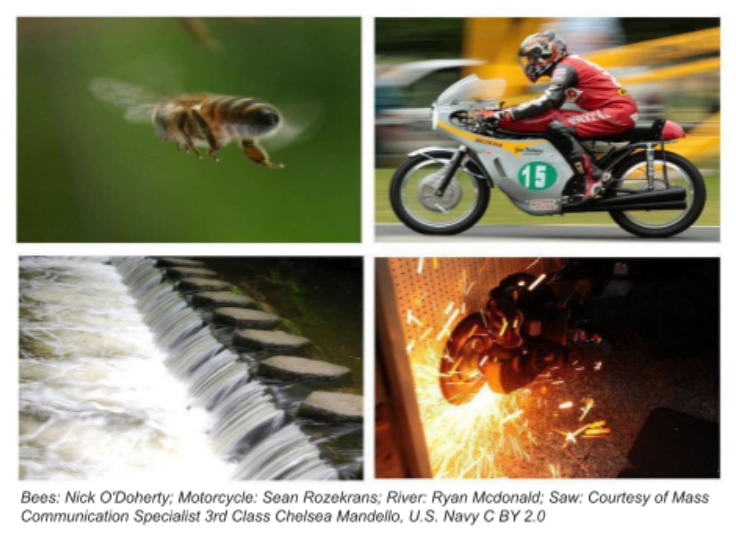
- A flying bee, a racing motorcycle, flowing water, and a spinning saw blade are all moving, so they all have kinetic energy — mass and material do not matter, only motion does.
- A stop street sign, two chairs, and an apple (at rest) do not have kinetic energy because they are not moving.
A flying bee, a racing motorcycle, flowing water, and a spinning saw blade
Factors Affecting Kinetic Energy
- An object's kinetic energy depends on two factors: mass and speed.
- The greater the mass, the more kinetic energy the object has.
- The greater the speed, the greater the kinetic energy.
- Kinetic energy is proportional to mass and grows with the square of speed.
- A car travelling at 200 km/h has more kinetic energy than at 100 km/h.
Mass and Kinetic Energy Investigation
- Rolling balls of different masses down a ramp into a paper cup shows how mass affects kinetic energy.
- In the experiment, a glass marble (20.4 g) moved the cup 208 cm, a plastic marble (9.5 g) moved it 107 cm, and a styrofoam ball (0.2 g) moved it 0 cm.
- The pattern: as mass increases, the distance the cup moves increases, indicating more kinetic energy.
- This evidence supports that moving objects with more mass have more kinetic energy.
Marble mass vs. distance moved
Speed and Kinetic Energy Investigation
- Rolling a toy car at different speeds and measuring how far it travels shows how speed affects kinetic energy.
- In the experiment, a slow car moved 250 cm, a medium car moved 882 cm, and a fast car moved 1450 cm.
- The pattern: as speed increases, the distance the car travels increases, indicating more kinetic energy.
- This evidence supports that objects with more speed have more kinetic energy.
Toy car speed vs. distance travelled
Kinetic vs. Potential Energy
- Potential energy is stored energy, such as a ball at the top of a ladder or petrol in a tank.
- Kinetic energy is the energy of motion, such as a moving car or flowing water.
- Some systems have both types, like a high jumper at the peak of a jump (has potential energy and some kinetic energy).
- A mountain biker at the top of a mountain has potential energy; a race-car at maximum speed has kinetic energy.
- A spring in a pinball machine before release has potential energy; a running refrigerator motor has kinetic energy.
A high jumper going over the bar

Energy Transfers and Conservation
- The Law of Conservation of Energy states that energy cannot be created or destroyed, only transferred or transformed.
- Energy transfers occur between systems, e.g., a kettle plugged in transfers electrical energy to thermal energy to heat water.
- In a high jumper's jump, as she rises, kinetic energy is converted to potential energy; at the top, she has maximum potential energy and minimum kinetic energy.
- When she falls, potential energy converts back to kinetic energy.
Real-World Applications
- Wind is moving air particles, so they have kinetic energy.
- Food contains stored potential energy that our bodies use for movement and functions.
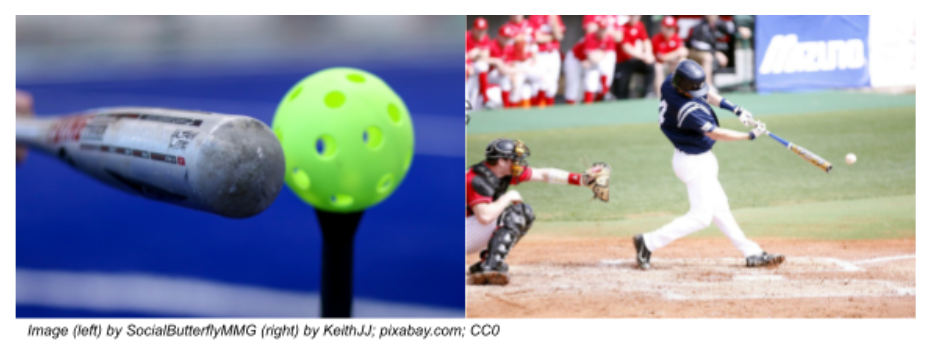
- A baseball has more kinetic energy than a wiffle ball when hit with the same force because it has more mass.
- A full cart has more kinetic energy than an empty cart moving at the same speed due to greater mass.
A baseball bat about to hit a wiffle ball, and a baseball bat hitting a baseball
投影片
練習題
免費預覽——38 題中的 8 題。註冊即可查看全部。
1.What is kinetic energy?
Easy- AEnergy stored in an object due to its position
- BEnergy of an object due to its motion
- CEnergy released during chemical reactions
- DEnergy transferred by heat
2.Which factor does kinetic energy depend on?
Easy- AMass and speed
- BMass and height
- CSpeed and temperature
- DHeight and temperature
3.A car and a bicycle are moving at the same speed. Which has more kinetic energy?
Medium- AThe car
- BThe bicycle
- CBoth have the same kinetic energy
- DIt depends on the direction of motion
4.If the speed of an object doubles, its kinetic energy becomes:
Medium- ATwice as much
- BFour times as much
- CHalf as much
- DThe same
5.A 2 kg ball is moving at 3 m/s. What is its kinetic energy?
Hard- A3 J
- B6 J
- C9 J
- D18 J
6.The SI unit of kinetic energy is the:
Easy- ANewton
- BJoule
- CWatt
- DPascal
7.A moving object has kinetic energy. When it comes to a stop, the kinetic energy is:
Medium- ADestroyed
- BConverted to other forms of energy
- CStored as potential energy
- DIncreased
8.Two objects have the same kinetic energy. Object A has twice the mass of object B. How do their speeds compare?
Hard- ASpeed of A is half that of B
- BSpeed of A is √2 times that of B
- CSpeed of A is 1/√2 times that of B
- DSpeed of A is twice that of B
歷屆試題
這個主題的歷屆試題練習即將推出。
即將推出